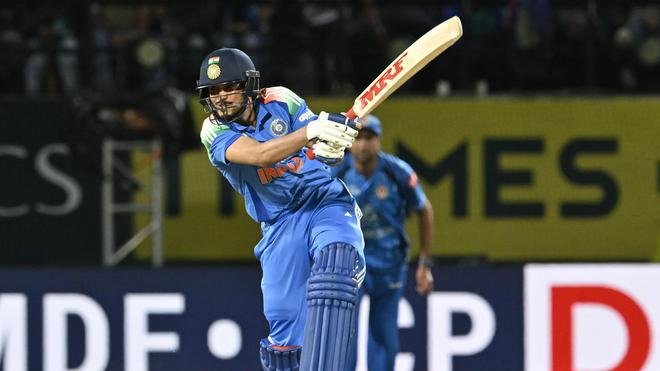
Shubman Gill’s extraordinary run across formats continued on Saturday as the Indian captain delivered another match-winning performance, guiding India to a comfortable seven-wicket victory over Afghanistan in the first ODI of the series. In a rain-affected encounter at the HPCA Stadium in Dharamsala, Gill produced a composed and mature unbeaten innings that highlighted why he is increasingly becoming the centerpiece of India’s white-ball plans.
The victory handed India a 1-0 lead in the three-match series and showcased the team’s ability to adapt quickly to challenging circumstances. With persistent rain reducing the contest to a 25-overs-per-side affair, both teams were forced to abandon conventional ODI strategies and embrace a more aggressive approach. India ultimately handled the conditions better, balancing calculated risk with disciplined execution.
While Afghanistan’s rahmanullah Gurbaz threatened to take the game away from the hosts with a spectacular century, India’s bowlers staged an impressive comeback before Gill ensured the chase was completed with minimal drama.
Rain Disrupts Proceedings but Sets Up an Exciting Contest
The match began under unusual circumstances after continuous rainfall delayed proceedings by more than three hours. Ground staff worked tirelessly to prepare the playing surface, and the covers were finally removed late in the afternoon.
The delay forced officials to reduce the match to 25 overs per side, fundamentally changing the tactical approach for both teams. In shortened matches, teams often prioritize aggression from the outset because there is less time to recover from slow starts.
Such conditions generally favor explosive batters and increase the importance of momentum, making every over significantly more valuable.
Shubman Gill Continues His Dream Run Across Formats
Few players in world cricket have enjoyed a more productive period than Shubman Gill over the last several weeks. The Indian skipper has demonstrated remarkable adaptability by succeeding in all three formats of the game.
His impressive IPL campaign, where he amassed more than 700 runs, was followed by a century in the Test format. Against Afghanistan in Dharamsala, he seamlessly transitioned back to ODI cricket and once again proved why he is regarded as one of the finest batters of his generation.
Gill’s unbeaten 84 from 66 deliveries was a masterclass in pacing an innings. Rather than chasing quick runs from the start, he carefully assessed the conditions before gradually increasing his scoring rate.
The innings combined technical excellence with tactical intelligence, qualities that have become hallmarks of his batting.
How Gill Controlled the Chase
Chasing 195 in a shortened match required balance rather than reckless aggression. Gill understood this perfectly.
Initially cautious, he focused on preserving wickets and settling into his rhythm. Once comfortable, he began targeting Afghanistan’s bowling attack with a mixture of elegant stroke play and calculated attacking shots.
His ability to manipulate spin proved particularly important.
Gill used his feet confidently against the spinners, disrupting their lengths and preventing them from building pressure. He attacked Afghanistan’s premier bowlers without taking unnecessary risks, ensuring the required run rate remained under control throughout the chase.
Several stylish boundaries through the off side highlighted his technical superiority, while timely sixes demonstrated his growing power-hitting capabilities.
Partnerships That Defined the Chase
Successful run chases are rarely built on individual brilliance alone. Partnerships often play a decisive role, and India benefited from a crucial stand between Gill and Ishan Kishan.
The duo added 70 runs for the second wicket, stabilizing the innings and steadily reducing the required scoring rate.
The partnership served two important purposes:
- It absorbed pressure during the middle overs.
- It ensured Afghanistan could not build momentum through wickets.
- It allowed Gill to bat at his preferred tempo.
- It positioned India for a controlled finish.
By the time the partnership ended, the chase was firmly in India’s control.
KL Rahul Provides the Finishing Touch
Although Gill laid the foundation for victory, KL Rahul ensured there would be no late drama.
Coming to the crease with the target within reach, Rahul played an aggressive cameo that effectively ended Afghanistan’s hopes of a comeback.
His unbeaten 39 from just 19 deliveries featured a combination of clean hitting and intelligent shot selection. The turning point came when he attacked Ziaur Rahman, collecting 20 runs in a single over.
That burst of scoring transformed a comfortable position into an inevitable victory.
India eventually crossed the finish line with 13 balls remaining, underlining the dominance of their chase.
Rahmanullah Gurbaz’s Century Keeps Afghanistan Competitive
Before India’s successful chase, Afghanistan’s innings revolved around a sensational knock from Rahmanullah Gurbaz.
The wicketkeeper-batter once again demonstrated why he is considered one of the most dangerous white-ball players in international cricket.
His innings of 102 from 51 deliveries combined power, timing, and fearless intent.
At a time when Afghanistan was struggling for stability, Gurbaz launched a counterattack that completely altered the course of the innings.
| Rahmanullah Gurbaz’s Innings | Statistics |
|---|---|
| Runs | 102 |
| Balls Faced | 51 |
| Fours | 8 |
| Sixes | 8 |
| Century Milestone | 48 Balls |
His century was one of the fastest in Afghanistan’s ODI history and reaffirmed his status as one of the team’s most valuable match-winners.
India’s New-Ball Bowlers Set the Tone
While Gurbaz dominated headlines for much of Afghanistan’s innings, India’s fast bowlers made crucial contributions during the opening phase.
Arshdeep Singh and Gurnoor Brar delivered an impressive new-ball spell that left Afghanistan under pressure almost immediately.
The pair extracted movement and maintained disciplined lines, reducing the visitors to 27 for three by the end of the PowerPlay.
Those early breakthroughs prevented Afghanistan from building a solid platform and ensured that Gurbaz had to shoulder much of the scoring responsibility.
Harsh Dubey Impresses Against Aggressive Batting
One of the encouraging aspects for India was the performance of Harsh Dubey.
Facing an attacking batter like Gurbaz is rarely easy for any spinner, particularly in a shortened match where batters are looking to dominate from the outset.
Although Gurbaz targeted him on occasions, Dubey showed composure and continued to challenge the batters.
Young players often gain valuable experience in such situations, and performances like this can accelerate their development at the international level.
The Collapse That Changed Afghanistan’s Innings
For much of the innings, Afghanistan appeared capable of posting a total well beyond 200.
However, cricket matches can change dramatically with a single wicket.
Once Nitish Kumar removed Gurbaz, the momentum shifted decisively in India’s favor. Afghanistan’s batting order struggled to maintain the same level of aggression and consistency.
The visitors lost their final six wickets for just 52 runs, transforming what could have been a commanding total into a merely competitive one.
This collapse ultimately proved decisive because India never faced an intimidating target during the chase.
Why Gill’s Leadership Is Becoming Increasingly Important
Beyond his batting performances, Gill’s leadership continues to evolve.
Captaining India brings enormous pressure and expectations, particularly during a period of transition. Yet Gill has displayed a calm demeanor and tactical maturity that suggest he is growing comfortably into the role.
His field placements, bowling changes, and personal performances are increasingly reflecting the qualities expected from a long-term leader.
When a captain leads from the front with the bat, it often inspires confidence throughout the squad.
What This Victory Means for India
The victory provides India with several positives ahead of the remainder of the series.
- Shubman Gill remains in exceptional form.
- The bowling attack showed resilience after being challenged.
- The middle order contributed effectively.
- The team adapted well to rain-affected conditions.
- Young players gained valuable international experience.
Most importantly, India secured the series lead while demonstrating flexibility across different match situations.
Series Outlook: Afghanistan Still Dangerous
Despite the defeat, Afghanistan showed enough quality to suggest the series remains competitive.
Gurbaz’s century highlighted the team’s batting firepower, while bowlers such as Rashid Khan remain capable of influencing matches almost single-handedly.
India may have taken a 1-0 lead, but the remaining matches are unlikely to be straightforward.
Afghanistan’s ability to challenge stronger opponents has grown significantly over the past decade, making them one of the most unpredictable teams in international cricket.
Conclusion
India’s seven-wicket victory over Afghanistan was built on two key performances: Rahmanullah Gurbaz’s stunning century and Shubman Gill’s composed match-winning chase. While Gurbaz provided the fireworks, Gill delivered the calm, calculated innings that ultimately determined the result.
His unbeaten 84 not only secured victory but also reinforced his reputation as one of the most complete batters in contemporary cricket. Combined with effective bowling and a strong finishing effort from KL Rahul, India produced a well-rounded performance that justified its status as the favorite.
With the Men in Blue now holding a 1-0 advantage, attention turns to the second ODI, where Gill will look to continue his remarkable form and move India one step closer to another series triumph.
For breaking news and live news updates, like us on Facebook or follow us on Twitter and Instagram. Read more on Latest Sports on thefoxdaily.com.






COMMENTS 0