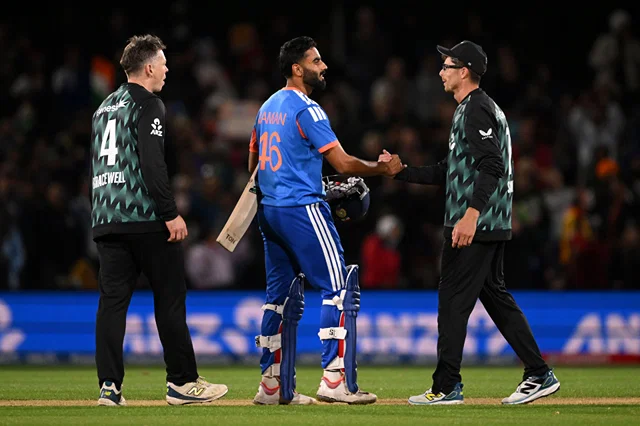
Former Indian cricketer Aakash Chopra has identified Mitchell Santner’s expensive 17th over as the decisive moment in India’s four-wicket victory over New Zealand in the first T20I of the 2026 series. Chopra believes the contest was still finely balanced before the New Zealand captain conceded 19 runs, allowing India to regain control of a demanding chase at Hagley Oval in Christchurch.
India defeated New Zealand on Thursday, October 22, 2026, while chasing a target of 226 in the opening match of the five-game T20I series. After a powerful start, the visitors encountered a middle-order collapse that brought the hosts back into contention. However, Shreyas Iyer and Naman Dhir delivered under pressure to guide India to victory with two balls remaining.
Chopra highlighted Santner’s costly over during a discussion on ESPNcricinfo, explaining that New Zealand had a realistic opportunity to turn the game in its favour before Dhir changed the momentum. The former batter also credited New Zealand’s spinners for slowing India’s progress and creating pressure after the visitors initially appeared capable of completing the chase comfortably.
Aakash Chopra Identifies Santner’s 19-Run Over as the Turning Point
India appeared to be in a strong position during the chase, but New Zealand’s spinners complicated the contest by taking crucial wickets and restricting the scoring rate. With the required run rate climbing and the middle order under pressure, the hosts had an opportunity to defend their total and level the match situation in their favour.
Chopra singled out Santner’s 17th over as the moment that shifted the balance back towards India. The New Zealand captain conceded 19 runs in the over, giving the visitors a substantial boost at a stage when the outcome remained uncertain.
Reflecting on the passage of play, Chopra explained that Santner might have helped New Zealand secure victory if the over had unfolded differently. Instead, Dhir attacked the left-arm spinner and ensured India remained firmly in the contest.
“Yes, it was the turning point, because it seemed that the match might change. Maybe Mitchell Santner could have taken New Zealand to victory. But Naman Dhir had completely different intentions.”
The over proved particularly important because India had entered the final phase of the chase needing to manage both the required runs and the pressure created by New Zealand’s comeback. Santner’s inability to contain the scoring allowed the visitors to reduce the equation and approach the closing overs with renewed confidence.
For New Zealand, the over represented a missed opportunity to maintain pressure on the Indian batters. For India, it provided the momentum needed to finish the chase, with Dhir’s aggressive approach complementing Iyer’s composure at the other end.
New Zealand’s Spinners Bring the Hosts Back Into the Contest
India’s chase began at a remarkable pace, with the opening batters putting the New Zealand attack under immediate pressure. Sanju Samson led the charge with a fluent innings, while the aggressive start from India’s top order suggested that the target could be reached well before the final overs.
However, New Zealand responded through the spin bowling of Santner and Michael Bracewell. The pair slowed India’s scoring and removed key batters, transforming what initially looked like a one-sided chase into a competitive contest.
Chopra acknowledged the impact of the spinners, noting that India’s early momentum had made a quick finish appear possible. Their ability to control the scoring rate and pick up wickets changed the complexion of the innings.
“The way the Indian batsmen started, it seemed that they would chase down the target by the 17th or the 18th over. But both the spinners came in and not only controlled the pace of the runs, but also got some wickets.”
Santner made a significant contribution by dismissing Samson and Ishan Kishan, who managed only one run. Bracewell added to New Zealand’s comeback by removing Abhishek Sharma and Tilak Varma, leaving India in a difficult position after its explosive beginning.
India slipped from 93 without loss to 122 for four, a dramatic reversal that gave New Zealand a genuine chance of defending its total. The wickets disrupted the visitors’ rhythm and forced the middle order to rebuild rather than continue attacking without interruption.
The contrasting phases of the innings illustrated how quickly a T20 International can change direction. India’s opening assault put the hosts on the defensive, but the spinners’ strikes brought New Zealand back into contention. Santner’s expensive over then swung the momentum again, setting up a tense finish.
Sanju Samson Gives India a Flying Start in the 226-Run Chase
Sanju Samson played a central role in India’s early charge, scoring 67 runs from just 33 deliveries. His attacking innings helped the visitors establish a strong platform and kept the required run rate within reach during the opening stages of the chase.
Samson’s innings put pressure on New Zealand’s bowlers, who struggled to slow India’s progress before the introduction of the spinners began to make a difference. His dismissal, however, became one of the key moments in the hosts’ recovery.
Santner removed Samson and then dismissed Kishan, while Bracewell struck at the other end. The wickets prevented India from maintaining its initial scoring pace and gave New Zealand an opportunity to exploit the pressure on the incoming batters.
Abhishek Sharma also contributed with an aggressive 29 from 12 balls before Bracewell dismissed him. Tilak Varma’s departure for six further deepened India’s middle-order difficulties, leaving the visitors needing a measured response to avoid losing control of the chase.
Despite the setback, India retained enough batting depth to rebuild. The partnership between Iyer and Axar Patel stabilised the innings, while Dhir’s late assault ensured that the hosts could not turn their bowling resurgence into a victory.
Shreyas Iyer and Axar Patel Rebuild India’s Innings
After India lost four wickets for 29 runs during a crucial phase, Shreyas Iyer and Axar Patel combined to steady the chase. Their fifth-wicket partnership was worth 45 runs from 24 deliveries, helping India recover from the pressure created by New Zealand’s spinners.
Iyer scored 42 from 28 balls, providing stability while continuing to find opportunities to score. Axar added 24 from 14 deliveries, contributing valuable runs during a phase when India needed to rebuild its innings without allowing the required rate to climb too sharply.
The partnership was important because it prevented New Zealand from extending its advantage after the dismissals of India’s top-order batters. Rather than allowing the innings to unravel, the pair restored some control and positioned the visitors for a late push.
Axar’s dismissal ended the stand, but Iyer remained at the crease and continued to guide the chase. His experience and ability to balance calculated aggression with sensible shot selection proved valuable as India approached the final overs.
The partnership also created the platform for Dhir to play an attacking role. With runs still required and the result undecided, India needed a batter capable of putting the bowlers under pressure. Dhir supplied precisely that impact, turning a challenging finish into a successful chase.
Naman Dhir’s Explosive Knock Seals India’s Victory
Naman Dhir emerged as one of the decisive performers in the closing stages, scoring an unbeaten 42 from only 15 balls. His innings featured five fours and two sixes, allowing India to accelerate at a crucial point and keep the required equation under control.
After Axar departed, Dhir joined Iyer to build a sixth-wicket partnership worth 43 runs from just 22 deliveries. The stand gave India the late momentum it needed and prevented New Zealand from applying the kind of pressure that had briefly threatened to derail the chase.
Dhir’s aggressive response was especially significant after Santner’s earlier success against India’s top order. Rather than allowing the New Zealand captain to dictate the final phase, Dhir attacked and capitalised on scoring opportunities, including during the costly 17th over identified by Chopra.
Iyer’s presence at the other end helped balance Dhir’s attacking approach. While Dhir focused on scoring quickly, Iyer provided support and ensured the partnership continued to move India towards the target.
India eventually reached the target with two balls to spare, completing a four-wicket win. The successful chase underlined the importance of partnerships in high-scoring T20 matches, where an early advantage can disappear quickly if wickets fall in clusters.
The result also marked India’s highest successful chase in T20 internationals, according to the supplied match report. The achievement reflected the combined contributions of Samson’s rapid start, Iyer and Axar’s rebuilding effort, and Dhir’s decisive late hitting.
Why Santner’s Over Mattered in the First NZ vs IND T20I
Santner’s 19-run over stood out because it arrived at a stage when New Zealand had begun to regain control. After the Indian innings moved from 93 without loss to 122 for four, the hosts had created pressure through disciplined spin bowling and timely wickets.
At that point, India needed to rebuild its momentum while keeping the required run rate manageable. A quiet over from Santner could have increased the pressure on the visitors and given New Zealand another opportunity to take wickets or restrict the scoring during the closing stages.
Instead, the expensive over helped India regain the initiative. It also highlighted Dhir’s willingness to attack despite the circumstances, a quality that became central to the outcome of the match.
Chopra’s assessment reflects the importance of individual overs in T20 cricket. Even when a bowling side has recovered from a difficult start, a single expensive over can undermine its progress. Likewise, a batting side under pressure can change the direction of a match through a short burst of aggressive scoring.
Nevertheless, Santner’s over was part of a broader contest rather than the only factor behind India’s win. Samson’s early runs, the rebuilding partnership between Iyer and Axar, and Dhir’s unbeaten finish all contributed to the successful chase. New Zealand’s earlier comeback made the late turnaround necessary, while India’s lower-order response ensured the opportunity was converted into victory.
India Take an Early Lead in the Five-Match T20I Series
The four-wicket victory gives India an early advantage in the five-match T20I series against New Zealand. The opening encounter offered both teams useful lessons, with India demonstrating its ability to chase a large total and New Zealand showing that its spin attack could disrupt even a powerful batting lineup.
For India, the match highlighted the value of batting depth and partnerships under pressure. Samson’s explosive start provided the foundation, but the middle-order recovery and Dhir’s late hitting proved equally important when New Zealand threatened to take control.
New Zealand, meanwhile, can take encouragement from the response of Santner and Bracewell after India’s opening assault. Their wickets and control of the scoring rate brought the hosts back into the game, although the expensive 17th over proved costly at a decisive moment.
The teams will now look ahead to the next match, with New Zealand seeking to respond and India aiming to build on its opening victory. If the first encounter is any indication, the series could feature further high-scoring contests in which partnerships, spin bowling and individual moments of pressure determine the outcome.
Conclusion
Aakash Chopra has identified Mitchell Santner’s 19-run 17th over as the turning point in India’s four-wicket victory over New Zealand in the first T20I at Christchurch. The former batter believes New Zealand had a chance to turn the match in its favour after its spinners removed key Indian batters and slowed the chase.
However, Naman Dhir’s aggressive response changed the momentum. His unbeaten 42 from 15 balls, combined with Shreyas Iyer’s composed innings and the earlier contributions from Samson and Axar Patel, enabled India to complete a record successful T20I chase with two balls remaining.
The result gives India a 1-0 lead in the series and highlights how quickly a T20 international can change direction. For Chopra, Santner’s expensive over was the moment when New Zealand’s opportunity slipped away and India’s late surge gathered pace.
For breaking news and live news updates, like us on Facebook or follow us on Twitter and Instagram. Read more on Latest Cricket on thefoxdaily.com.






COMMENTS 0