Australia produced their most convincing performance of the tournament at a crucial moment, overpowering Samoa 44-12 to reach the men’s Rugby League World Cup final. Reece Walsh was the standout performer, scoring a hat-trick in a match that exposed the gap between the teams’ discipline and execution.
Australia take control after an intense Siva Tau
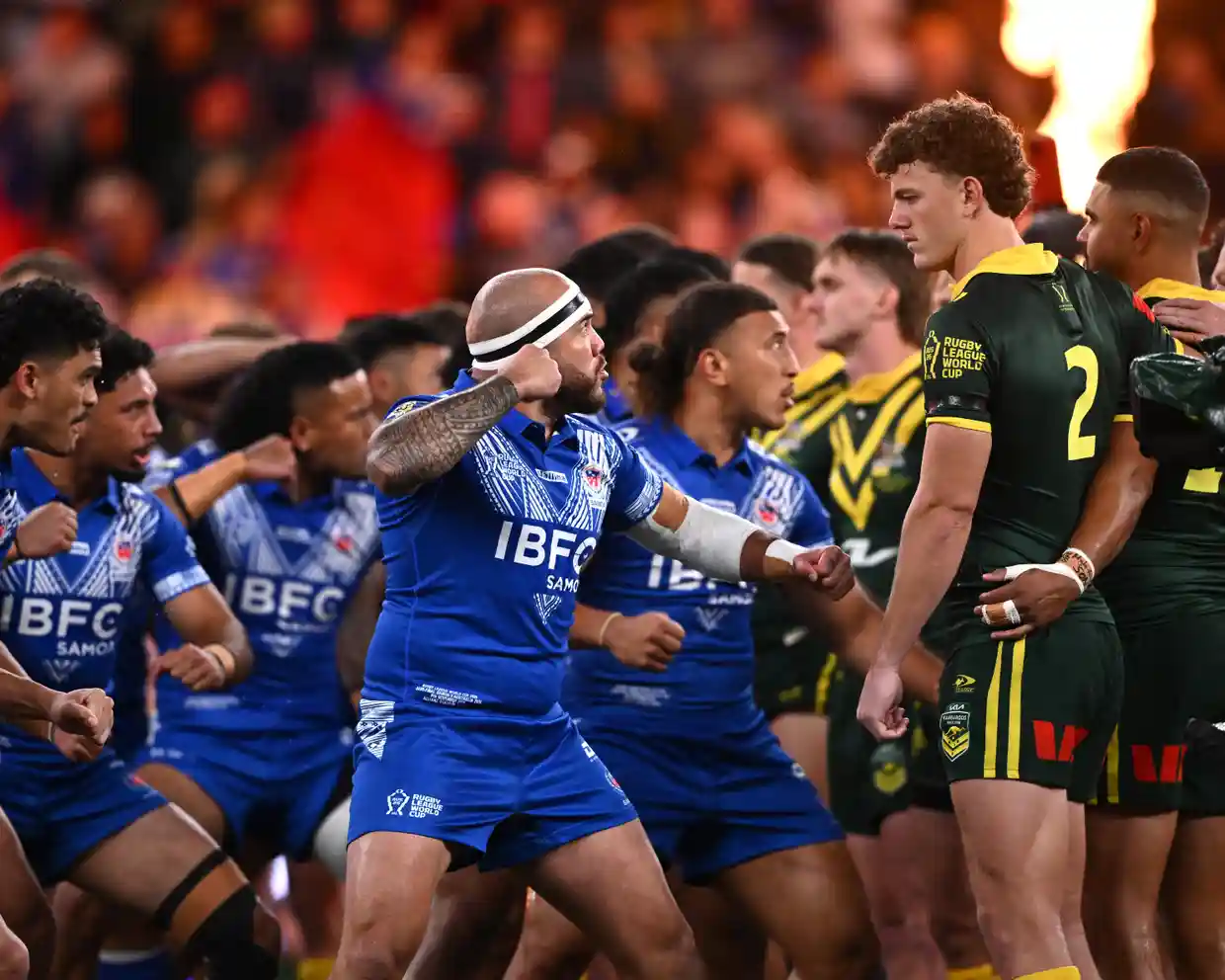
The atmosphere before kick-off reflected the importance of the contest. Samoa’s traditional Siva Tau, led by captain Junior Paulo, brought the two teams face to face in an emotionally charged pre-match exchange at Allianz Stadium.
The ritual ended with players standing almost forehead to forehead. Samoa winger Brian To’o came close to Australian prop Tino Fa’asuamaleaui, who had represented Samoa once as a teenager before establishing himself in Australian rugby league.
Stephen Crichton’s intense expressions, Jazz Tevaga’s exchanges with Jack Bostock and the players’ aggressive gestures added to the tension. However, the confrontation concluded with mutual respect rather than a physical altercation.
The build-up raised expectations of a fiercely competitive semi-final, particularly because Samoa had been seeking another opportunity to challenge Australia after losing the 2022 World Cup final 30-10.
Samoa initially brought the physical intensity expected of them. Fa’asuamaleaui was met by multiple defenders on Australia’s first attacking carry, while an early high tackle by the Australian forward gave Samoa an opportunity near the Kangaroos’ try line.
The Samoans converted their field position into two points after Australia were penalised for rushing off their defensive line. But the early pressure did not translate into sustained attacking momentum.
Tom Dearden and Jacob Preston put Australia ahead
Australia’s response began with halfback Tom Dearden, whose selection at No. 7 had attracted attention before the semi-final. Some observers had questioned the decision to prefer him over Sam Walker, who had enjoyed an impressive NRL season.
Dearden answered those doubts with a decisive attacking run. Receiving the ball at first receiver after a scrum, he used a dummy to exploit a gap between Jazz Tevaga and Francis Manuleleua. The halfback accelerated through the opening and crossed for Australia’s first try.
The score gave the Kangaroos confidence and demonstrated the value of their decision to retain Dearden in the starting lineup. His ability to identify space and commit defenders helped Australia establish control of the contest.
The second try arrived in the 14th minute. Keaon Koloamatangi, who had been promoted into the starting side, made a powerful run through the middle before releasing the ball. His carry drew several Samoan defenders and disrupted their defensive formation.
Jacob Preston capitalised on the opening, running through the broken defensive line to extend Australia’s advantage. The try highlighted the growing influence of the Kangaroos’ forward pack, which had faced questions following the team’s less convincing performances earlier in the tournament.
Australia’s forwards continued to win important physical contests. Replacement Pat Carrigan also made an immediate impact when the ball came loose during a carry by Samoan forward Spencer Leniu. The turnover gave the Kangaroos another opportunity to attack.
Tom Trbojevic finished the resulting movement with another try, pushing Australia further ahead. By this stage, the Kangaroos had established a commanding advantage and were making Samoa pay for their mistakes.
Reece Walsh’s hat-trick becomes the highlight
Reece Walsh provided the match’s defining moments, combining his attacking instincts with the speed and improvisation that have made him one of rugby league’s most entertaining players.
His first try came after a difficult aerial contest involving Samoa’s Ronald Volkman and Hamiso Tabuai-Fidow. Walsh dropped a kick, allowing the ball to reach Stephen Crichton, who crossed the line.
However, the video referee ruled that Crichton had not completed the catch cleanly because of a knock-on in the aerial contest. The decision prevented Samoa from reducing the deficit and triggered frustration among the players and supporters.
Australia responded almost immediately. Walsh found space at the other end of the field and crossed for his first try, restoring the Kangaroos’ momentum.
His celebration was as memorable as the finish. Walsh performed a barrel-roll-style acrobatic move before briefly using a plastic chair belonging to a security guard to help put his boot back on. The moment reflected the fullback’s colourful personality, although his celebrations had already become a talking point during the match.
Walsh’s second try arrived early in the second half, but not before he made a costly mistake. He dropped a Ronald Volkman bomb, allowing Stephen Crichton to score and giving Samoa a brief opportunity to revive the contest.
The Samoan comeback, however, did not develop. Walsh quickly made amends after receiving a pass from Harry Grant. He spun through the defensive line and crossed the try line, demonstrating the acceleration and footwork that make him so dangerous close to attacking opportunities.
The fullback completed his hat-trick with another impressive attacking movement. Cameron Munster helped create the opening, and Walsh finished the flowing move with an acrobatic dive into the in-goal area.
His finish came after coach Kevin Walters had publicly indicated that Walsh should avoid unnecessary acrobatics following an earlier backflip. The fullback’s final celebration suggested that his instinct for spectacular moments had not disappeared.
Samoa’s errors and ill-discipline make the task harder
Samoa entered the semi-final with the physical strength and attacking ability to trouble Australia, but their execution did not match the intensity of their pre-match challenge.
Handling mistakes, defensive gaps and penalties repeatedly interrupted their attempts to build pressure. Against a side as experienced as Australia, those errors made it difficult to recover once the Kangaroos had established a substantial lead.
One of the most damaging incidents occurred shortly before half-time. Cameron Murray made a strong run that opened space on the left, allowing Bradman Best to cross for another Australian try.
Samoa’s frustration increased when Leniu confronted referee Adam Gee and was sent to the sin-bin. The temporary dismissal left the Samoans with an additional defensive challenge at a time when they were already struggling to contain Australia’s attack.
The Kangaroos went into the break with a substantial lead after scoring four converted tries. The scoreline was a major disappointment for the 41,529 spectators at Allianz Stadium, many of whom had travelled to support Samoa.
The Samoan players showed greater urgency after half-time, but their efforts did not produce a sustained comeback. Australia remained composed and continued to control the important moments.
Controversial bunker decisions add to Samoa’s frustration
Video referee decisions became another major talking point during the semi-final. Samoa were unhappy with the ruling that disallowed Crichton’s try following the aerial contest involving Walsh.
Another controversial moment involved Hamiso Tabuai-Fidow, whose second-half effort was disallowed by the bunker. The decision further reduced Samoa’s hopes of returning to the contest.
The rulings were frustrating for the Samoan side, particularly because they came during moments when a successful try could have changed the atmosphere and momentum of the match.
However, the decisions should be considered separately from Australia’s overall performance. The Kangaroos had already built a commanding advantage through their attacking efficiency, stronger execution and ability to capitalise on Samoa’s mistakes.
Even without the disputed decisions, Australia had demonstrated enough control to remain favourites to progress. Their defensive organisation limited Samoa to just one line break, while their attacking play repeatedly exposed gaps in the opposition’s defensive structure.
Australia’s forward pack answers questions before the final
The semi-final was important for Australia beyond the result. The Kangaroos had entered the knockout stage after three performances that had raised questions about their consistency and ability to dominate the strongest opponents.
Against Samoa, their forward pack delivered a much more convincing display. The Australian forwards matched the physical challenge, created opportunities through the middle and gave the backline a platform to attack.
The team’s completion rate of nearly 90% was another important factor. In rugby league, completing attacking sets allows a side to maintain possession, build field position and put sustained pressure on the opposition.
Australia’s discipline and composure were particularly valuable after Samoa attempted to increase the intensity of the contest. Rather than becoming distracted by confrontations or disputed decisions, the Kangaroos continued to execute their attacking plans.
Holding Samoa to just one line break also demonstrated the improvement in their defensive organisation. The performance suggested that the defending champions were beginning to find the balance between physicality, patience and attacking creativity that had been missing earlier in the tournament.
Australia set up Rugby League World Cup final against New Zealand
Australia’s victory sends the Kangaroos into the men’s Rugby League World Cup final, where they will face New zealand on November 15 at Lang Park in Brisbane.
New Zealand secured its place in the decider by defeating Tonga 34-10 in the other men’s semi-final at Newcastle’s McDonald Jones Stadium on November 7. The result sets up a rematch of the tournament’s opening fixture, when Australia narrowly defeated the Kiwis 24-22.
That earlier encounter demonstrated how closely matched the two sides can be. New Zealand will now have another opportunity to challenge Australia for the title, while the Kangaroos will aim to carry the confidence gained from their emphatic win over Samoa into the final.
The trans-Tasman rivalry adds another layer of significance to the championship match. Both teams have strong rugby league traditions, experienced international players and the ability to produce high-quality performances under pressure.
The women’s competition will also feature a major final-day contest. New Zealand defeated Samoa 32-0 in its semi-final, while Australia beat Fiji 30-14 to secure the other place in the women’s decider.
For Australia, the 44-12 victory represents more than a place in the final. It is a timely statement of intent after a tournament in which the Kangaroos had not always looked convincing. Walsh’s hat-trick, Dearden’s attacking contribution and the forward pack’s improved performance have given the defending champions renewed momentum.
New Zealand will present a different challenge, and the opening match showed that the margin between the teams can be narrow. But after dismantling Samoa in Sydney, Australia will enter the final with confidence and the opportunity to defend their World Cup crown.
For breaking news and live news updates, like us on Facebook or follow us on Twitter and Instagram. Read more on Latest Sports on thefoxdaily.com.





COMMENTS 0