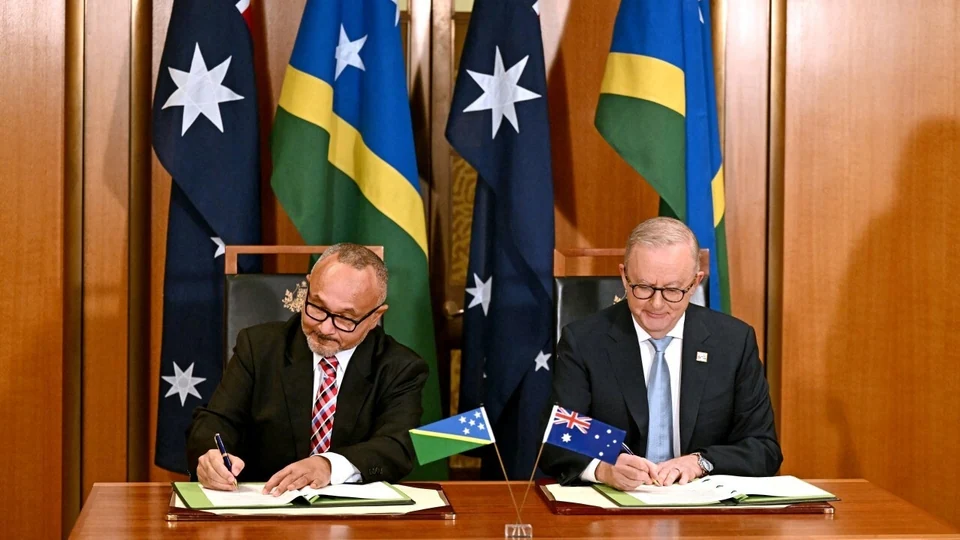
China has suffered a significant diplomatic setback in the Pacific as the Solomon Islands has pledged not to allow foreign military bases on its territory under a new security treaty with Australia. The agreement, signed in Canberra on Wednesday, signals a shift towards closer security cooperation with Australia and offers reassurance to Western governments concerned about Beijing’s expanding strategic presence across the region.
The commitment is particularly important because of the Solomon Islands’ location northeast of Australia, across a vast group of approximately 1,000 islands. With a population of more than 800,000, the country occupies a strategically sensitive position in the South Pacific, close to important maritime routes connecting Australia with the wider Pacific.
Concerns about its security alignment intensified after the Solomon Islands signed a security agreement with China in 2022. Western governments and regional analysts feared the arrangement could eventually allow Chinese military vessels to use local facilities more regularly or provide the foundation for a permanent Chinese military presence.
The new agreement with Australia does not necessarily end the Solomon Islands’ relationship with Beijing. However, it establishes a clearer framework for future security cooperation and makes the possibility of a foreign military base considerably more difficult under the country’s current commitments.
Solomon Islands Draws a Line on Foreign Military Bases
The central provision of the new treaty is the Solomon Islands’ commitment to preventing the militarisation of sensitive infrastructure and keeping foreign military bases off its territory. The agreement also establishes that security cooperation should come through members of the Pacific Islands Forum, a regional organisation that includes Australia but not China.
Solomon Islands Prime Minister Matthew Wale described the agreement as a turning point in his country’s relationship with regional partners. Speaking during his visit to Canberra, Wale said the uncertainty surrounding the Solomon Islands’ security direction had lasted for several years but was now coming to an end.
His remarks were significant because the country had become one of the most closely watched examples of China’s expanding diplomatic and security engagement in the Pacific. The 2022 agreement with Beijing had raised concerns that a small island nation could become strategically important in a potential confrontation between China and Western powers.
Australian Prime Minister Anthony Albanese welcomed the agreement, presenting it as part of a broader effort to deepen Australia’s partnerships with Pacific island nations.
For Canberra, the treaty is not simply a diplomatic statement. It is an attempt to strengthen regional security relationships before strategic competition between major powers becomes more difficult to manage.
Why the 2022 China-Solomon Islands Security Pact Caused Concern
The diplomatic controversy surrounding the Solomon Islands began in 2022, when the government signed a security cooperation agreement with China. Although Beijing presented its Pacific engagement as a partnership focused on development and regional cooperation, the agreement triggered serious concerns in Australia, the United States and other Western capitals.
The main concern was the possibility that China could eventually use the arrangement to establish a military or logistical presence in the South Pacific. A Chinese facility in the Solomon Islands could provide Beijing with greater access to the region, complicating military planning for Australia and its allies during a future crisis.
The country’s geographical position explains why the agreement attracted such attention. The Solomon Islands lies along the broader maritime approaches to Australia and within a region that has long been important to military and commercial movement across the Pacific.
During the Second World War, the islands were the scene of major battles between Allied forces and Japan. The Guadalcanal campaign, fought in the Solomon Islands between 1942 and 1943, became one of the defining military campaigns of the Pacific War.
That history remains relevant to modern strategic calculations. The Pacific is not simply a collection of distant island states. It is a region containing important maritime routes, military access points and territories that could influence the movement of forces during a major conflict.
Western governments therefore viewed the 2022 agreement as a potential long-term strategic challenge, even though China denied seeking a permanent military base in the country.
Wale Avoids Confirming Whether the China Agreement Will Be Scrapped
Despite the strong language surrounding the new treaty, Wale has not confirmed that the Solomon Islands will formally terminate its 2022 security agreement with China.
During a joint news conference with Albanese, the prime minister said the agreement contained a nondisclosure clause and declined to discuss whether it would be scrapped. He confirmed that discussions with Beijing were continuing.
This distinction matters. The new treaty establishes limits on the Solomon Islands’ future security arrangements, but it does not automatically mean that the country is ending diplomatic, commercial or other forms of cooperation with China.
China remains the Solomon Islands’ largest trading partner, making a complete political or economic break with Beijing difficult. The country depends on international partnerships for investment, trade, infrastructure and development, and maintaining access to multiple economic partners remains important to its national interests.
Wale’s position therefore appears to involve balancing two priorities: strengthening security ties with Australia while preserving the economic relationship with China.
That balancing act could become more difficult if Beijing interprets the treaty as a direct restriction on its regional ambitions. China’s economic importance gives it potential leverage, even without a military presence in the country.
China Rejects the Idea of a Geopolitical Contest in the Pacific
Beijing has repeatedly rejected claims that its engagement with Pacific island countries is primarily driven by military ambitions. Chinese officials have described their regional diplomacy as cooperation focused on development, infrastructure and mutual benefit.
A spokesperson for China’s foreign ministry criticised attempts to obstruct Beijing’s relationships with Pacific nations, arguing that the international community should respect their independence and prioritise sustainable development.
China has also denied seeking to establish a military base in the Solomon Islands. Its position is that Pacific island countries should be free to maintain relationships with international partners without becoming instruments in competition between major powers.
However, the new Australian treaty demonstrates that regional governments are increasingly concerned about the security implications of external partnerships. For Australia and its allies, the issue is not necessarily whether China currently intends to establish a base, but whether existing agreements could create opportunities for a future military presence.
The disagreement reflects a wider strategic divide. Beijing argues that its regional engagement should not be treated as a threat, while Western governments believe China’s growing diplomatic, economic and security influence could eventually change the military balance in the Pacific.
Australia Expands Its Security Network Across the Pacific
The Solomon Islands agreement is part of a broader Australian strategy to strengthen relationships with Pacific island governments and reduce the possibility that regional security arrangements could shift towards competing external powers.
Australia has signed several agreements with Pacific countries in recent years. One of the most significant was its mutual-defence treaty with Papua New Guinea, signed in 2025. The agreement marked Australia’s first new military alliance since the establishment of the ANZUS security arrangement with the United States and New Zealand in 1951.
Additional agreements with Vanuatu and Fiji followed in June and July, respectively, as Canberra continued expanding its regional partnerships.
These arrangements reflect a growing recognition within Australia that its security cannot be separated from the stability of the Pacific island region. Developments in countries spread across the South Pacific can affect maritime access, regional diplomacy and the ability of external powers to operate in Australia’s wider neighbourhood.
Albanese described the agreements as an effort to take Australia’s partnerships across the Pacific to a new level. The approach combines traditional security cooperation with economic, social and institutional support.
What Australia Is Offering the Solomon Islands
The new treaty is broader than a commitment concerning foreign military bases. Australia has also outlined several areas in which it intends to support the Solomon Islands.
- Police development: Australia will continue helping the Solomon Islands strengthen its police force and improve domestic security capabilities.
- Employment opportunities: The agreement aims to create more opportunities for Solomon Islanders to work in Australia.
- People-to-people connections: Both countries intend to strengthen ties through sport, culture and faith-based relationships.
- Security cooperation: The treaty establishes a framework for cooperation involving Pacific Islands Forum members and reinforces commitments concerning sensitive infrastructure.
These areas are important because Pacific island governments often evaluate international partnerships through practical benefits rather than security considerations alone. Employment, policing, education, infrastructure and economic development can influence whether a regional agreement is politically sustainable.
Australia’s challenge will be to demonstrate that its promises translate into meaningful improvements for ordinary Solomon Islanders. A security treaty may strengthen diplomatic alignment, but its long-term success will depend partly on whether the country sees tangible benefits from the relationship.
Why the Pacific Islands Forum Matters to the Agreement
One of the important features of the new treaty is its reference to the Pacific Islands Forum. The organisation brings together Pacific island countries and regional partners to discuss shared challenges, including security, economic development, climate change and political cooperation.
Australia is a member of the forum, while China is not. By placing security cooperation within a framework involving forum members, the treaty gives regional institutions a more prominent role in shaping the Solomon Islands’ security relationships.
This approach also reflects a wider diplomatic message: Pacific island countries should have a central role in determining the future of their region rather than becoming passive participants in competition between larger powers.
For Australia, working through regional institutions can help strengthen its diplomatic position while reducing the perception that it is attempting to dictate security decisions to smaller neighbouring countries.
For the Solomon Islands, the framework offers a way to deepen cooperation with Australia while presenting the arrangement as part of a broader regional approach rather than an exclusive alignment against China.
Can a Future Solomon Islands Government Reverse the Treaty?
One of the biggest questions surrounding the agreement is whether it will remain in place if the Solomon Islands elects a government with a different foreign-policy direction.
Wale took office in May and said he would seek to introduce legislation to give the treaty a stronger domestic legal foundation. His stated objective is to make the agreement more firmly established within the country’s legal and political system.
This is significant because diplomatic agreements can become vulnerable when political leadership changes. A future government could have different priorities, particularly if it believes closer engagement with China offers greater economic or strategic benefits.
Embedding the treaty in domestic legislation could make reversing the arrangement more complicated. However, it would not necessarily make the agreement permanent or prevent a future government from pursuing changes through the country’s legal and political processes.
The durability of the treaty will therefore depend on more than its formal wording. Continued public support, parliamentary backing and the delivery of promised benefits will all influence whether the arrangement survives future political changes.
China’s Economic Influence Remains a Major Challenge for Australia
Although the treaty represents a diplomatic success for Australia, it does not eliminate China’s influence in the Solomon Islands. Beijing remains the country’s largest trading partner, giving the relationship an economic dimension that cannot easily be replaced by security cooperation.
Connor Graham, a research fellow at the Lowy Institute in Sydney, highlighted this challenge, noting that the Solomon Islands could be vulnerable to possible economic retaliation from China. He also questioned whether Australia would deliver enough on its commitments to make the long-term costs of the agreement worthwhile for the island nation.
This is a critical issue for Canberra. If Australia wants the Solomon Islands to maintain its security commitments, it must offer more than diplomatic assurances. Economic opportunities, reliable assistance and long-term development partnerships will be essential.
China has considerable economic influence across the Pacific, where infrastructure investment, trade and development financing can shape relationships with smaller countries. Even if a government chooses to strengthen security cooperation with Australia, it may still depend on China for important commercial links.
The result is likely to be a complex relationship rather than a straightforward choice between Beijing and Canberra. The Solomon Islands may seek Australian support on security while continuing to engage with China on trade and economic development.
What the Treaty Means for the United States and the Wider Pacific
The agreement also has implications for the United States, which has been working with Australia and other partners to strengthen its relationships across the Pacific.
Washington’s concerns about the 2022 China-Solomon Islands agreement were part of a wider effort to prevent Beijing from gaining strategic access to locations that could become important during a future regional conflict.
The United States and its allies view the Pacific as a strategically important area connecting North America, Australia and Asia. Any significant change in military access or security partnerships could influence how forces operate across the region.
Australia’s growing network of agreements offers Washington a stronger regional security environment through an ally with close geographical and political ties to Pacific island countries.
However, the Solomon Islands treaty should not be interpreted as evidence that the country has completely aligned itself with the United States or Australia against China. Its government has maintained that discussions with Beijing are continuing, and its economic relationship with China remains important.
The agreement is better understood as a limit on the country’s future security arrangements rather than a complete rejection of Chinese engagement.
A Diplomatic Victory, but Not the End of Pacific Competition
The Solomon Islands’ decision to rule out foreign military bases marks an important moment in the strategic competition unfolding across the Pacific. For Australia, it represents progress in securing closer cooperation with a country that had become a major source of concern following its 2022 agreement with China.
For Beijing, the treaty limits the possibility of expanding its security presence through the Solomon Islands, although China has denied seeking a military base there. Its economic and diplomatic relationships with the country remain intact, and the agreement does not prevent continued cooperation in other areas.
The most important test will be whether Australia can turn its promises into long-term benefits for the Solomon Islands. Stronger policing, employment opportunities and sustained development support could help make the treaty valuable beyond its immediate security objectives.
Ultimately, the agreement highlights a broader reality of Pacific geopolitics: smaller island nations have become increasingly important in the strategic calculations of major powers, but they also have their own interests and priorities. Their governments are seeking investment, security, economic opportunities and political independence without necessarily committing themselves exclusively to one side.
Australia may have secured an important diplomatic commitment, but the competition for influence in the Pacific is far from over. The Solomon Islands’ ability to maintain its independence while managing relationships with both Beijing and Canberra will determine how lasting this latest strategic shift becomes.
For breaking news and live news updates, like us on Facebook or follow us on Twitter and Instagram. Read more on Latest World on thefoxdaily.com.





COMMENTS 0