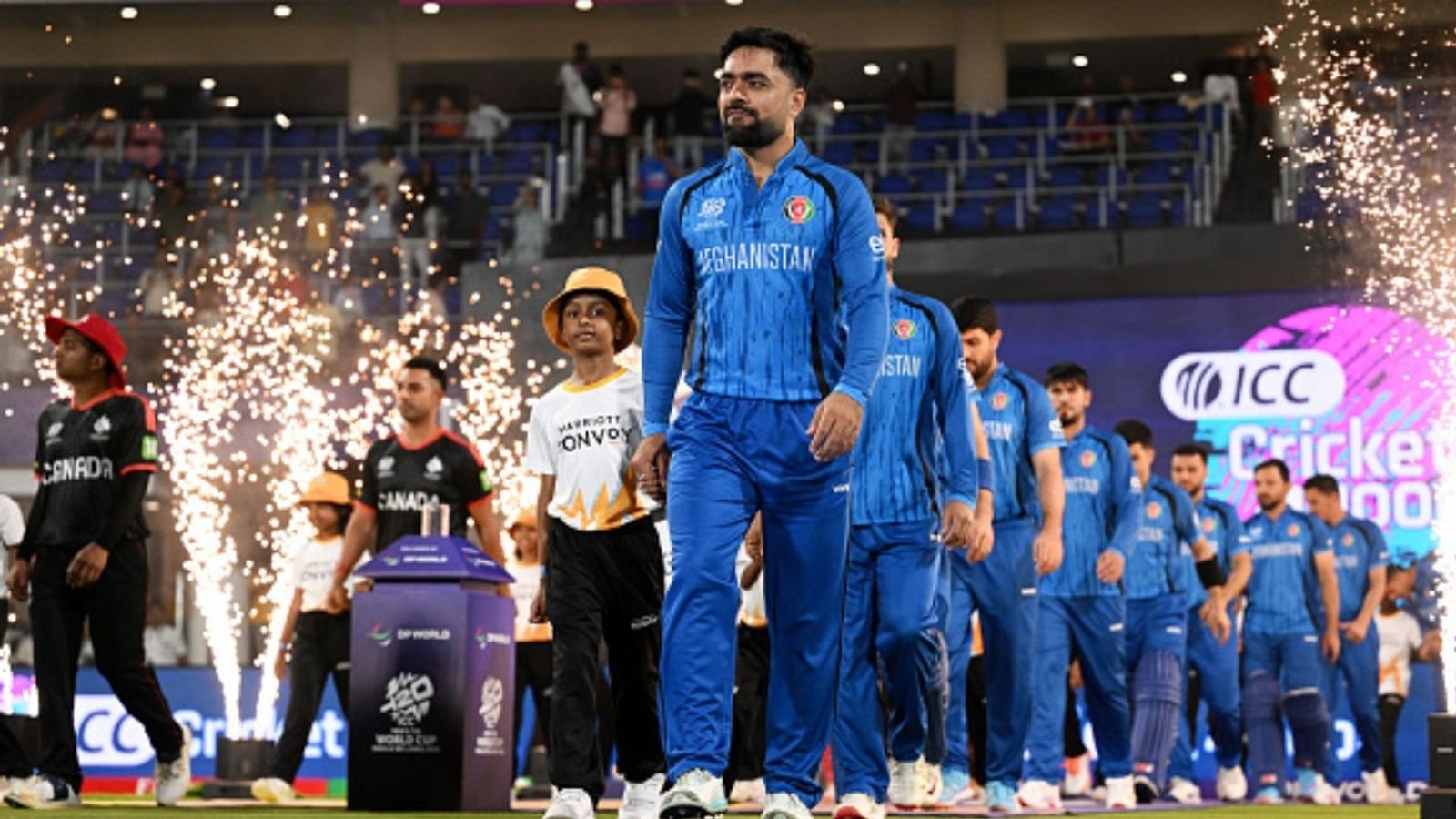
Afghanistan’s 2026 home cricket schedule has taken shape with the announcement of a busy multi-format series against Bangladesh and Zimbabwe. Although Afghanistan will be the designated home side, all fixtures are scheduled to take place in the United Arab Emirates during October and November.
The programme covers all three major international formats and begins with a one-off Test against Bangladesh. Afghanistan will then participate in an ODI tri-series featuring Bangladesh and Zimbabwe before facing Zimbabwe in a three-match T20I series.
The schedule will conclude with a two-Test series against Zimbabwe, giving Afghanistan an unusually packed stretch of international cricket and valuable opportunities to test its squad across different formats.
Afghanistan vs Bangladesh and Zimbabwe schedule at a glance
| Match/Series | Teams | Dates | Format |
|---|---|---|---|
| One-off Test | Afghanistan vs Bangladesh | October 9-13, 2026 | Test |
| ODI Tri-Series | Afghanistan, Bangladesh, Zimbabwe | October 17-23, 2026 | ODI |
| T20I Series | Afghanistan vs Zimbabwe | October 27-November 1, 2026 | T20I |
| Test Series | Afghanistan vs Zimbabwe | November 5-9 and November 13-17, 2026 | Test |
The individual venues have not yet been confirmed, but the entire programme will be staged in the UAE. The arrangement continues Afghanistan’s established practice of playing designated home fixtures outside the country.
Bangladesh Test opens Afghanistan’s busy schedule
The first assignment will be a one-off Test between Afghanistan and Bangladesh from October 9 to 13. The match will provide both sides with an opportunity to assess their Test squads before Afghanistan moves into a much shorter-format-heavy portion of the schedule.
For Afghanistan, the Test is especially significant because the team is continuing to develop its red-ball identity. Afghanistan has made rapid progress in international cricket, and regular Test opportunities remain important for building experience in the longest format.
Playing Bangladesh also presents a useful challenge. Bangladesh have considerably more experience in Test cricket, while Afghanistan have been gradually establishing themselves as a competitive side in the format.
The one-off nature of the contest adds importance because there is no second match in which either team can immediately correct weaknesses. A strong performance over five days will therefore be crucial.
ODI tri-series adds another competitive challenge
After the Bangladesh Test, attention will switch to limited-overs cricket. Afghanistan, Bangladesh and Zimbabwe will compete in an ODI tri-series between October 17 and 23.
The tri-series format can provide more tactical variety than a conventional bilateral series. Teams must adapt to different opponents while also managing their combinations across multiple matches in a short period.
For Afghanistan, this phase could be particularly useful for identifying the strongest ODI combination. The side has developed a reputation for producing talented spin bowlers and dangerous white-ball players, but success in 50-over cricket requires depth in every department.
Bangladesh and Zimbabwe will provide contrasting challenges, making the competition useful preparation for Afghanistan’s broader ODI ambitions.
Afghanistan and Zimbabwe renew their rivalry in T20Is
The schedule then moves rapidly into T20 cricket. Afghanistan will face Zimbabwe in three T20Is between October 27 and November 1.
The shortest format will require a different approach from the Test and ODI assignments that precede it. Players will need to adapt quickly to high-tempo cricket, with batting acceleration, death bowling and fielding likely to become especially important.
Afghanistan have become one of the most competitive associate-era teams in T20 cricket and have developed several players with extensive experience in franchise leagues around the world.
Zimbabwe, meanwhile, have continued to strengthen their presence in international white-ball cricket. The three-match series should therefore provide both teams with meaningful competition rather than simply serving as a short transition between longer-format fixtures.
Two Tests against Zimbabwe complete the programme
Afghanistan’s demanding schedule will finish with two Tests against Zimbabwe. The first is scheduled for November 5-9, followed by the second from November 13-17.
Having two Tests against the same opponent provides considerably more room for tactical adjustments than a one-off match. Teams can learn from the opening Test and modify their selections, batting plans or bowling combinations for the second encounter.
For Afghanistan, the two-Test series could also be a major test of stamina. The players will have already gone through a Test against Bangladesh, an ODI tri-series and three T20Is before returning to red-ball cricket.
The transition from T20 cricket back to Test cricket will demand careful preparation, particularly for bowlers who may be required to manage workloads across formats.
Afghanistan set for four Tests in 2026
One of the most significant aspects of the announced programme is the number of Test matches Afghanistan will play during the calendar year.
The Bangladesh Test and two Tests against Zimbabwe would give Afghanistan three matches in this particular schedule. Combined with the Test against India earlier in the year, Afghanistan are set to play a record four Tests in 2026.
That represents an important development for a nation still building its red-ball cricket infrastructure and experience.
Test cricket requires a different level of technical preparation and patience compared with limited-overs cricket. More matches give Afghanistan’s players greater exposure to the demands of the format and provide selectors with a larger sample from which to evaluate emerging talent.
Afghanistan’s Test record against Bangladesh and Zimbabwe
Afghanistan have already faced both opponents in Test cricket, giving the upcoming matches an element of familiarity.
Against Bangladesh, Afghanistan have played two Tests so far, meaning the October encounter will add another chapter to a relatively young rivalry in the longest format.
Afghanistan have also faced Zimbabwe in five Tests. Their record in those matches includes two wins, two defeats and one draw, showing that the contests between the teams have generally been competitive.
That previous experience could be useful when the sides meet again in November. Afghanistan will know more about Zimbabwe’s strengths and weaknesses, while Zimbabwe will have an understanding of the conditions and challenges posed by Afghanistan’s bowling attack.
Why the UAE is important for Afghanistan’s home fixtures
The decision to stage the matches in the United Arab Emirates is part of Afghanistan’s longer-running approach to hosting international cricket away from home.
Security, infrastructure and logistical considerations have historically influenced Afghanistan’s choice of overseas venues for designated home fixtures. The UAE has consequently become an important base for Afghanistan’s international schedule.
Playing in familiar overseas surroundings can also provide Afghanistan with a degree of continuity. The UAE offers established cricket facilities and conditions that the team has experienced previously.
For visiting teams, however, the designation of Afghanistan as the home side still creates an interesting dynamic because the matches are technically being played at a neutral overseas location rather than in Afghanistan itself.
What the packed schedule means for Afghanistan
The biggest benefit of this programme is exposure. Afghanistan will have opportunities to test their players in every major international format within a relatively short period.
At the same time, the schedule creates a significant workload challenge. The calendar moves from a five-day Test to ODIs, then T20Is, before returning to five-day cricket for the final two Tests.
Squad management will therefore be critical. Afghanistan may need to rotate certain players, particularly fast bowlers, while ensuring that their best possible combinations are available for the most important matches.
The schedule could also reveal which players are capable of switching between formats effectively. Multi-format adaptability is increasingly valuable in modern international cricket, and Afghanistan will have a useful opportunity to evaluate that quality.
Bangladesh and Zimbabwe also have plenty to gain
The series is not only important for Afghanistan. Bangladesh will receive a Test and ODI opportunities against Afghanistan and Zimbabwe, while Zimbabwe will play ODIs, T20Is and Tests during the programme.
For Zimbabwe, the two-Test series against Afghanistan will be particularly valuable because regular red-ball cricket is essential for maintaining and developing a competitive Test side.
Bangladesh, meanwhile, will have the chance to challenge Afghanistan in both a five-day Test and the ODI tri-series. The variation in formats will test their squad depth and adaptability.
Afghanistan’s multi-format series could shape the next phase
The October-November programme arrives at an important stage of Afghanistan’s international development. The team has already established itself as a dangerous white-ball opponent, particularly in T20 cricket, while continuing to build credibility in Tests and ODIs.
Playing three formats against two familiar opponents allows Afghanistan to measure progress across a broad range of skills.
The Test matches will test patience and technical ability. The ODIs will demand balance and consistency, while the T20Is will reward innovation and execution under pressure.
That makes the UAE schedule more than a collection of fixtures. It is effectively a multi-format examination for Afghanistan’s current generation of players.
What to expect from Afghanistan in October and November 2026
Afghanistan will enter the programme with several objectives: strengthen their Test credentials, sharpen their ODI combinations, maintain their T20I competitiveness and manage player workloads effectively.
The Bangladesh Test will begin the campaign with a focus on red-ball cricket, while the ODI tri-series will immediately require a tactical shift. The three T20Is against Zimbabwe will then test Afghanistan’s ability to operate in the shortest format before the team returns to Tests for the final two matches.
That unusual sequence makes the schedule particularly demanding but also potentially rewarding.
For Afghanistan, the message is clear: the UAE will become the centre of their international cricket activity for several weeks, with Bangladesh and Zimbabwe providing challenges across all three formats.
With four Tests in the calendar year and a full programme of ODI and T20I cricket, Afghanistan have a valuable opportunity to turn international exposure into sustained progress. The results across October and November could offer an important indication of how far the team has developed beyond its reputation as a dangerous white-ball side.
For breaking news and live news updates, like us on Facebook or follow us on Twitter and Instagram. Read more on Latest Cricket on thefoxdaily.com.






COMMENTS 0