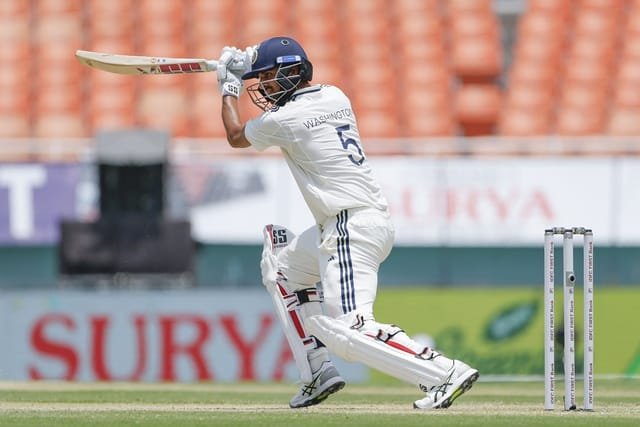
Aakash Chopra says batting will never be Washington Sundar‘s challenge, and the unbeaten 52 he made as India declared at 564/8 against Afghanistan is the latest evidence. But Chopra’s deeper point, that Sundar’s real examination is whether he can fill Ravichandran Ashwin’s bowling shoes, is the more consequential one for India’s Test future.
The All-Rounder Who Has One Answer and One Open Question
Washington Sundar walked to the crease on Day 2 of the one-off Test between India and Afghanistan in New Chandigarh with the innings already well established. India were deep into a commanding first innings, the bowlers had nothing threatening to offer, and the lower order’s job was simply to extend the total and allow the skipper to declare at a psychologically and strategically decisive moment.
Sundar did more than his job. He scored an unbeaten 52 off 68 balls, striking five fours and a six with the kind of clean timing and technical assurance that prompted Aakash Chopra to make an observation that the cricket world has been dancing around for some time: Washington Sundar is not a lower-order batter who can hit. He is a proper batter who happens to bowl.
That distinction carries significant implications for how India should think about him and how they should deploy him. It also creates a specific question, one that Chopra raised directly, about what happens when the batting is taken for granted and the bowling is placed under scrutiny.
The Innings: Unbeaten at the Declaration, the Perfect Lower-Order Contribution
India declared their first innings at 564/8 after 127 overs on Sunday, June 7. Washington’s 52 not out, batting at number nine in the order, extended the total in the final stages of the innings and allowed Shubman Gill to make the declaration at a point where the lead was already comfortably beyond any realistic Afghanistan response.
Afghanistan ended Day 2 at 113/5 in their first innings, trailing by 451 runs with five wickets remaining. The declaration mathematics were irrelevant long before the close of play. The margin India have built makes this match effectively over as a competitive contest, and the remaining days will be about whether Afghanistan can avoid an innings defeat rather than whether they can achieve anything positive.
In that context, Sundar’s innings was the final flourish on a first innings total that had already been built on the centuries of Rahul and Gill, the half-centuries of Sudharsan and Pant, and the wider batting depth that India’s current Test squad possesses in unusual abundance.
| Day | Score | Status |
|---|---|---|
| End of Day 2 | India 564/8 declared; Afghanistan 113/5 | India lead by 451 runs |
Chopra’s Core Observation: The Gambhir Temptation Explained
“He is actually a proper batter. He is a top-order batter, and that’s why Gautam probably got tempted once to bat him at No. 3. That was the Kolkata Test match, but he has a century to his name, and that too came in difficult circumstances in terms of the context of the game.”
Aakash Chopra, Star Sports
The reference to the Kolkata Test against South Africa is the key piece of historical context in this observation. Washington was deployed at number three by Gautam Gambhir in that match, a positional decision that raised eyebrows when it was made but which was based on a genuine assessment of his batting ability. In the first innings, he scored 29 off 82 balls. In the second, he top-scored with 31 off 92 deliveries. Neither knock was spectacular by the numbers, but both demonstrated exactly the technical qualities Chopra is pointing to: a player with genuine defensive solidity and batting intelligence who can occupy the crease under pressure.
The century Chopra references, scored in difficult circumstances, is the most powerful piece of evidence for the “proper batter” argument. T20I centuries are one thing. A Test century scored in a high-stakes situation is the mark of a player whose batting has depth and quality beyond what his position in the order suggests. Gambhir clearly saw that quality and was willing to place institutional confidence in it by promoting him to number three.
“He is technically extremely compact, and he just continues to score runs. Until he keeps playing this format, he will keep scoring runs like this. This is not his challenge at all. He will only get praised here.”
Aakash Chopra, Star Sports
Technically compact is the specific phrase that Chopra uses, and it is worth dwelling on. In Test cricket, technical compactness, the ability to play with a straight bat, to leave deliveries that do not need to be played, to defend with a full face and a high elbow, is the foundation on which all productive batting is built. It is, notably, the quality most commonly absent in players whose batting flourishes in T20 cricket but fails to transfer to the longer format. That Washington has it is not accidental. It reflects a genuinely well-constructed batting technique that his bowling role has never been allowed to overshadow in the way it might overshadow a less skilled batsman.
The Bowling Challenge: Filling Ashwin’s Shoes
If batting is not Washington Sundar’s challenge, Chopra is equally direct about what is.
“His challenge will be how he bowls when he tries to fill Ravichandran Ashwin’s shoes. He will run ahead of him in batting. He is better-skilled than him, and he has that upside.”
Aakash Chopra, Star Sports
“The ceiling is really high, but his real test is bowling. Washington Sundar, as a Test all-rounder, as a batter who can bowl, is outstanding, no doubt, but the challenge will come now in bowling.”
Aakash Chopra, Star Sports
These two statements contain a claim and a challenge that deserve to be separated and examined individually. The claim is that Washington may actually be a better batter than Ashwin. This is a striking assertion from Chopra, particularly given Ashwin’s batting record in Tests, which includes multiple important innings and an average that substantially outperforms what is typically expected from a spinner in the lower order. Chopra is not dismissing Ashwin’s batting. He is arguing that Washington’s batting ceiling may be even higher, a claim supported by his technical compactness and the diversity of shots available to him at the crease.
The challenge, however, is the bowling. This is where the comparison between Washington and Ashwin becomes most uncomfortable for India’s Test planning. Ashwin retired from international cricket with 537 Test wickets and a legacy that makes him one of the most effective spin bowlers in the history of the format. He was not merely a wicket-taker. He was a match-winner, someone whose ability to take decisive wickets in the middle phases of a Test could change the entire trajectory of a match in the space of a single session.
Washington’s Test bowling record is respectable but not comparable. In 17 previous Tests, he has taken 36 wickets at an average of 32.97. He went wicketless in four overs bowled on Day 2 against Afghanistan, which against lower-ranked opposition at home is not catastrophic but is not the kind of bowling display that answers the questions being asked. The wickets-per-match rate and the average both suggest a bowler who contributes usefully without yet imposing the kind of match-winning influence that Ashwin made routine.
| Washington Sundar Test Career | Figures |
|---|---|
| Tests played | 18 (including vs AFG 2026) |
| Test wickets (prior to AFG match) | 36 |
| Bowling average | 32.97 |
| Test centuries | 1 (scored in difficult circumstances) |
| Current innings (vs AFG) | 52* off 68 balls (5 fours, 1 six) |
| Day 2 bowling figures vs AFG | 0/N in 4 overs |
The Ashwin Comparison: Context and Fairness
It is important to apply the correct framework to the Ashwin comparison. Ashwin did not arrive at his peak Test bowling output in his 18th Test. He developed across hundreds of matches, in conditions ranging from subcontinental dustbowls to green seaming English pitches, against batters who had studied him for years and forced him to constantly evolve his craft. The 537 wickets are the product of a career-long process of refinement that Washington is still at the early stages of.
Comparing Washington’s bowling average at this stage of his career with Ashwin’s final career figures is not a fair analytical exercise. The more appropriate comparison is with Ashwin at an equivalent career point, and by that measure, the gap narrows considerably. The question is not whether Washington can match Ashwin’s eventual peak. The question is whether he can develop into a comparable match-winning bowling force over the course of his own long Test career.
The England tour in July will provide a more rigorous early assessment than the Afghanistan match can offer. English conditions, with their natural assistance for off-spin in certain circumstances, will test Washington’s ability to flight, drift, and turn the ball against batters who will have prepared specifically for what he offers. If he takes wickets in those conditions, the bowling question begins to receive meaningful answers.
Conclusion: The Complete Package Is in Development. The Batting Is Already Arrived.
Aakash Chopra’s assessment of Washington Sundar after his unbeaten 52 in New Chandigarh is both a compliment and a challenge delivered simultaneously. The batting is settled. It is technically grounded, consistently productive, and carries the potential ceiling of a player who can bat as high as number three in Test cricket when required. That much is established.
What is not yet established, and what India’s Test planning needs to see developed urgently given the WTC commitments ahead, is the bowling version of that same player. The 36 wickets at 32.97 are a foundation, not a legacy. The Ashwin-shaped hole in India’s Test bowling lineup is one of the most significant structural vacancies in international cricket right now. Washington has the right profile to fill it, and Chopra is correct that his ceiling is genuinely high.
But ceilings are not achievements. The Afghanistan Test provides batting practice and confidence. The England series, with real conditions and real bowling challenges, provides the examinations that will tell us whether India have found their next match-winning Test spinner or simply a very accomplished batting all-rounder who bowls usefully.
Afghanistan trail by 451 runs. The match will be won. The question that matters most for India’s Test future remains very much open.
For breaking news and live news updates, like us on Facebook or follow us on Twitter and Instagram. Read more on Latest Sports on thefoxdaily.com.






COMMENTS 0