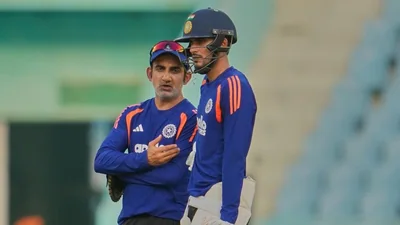
Shubman Gill’s reverse-swing preparation has emerged as one of the most interesting details from India’s training ahead of the first Test against Sri Lanka in Galle. With the two-match World Test Championship series beginning on August 15, India are preparing for a contest in which spin is expected to dominate, but the team management is clearly unwilling to overlook another potential threat: reverse swing.
The decision to recreate a worn pitch and use semi-old Kookaburra balls during practice underlines a broader change in India’s preparation. Rather than simply training for the conditions that are easiest to predict, Gill and the coaching staff appear to be preparing for how the game could evolve from the first session to the final day.
India have already completed a three-day warm-up match against Sri Lanka Cricket XI, giving the squad valuable match practice. The team then returned to training at the Nondescripts Cricket Club, where the focus shifted from conventional net practice to specific scenarios. Gill was at the centre of that work, facing throw-down specialists with semi-old balls before moving to the centre wicket.
Why India are preparing for reverse swing in Sri Lanka
At first glance, preparing for reverse swing in Sri Lanka might seem unusual when the traditional expectation is that spin will be the defining challenge. India, however, have reasons to consider both aspects of bowling.
Galle is known for surfaces where spin can become increasingly influential as a Test progresses. As the pitch wears, batters can face greater uncertainty in terms of bounce, turn and pace off the surface. That naturally places India’s four spinners — Ravindra Jadeja, Kuldeep Yadav, Manav Suthar and Saransh Jain — in an important part of the team’s planning.
But a Test match is rarely controlled by one type of bowling throughout. A new ball can offer conventional movement, while an older and scuffed ball can behave differently as the surface deteriorates. If conditions allow reverse swing to develop, Indian batters may have to deal with a different technical problem precisely when concentration and footwork are already being tested by a tiring pitch.
That is why Gill’s session is significant. The objective was not simply to hit balls. It was to make the batters experience a situation in which the ball could move late and challenge their defensive technique.
Gill personally leads the unusual batting drill
According to the report, India’s ground staff were asked to prepare a surface similar to the one used during the team’s recent practice game. The wicket was deliberately allowed to resemble a later-stage Test surface, including cracks and conditions that could encourage reverse swing.
Gill then spent around 20 minutes facing three throw-down specialists: Nuwan Seneviratne, Raghavedra Dwivedi and Dayanand Garani. Instead of relying only on fresh cricket balls, he specifically asked for semi-old Kookaburra balls so that the throw-downs could reproduce the movement India might encounter during the Test.
The exercise did not stop at throw-downs. Gill subsequently moved to the centre wicket, where Jammu & Kashmir pacer Auqib Nabi was instructed to bowl with semi-old balls.
This is an important distinction in preparation. Throw-downs allow a batter to repeat movements and focus on technique, but facing a genuine bowler adds variations in release, pace and angle. By moving between the two forms of practice, Gill could work on both reaction and technique.
The Kookaburra-ball factor could matter in Galle
India’s decision to carry different types of Kookaburra balls to Sri Lanka also provides an insight into the level of detail behind the preparation.
The condition of a cricket ball changes throughout a Test. A new ball is generally harder and more capable of producing conventional movement, while an older ball can become increasingly rough. The interaction between the ball, pitch and weather determines how much movement is available to bowlers.
The report’s explanation is particularly relevant to Sri Lankan conditions. Abrasive surfaces and dry surroundings can cause a cricket ball to deteriorate faster than it might on a lush outfield. If the ball becomes sufficiently worn, reverse swing can become an important weapon for fast bowlers.
That possibility makes India’s preparation more than a technical curiosity. It reflects an understanding that a Test played over five days can contain several different battles.
Galle may begin as a spin contest but finish differently
The most obvious expectation for the Galle Test is a contest dominated by spin. India’s squad selection reinforces that expectation, with Jadeja, Kuldeep, Suthar and Saransh giving the visitors multiple options in the spin department.
However, the fourth and fifth days could produce a completely different tactical environment.
A worn pitch can make batting difficult regardless of the type of bowling. Spinners can exploit cracks and uneven bounce, while fast bowlers can potentially attack with an older ball if reverse swing becomes available. The result is a challenge that changes as the match moves forward.
For India’s batters, this means preparation cannot be limited to sweeping and using their feet against spin. They also need to maintain compact defensive techniques against movement at a stage when fatigue can make decision-making harder.
Gill’s session therefore offers a clue about how India could approach batting in the Test: prepare for the worst conditions rather than assuming the match will follow the traditional script.
Shubman Gill’s own return to practice adds another layer
Gill’s involvement is particularly important because the Indian captain had missed the first two days of the warm-up match after suffering an impact injury to his right finger.
He returned on the final day and scored a fluent 54 while opening alongside Yashasvi Jaiswal. That innings provided useful match practice, but the subsequent training session showed that Gill was not treating the warm-up performance as the end of his preparation.
Instead, he immediately moved into a more specialised workload.
For a captain, that can have significance beyond personal batting preparation. Gill is expected to lead a team returning to World Test Championship action after a lengthy gap, and his own readiness can influence how confidently India approach the opening Test.
There is also a practical benefit. By personally testing the conditions created by the coaching staff, Gill can better understand whether the preparation actually reproduces the problems the team expects to face.
India’s batting will be tested differently as the Test progresses
India’s batting approach in Galle could require considerable adaptability. Against spin, batters generally need to make decisions about whether to attack the ball with their feet, play back, sweep, or rotate the strike. Against reverse swing, the challenge is different because late movement can make an apparently safe defensive stroke dangerous.
The combination becomes especially difficult when a batter has already spent several hours at the crease.
That is where India’s preparation on a Day 4-style surface becomes valuable. It allows the players to experience a pitch that is closer to the kind of conditions they could encounter when the match reaches its decisive stages.
Rather than asking only, “How do we score runs in Galle?”, the preparation appears designed around a more useful question: “How do we continue batting when the conditions become significantly harder?”
What the reverse-swing drill says about India’s bowling plans
The session also has implications for India’s bowling strategy.
India have several spin options, but Mohammed Siraj, Prasidh Krishna and Gurnoor Brar provide the pace-bowling choices. If reverse swing becomes available, even relatively short spells from fast bowlers could become strategically important.
A fast bowler does not necessarily need to dominate the match to influence it. A spell with an old ball can create pressure, force mistakes and potentially break partnerships when spinners have been unable to make an immediate breakthrough.
That could become particularly useful if Sri Lanka’s batters settle against spin or if India need a different angle of attack.
India’s four-spinner combination creates selection questions
The presence of four spinners gives India considerable flexibility, but it also creates a selection puzzle. The team has to balance spin options against the need for pace and lower-order batting.
| Area | India’s preparation focus | Why it matters |
|---|---|---|
| Spin | Four specialist spin options in the squad | Galle is expected to provide significant assistance to spinners |
| Reverse swing | Semi-old Kookaburra balls | Prepares batters for late movement from the older ball |
| Worn surface | Day 4-style practice wicket | Replicates difficult batting conditions later in the Test |
| Batting technique | Throw-downs and centre-wicket practice | Allows players to work on both repetition and match-like reactions |
| Captain’s readiness | Gill returned to batting and undertook specialised drills | Important for India’s leadership and top-order stability |
Why this preparation could become India’s hidden advantage
One of the biggest advantages in Test cricket is not always visible on the scoreboard. Preparation can determine how quickly a team adapts when conditions move away from expectations.
That could be India’s biggest benefit from the reverse-swing exercise.
If the Galle surface turns sharply, India have already prepared for it. If the pitch becomes slower, the batters can adapt. If the ball begins to reverse, they have at least experienced the movement during practice. The team is effectively trying to reduce the number of surprises waiting for them during the Test.
There is also a psychological advantage. Batters who have already faced an older ball moving late in practice are less likely to be completely unfamiliar with the challenge when it appears during a competitive innings.
That does not guarantee success, of course. Practice conditions can never perfectly reproduce a live Test match, particularly when pressure, fatigue and the match situation are involved. But detailed preparation can narrow the gap between expectation and reality.
Gill’s leadership will be under the spotlight in Galle
The Galle Test is also an important moment in Gill’s development as India’s Test captain. Leadership in Test cricket is not only about field placements and bowling changes. It involves reading how the pitch changes, knowing when to attack and understanding when patience is more valuable than aggression.
The captain’s batting preparation reflects that mindset.
Gill is preparing himself for the same difficult scenarios his teammates will face. That could help establish the tone for India’s campaign, particularly after the long gap since their previous WTC assignment.
His ability to contribute runs at the top of the order will be equally important. A captain who spends significant time at the crease can influence the tempo of an innings while gaining a clearer understanding of how the opposition’s bowlers are operating.
India’s WTC campaign gives the series added importance
The Sri Lanka series is not simply another bilateral assignment. It forms part of India’s World Test Championship campaign, making every session more meaningful.
India have twice finished as WTC runners-up, and their position in the current standings means they need strong results as the cycle develops. A two-Test series offers fewer opportunities to recover from a poor start, which makes the first Test especially important.
A strong performance in Galle would give India momentum before the second Test at the SSC Ground in Colombo, scheduled to begin on August 23.
That makes the team’s preparation understandable. India are not preparing for one type of condition or one phase of the game. They are preparing for a five-day contest in which the pitch, ball and tactical priorities can all change.
What to watch when India face Sri Lanka
- Gill’s batting: His recovery from the finger issue and ability to provide stability at the top will be closely watched.
- Reverse swing: The performance of the older ball could determine whether India’s specialised preparation becomes relevant during the match.
- Spin combination: India have several options, and the balance between spin and pace will be one of the biggest selection decisions.
- Galle’s pitch: How quickly the surface deteriorates could influence both batting strategy and bowling combinations.
- Late-innings batting: India’s ability to handle difficult conditions on Days 4 and 5 could ultimately decide the Test.
The bigger picture: India are preparing for the match, not just the venue
The most revealing aspect of India’s latest training session is that the team does not appear to be preparing for a stereotypical Galle Test. The expectation may be spin, but the preparation covers reverse swing, an ageing ball, a deteriorating surface and the technical demands of batting late in the match.
That approach could prove especially valuable in a two-Test series. There is little room for complacency, and one unexpected session can change the entire direction of a match.
Gill’s decision to personally spend time on the reverse-swing drill also sends a clear message. India are treating preparation as part of the contest itself. Rather than waiting for the conditions to expose a weakness, the team is attempting to recreate those weaknesses before the first ball is bowled.
Conclusion
Shubman Gill’s reverse-swing preparation ahead of the Galle Test provides an important glimpse into India’s thinking before their return to World Test Championship action. While spin is likely to remain central to the series, India’s use of semi-old Kookaburra balls and a worn practice surface shows that the team is preparing for the full five-day challenge.
Gill’s return after his finger issue, his specialised throw-down session and the involvement of Auqib Nabi all point towards a preparation strategy built around realistic match scenarios. The presence of four spinners gives India plenty of options, but the willingness to prepare for reverse swing could prove just as valuable if the ball starts moving late.
The real test will come on August 15. If Galle behaves as expected, India’s spinners may dominate the conversation. If the pitch deteriorates and the older ball starts talking, however, the work done away from the spotlight could suddenly become one of India’s biggest advantages.
For a team chasing a strong start to its WTC campaign, that kind of preparation may be exactly what separates a well-prepared side from one that simply arrived expecting the usual Sri Lankan script.
For breaking news and live news updates, like us on Facebook or follow us on Twitter and Instagram. Read more on Latest Cricket on thefoxdaily.com.






COMMENTS 0