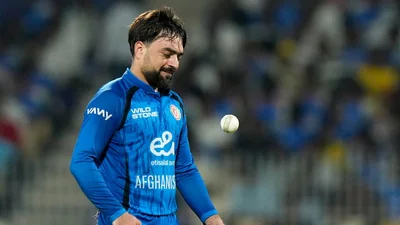
India vs Afghanistan T20I series 2026 has received a major scheduling update after the Afghanistan Cricket Board confirmed the dates and venue for the three-match series, potentially bringing an end to India’s proposed white-ball tour of Bangladesh.
Afghanistan are scheduled to play India in three T20Is at the Arun Jaitley Stadium in New Delhi on September 13, 15 and 17. The dates were communicated by the Afghanistan Cricket Board to its commercial partners after being agreed with the Board of Control for Cricket in India, although an official public announcement from the relevant authorities is still awaited.
The confirmation has wider implications for India’s packed international calendar. The proposed Bangladesh tour was scheduled to conclude with a T20I on September 13, exactly when Afghanistan are due to begin their series against India.
That makes the existing Bangladesh itinerary extremely difficult to execute without major changes.
Why the Afghanistan series creates a direct Bangladesh tour clash
India’s proposed Bangladesh tour was originally scheduled to begin on August 28.
The itinerary included three ODIs followed by three T20Is. The ODIs were planned for September 1, 3 and 6, while the T20Is were scheduled for September 9, 12 and 13.
The problem is the final Bangladesh T20I and the opening Afghanistan T20I are both listed for September 13.
Even if the two matches were played in different countries, the logistical challenge would be enormous.
India would need to complete a T20I in Bangladesh and then travel to Delhi for another international match almost immediately. International players require recovery time, transportation and preparation, while broadcasting and team logistics also need to be arranged well in advance.
As a result, the issue is not simply a calendar overlap. It is a practical scheduling problem involving players, support staff, broadcasters, venues and commercial partners.
Afghanistan series will be played entirely in Delhi
Despite being described as Afghanistan’s first bilateral series against India as the host, the matches will not take place in Afghanistan.
All three T20Is are scheduled at the Arun Jaitley Stadium in New Delhi.
The arrangement allows Afghanistan to formally host India for the bilateral assignment while avoiding the logistical complications associated with staging the matches in Afghanistan.
The three-match schedule gives both teams a short but focused T20I window before the next major phase of the international calendar.
| Match | Date | Venue | Format |
|---|---|---|---|
| India vs Afghanistan 1st T20I | September 13, 2026 | Arun Jaitley Stadium, New Delhi | T20I |
| India vs Afghanistan 2nd T20I | September 15, 2026 | Arun Jaitley Stadium, New Delhi | T20I |
| India vs Afghanistan 3rd T20I | September 17, 2026 | Arun Jaitley Stadium, New Delhi | T20I |
ACB says dates have already been agreed with BCCI
The Afghanistan Cricket Board’s communication to its commercial partners is significant because it indicates that the dates are not merely provisional discussions.
ACB CEO Naseeb Khan confirmed that the schedule and venues had been agreed with the BCCI.
The board also told media-rights holders and commercial partners to begin their planning based on the announced schedule.
That includes broadcast scheduling, production arrangements, resource allocation and promotional activity.
This level of preparation suggests that the Afghanistan series has moved considerably further along the planning process than a tentative bilateral proposal.
Why the Bangladesh tour now looks increasingly unlikely
The biggest consequence of the Afghanistan schedule is the uncertainty surrounding India’s proposed Bangladesh tour.
Under the original itinerary, India would have played six white-ball matches in Bangladesh between September 1 and 13.
The final three T20Is were especially problematic because they were scheduled on September 9, 12 and 13.
With Afghanistan beginning its series on September 13, the final Bangladesh fixture would need to be moved.
But moving only that match would not necessarily solve the problem.
India would still have to travel from Bangladesh to Delhi and prepare for the Afghanistan series. A one-day shift would therefore provide limited relief.
The Bangladesh itinerary would likely require a broader restructuring if it is to survive.
What options remain for the Bangladesh tour?
There are several theoretical possibilities, but each comes with complications.
- Reschedule the Bangladesh T20Is: The fixtures could be moved to different dates if suitable windows are available.
- Shorten the tour: Some matches could potentially be removed from the itinerary.
- Postpone the tour: The Bangladesh series could be moved to a later international window.
- Adjust the Afghanistan schedule: ACB has discussed a possible change to one fixture, although that alone would not resolve the larger conflict.
The most realistic solution would require coordination among the cricket boards and other stakeholders rather than a simple date swap.
ACB has reportedly explored a one-day adjustment
The Afghanistan Cricket Board has also approached the BCCI about potentially moving either the first or second T20I by one day.
One option discussed involves September 14, which coincides with Ganesh Chaturthi.
However, even such a change would not automatically make the existing Bangladesh schedule workable.
If India’s Bangladesh T20I remains on September 12 or September 13, the team would still face an extremely compressed transition into the Afghanistan series.
This is why the scheduling problem should be viewed as a wider calendar issue rather than simply a clash involving one date.
The commercial side makes the Afghanistan series more significant
The ACB’s communication to broadcasters and commercial partners is another important development.
When a board begins asking media-rights holders to prepare production resources and promotional campaigns, it indicates that the commercial ecosystem surrounding the series is already being activated.
ITW Universe owns the media rights for the series, while discussions have reportedly involved JioStar, Sony Sports and Zee Unite8 regarding linear broadcast arrangements.
FanCode holds the digital rights.
For a bilateral series involving India, broadcast planning is a major operation. Television production, digital streaming, advertising, studio programming, sponsorship and promotional campaigns all require considerable preparation.
That commercial momentum makes a major last-minute alteration increasingly complicated.
Why the series is a landmark moment for Afghanistan cricket
The India-Afghanistan cricket relationship has grown significantly over the past decade.
Afghanistan have established themselves as a competitive international side, particularly in white-ball cricket, and their emergence has been powered by a generation of high-quality spin bowlers and increasingly experienced batters.
A bilateral series against India represents another step in that development.
For Afghanistan, the significance extends beyond three T20I matches.
Playing a full bilateral series against one of cricket’s biggest teams provides international exposure, commercial value and an opportunity to strengthen the country’s position within the global cricket ecosystem.
It also gives Afghanistan’s players the chance to compete regularly against India’s strongest available white-ball squad.
Rashid Khan could be central to the contest
Any India-Afghanistan T20I series naturally brings attention to Rashid Khan.
The Afghanistan captain and premier leg-spinner has extensive experience in franchise cricket and international T20 cricket, including matches involving several Indian players.
His knowledge of Indian conditions could become particularly valuable in Delhi.
Rashid’s ability to bowl during the middle overs and restrict scoring while taking wickets gives Afghanistan a weapon that can change the course of a T20 match.
The matchup between India’s batters and Afghanistan’s spin attack could therefore become one of the defining tactical themes of the series.
Why Delhi could influence the tactical battle
The Arun Jaitley Stadium provides a familiar Indian setting for the series, but familiarity does not necessarily mean predictable conditions.
T20 cricket at the venue can place significant importance on how teams manage the middle overs and death overs.
Afghanistan’s spin resources could be particularly relevant if the surface offers assistance to slower bowlers.
India, meanwhile, are likely to possess the batting depth required to attack during multiple phases of an innings.
The key tactical question will be whether Afghanistan can prevent India from building momentum during the middle overs.
India’s calendar management becomes increasingly important
The scheduling controversy also highlights a larger issue facing international cricket: the increasing difficulty of fitting bilateral series into an already crowded calendar.
International cricket now operates alongside franchise leagues, ICC tournaments, domestic competitions and player workload considerations.
For India, the challenge is particularly pronounced because the national team plays a large number of international fixtures while also operating within a packed domestic and commercial ecosystem.
A schedule that looks manageable on paper can quickly become difficult once travel, player recovery and broadcasting requirements are added.
The Bangladesh-Afghanistan situation is therefore an example of the broader calendar-management problem facing modern cricket.
Potential impact on India’s players
If the Afghanistan series proceeds as scheduled, India’s selectors will have to carefully consider workload and squad rotation.
Three T20Is in five days is not an unusually demanding schedule by itself, but the surrounding calendar matters.
If players have just completed another white-ball series, selectors may decide to rotate some members of the squad or provide opportunities to younger players.
That could turn the Afghanistan series into an important audition for players competing for positions in India’s T20I setup.
It may also allow the team management to evaluate combinations without overworking established players.
Bangladesh could be the biggest loser from the scheduling clash
From Bangladesh’s perspective, the situation is particularly frustrating.
The proposed tour represented a significant bilateral opportunity, with three ODIs and three T20Is scheduled across two weeks.
A cancellation or postponement would remove six international fixtures from the calendar and potentially create a major gap in Bangladesh’s home schedule.
The consequences would extend beyond cricket.
Broadcasters, sponsors, ticketing operations, hotels, travel companies and local businesses connected to the series would all be affected by a major change.
That is why a final decision is likely to require careful coordination rather than a rushed announcement.
Could the Bangladesh tour be postponed instead of cancelled?
Postponement may ultimately prove more practical than outright cancellation if both boards want to preserve the series.
The challenge would be finding an appropriate future window.
India’s international calendar is already heavily populated, while Bangladesh also have their own commitments.
A postponed series could therefore create another scheduling puzzle further down the line.
Still, preserving the six-match itinerary may be preferable to abandoning it altogether if a mutually acceptable window can be found.
The bigger picture: India-Afghanistan cricket is entering a new phase
The upcoming series is also significant because it reflects the changing status of Afghanistan in international cricket.
Afghanistan are no longer simply a developing associate-era success story. They have become a competitive full member in the white-ball game and regularly challenge established cricket nations.
A bilateral series against India reinforces that progression.
For India, it provides another opportunity to test players and combinations in T20 cricket. For Afghanistan, it offers a platform to compete against one of the deepest squads in the sport.
That makes the series meaningful even if the Bangladesh tour ultimately has to be rearranged.
What happens next?
The immediate focus will be on the formal public confirmation of the Afghanistan series and any subsequent decision regarding India’s Bangladesh tour.
The key question is whether the Bangladesh itinerary will be moved, shortened or postponed.
The ACB’s communication suggests that the Afghanistan dates are already sufficiently advanced for commercial planning, meaning the burden of adjustment may now fall primarily on the Bangladesh schedule.
Any changes would need to account for player travel, recovery, broadcasting, venue availability and the wider international calendar.
India vs Afghanistan 2026 schedule: Key takeaways
- Three T20Is: India and Afghanistan are scheduled to play three matches.
- Dates: September 13, 15 and 17, 2026.
- Venue: All three matches are scheduled at Arun Jaitley Stadium in New Delhi.
- Major clash: India’s proposed Bangladesh tour currently has its final T20I scheduled for September 13.
- Possible changes: The Bangladesh itinerary may need to be rescheduled, shortened or postponed.
- Commercial planning: ACB has already asked media-rights holders and commercial partners to begin preparations.
Conclusion: Afghanistan series gains clarity as Bangladesh tour enters uncertainty
The India vs Afghanistan T20I series 2026 now appears to have a firm framework, with the Afghanistan Cricket Board confirming three matches in Delhi from September 13 to 17.
The development, however, creates a major complication for India’s proposed Bangladesh tour, whose final T20I is currently scheduled for the same day as the Afghanistan series opener.
Simply moving one Afghanistan fixture may not be enough. The Bangladesh itinerary would still leave India facing a difficult travel and recovery schedule, making a broader adjustment increasingly likely.
For Afghanistan, the series represents a landmark bilateral opportunity and another sign of the team’s growing status in international cricket. For India, it could provide a valuable T20I window for testing squad combinations and managing player workloads.
The immediate winner may therefore be Afghanistan, whose series has gained clarity, while Bangladesh face uncertainty over a tour that was already planned.
The next major development will be whether India and Bangladesh can find a workable solution without sacrificing the proposed six-match white-ball series. Until then, the Afghanistan dates have fundamentally reshaped India’s September cricket calendar.
For breaking news and live news updates, like us on Facebook or follow us on Twitter and Instagram. Read more on Latest Cricket on thefoxdaily.com.






COMMENTS 0