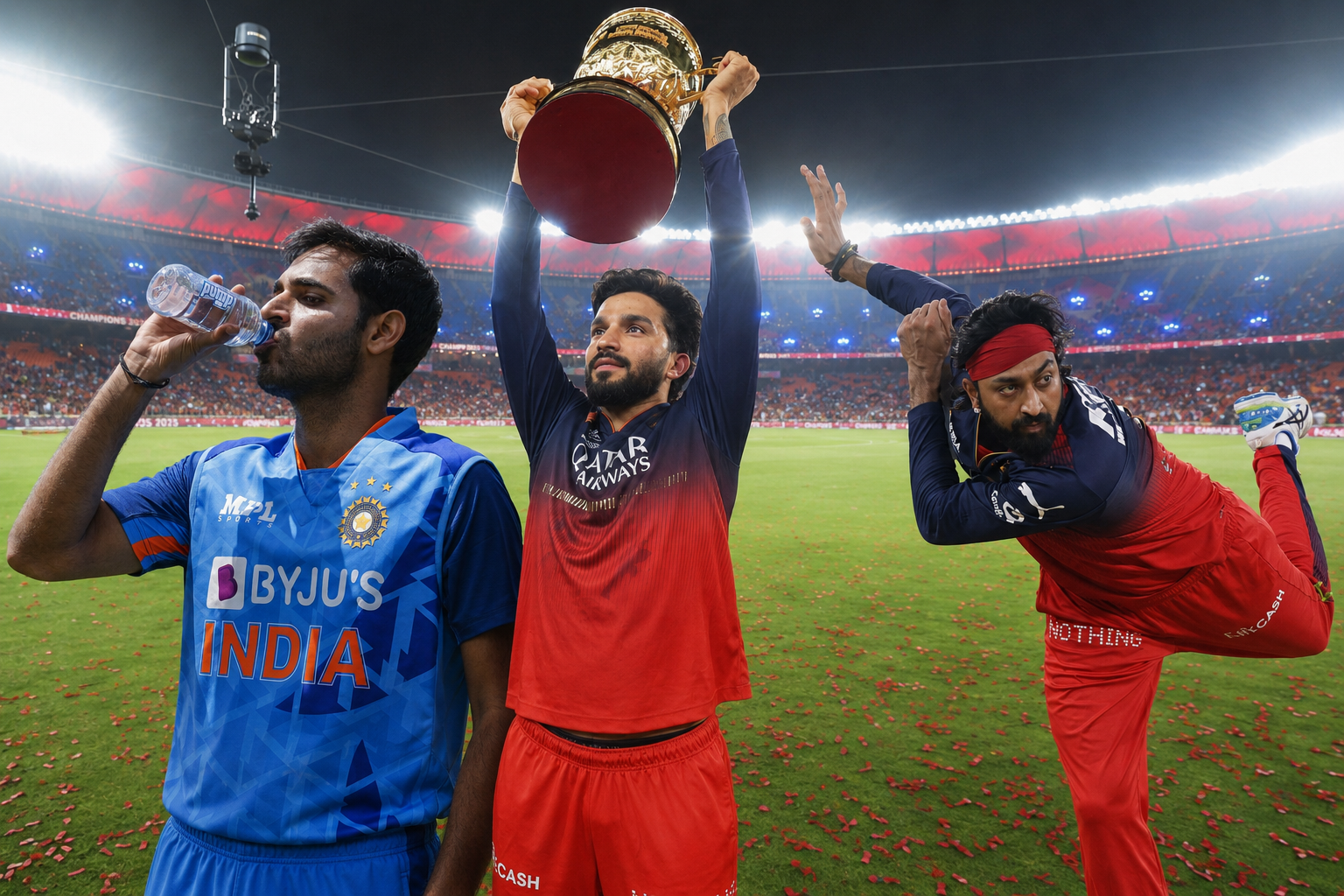
India’s 16-member T20I squad for Ireland and England contains bold selections and genuine excitement. It also contains three conspicuous absences. Rajat Patidar, Bhuvneshwar Kumar, and Krunal Pandya all produced strong IPL 2026 campaigns and all have a case that the selectors have not publicly answered.
The Other Side of Every Selection Decision
When India’s T20I squad for the Ireland and England series was announced, the conversation focused almost entirely on the names that were in it. Vaibhav Sooryavanshi at 15, breaking records. Shreyas Iyer as captain, returning from 2.5 years outside the setup. Prince Yadav, the uncapped pace prospect. These are the stories that capture public attention.
But selection is always a bilateral exercise. For every name that makes the list, at least one name that had a reasonable claim does not. In the case of this particular squad, three absences stand out as genuinely difficult to explain on purely performance-based grounds.
The squad itself reads: Shreyas Iyer (c), Abhishek Sharma, Sanju Samson, Ishan Kishan, Shivam Dube, Tilak Varma (vc), Nitish Kumar Reddy, Axar Patel, Washington Sundar, Varun Chakaravarthy, Ravi Bishnoi, Mohammed Siraj, Harshit Rana, Arshdeep Singh, Prince Yadav, Vaibhav Sooryavanshi.
Notable by absence: Rajat Patidar, Bhuvneshwar Kumar, and Krunal Pandya.
Player 3: Bhuvneshwar Kumar: The Craftsman Who Keeps Proving a Point Nobody Is Choosing to Hear
Bhuvneshwar Kumar’s IPL 2026 season for Royal Challengers Bengaluru was not merely good. It was the kind of sustained, high-quality seam bowling performance that reminded the cricket world exactly why he spent the better part of a decade as India’s most reliable white-ball bowler. He came close to winning the Purple Cap. He was effective in the powerplay and at the death, which is the combination that all T20 teams need from their primary seamer. He contributed meaningfully to RCB’s second consecutive IPL title.
The selectors have still not called him up.
Ravichandran Ashwin addressed this earlier in the week, noting that Bhuvneshwar’s exclusion follows the precedent established when Mohammed Shami was not recalled post-injury despite strong form. The message, once delivered, becomes a policy: certain experienced players are no longer in the T20I picture regardless of what they produce in domestic cricket. The door has been classified as closed.
The frustration of Bhuvneshwar’s case is that the players selected ahead of him in the seam bowling department have not clearly outperformed him across the same period. Arshdeep Singh and Harshit Rana both have their considerable merits, but a direct comparison of IPL 2026 numbers between Bhuvneshwar and either bowler does not produce a clean verdict in favour of the younger options. The selection is being made on age and trajectory, not on current form, and while that is a defensible philosophical position, it is not the same as a performance-based decision.
For a series in England, where swing conditions and seam movement reward exactly the skills Bhuvneshwar possesses most acutely, the specific absence is particularly pointed. He bowls the kind of outswing and variations that consistently create problems for left and right-handed batters on English wickets. Leaving him out of an England T20I series, specifically because of age policy rather than skill decline, is a choice that the results will either validate or undermine.
| Player | IPL 2026 Wickets | Average | Economy | India T20I Status |
|---|---|---|---|---|
| Bhuvneshwar Kumar | 28 (near Purple Cap) | Under 18 | 7.95 | Not selected |
| Arshdeep Singh | Selected reference | N/A | N/A | Selected |
| Prince Yadav (uncapped) | 16 | Under 29 | N/A | Selected (uncapped debut) |
Player 2: Rajat Patidar: The Middle-Order Batsman India Keeps Finding Reasons Not to Pick
Rajat Patidar’s absence from India’s T20I setup has reached the point where it requires a genuine explanation rather than a vague reference to squad balance. The RCB captain is one of the most destructive middle-order batters in Indian domestic cricket. His record against both spin and pace is not the profile of a one-dimensional hitter who can be dismissed as a flat-track specialist. He is an intelligent, technically capable batter who performs in pressure situations and who led RCB to a second consecutive IPL title in 2026 while personally contributing over 500 runs at a strike rate approaching 193.
Ravichandran Ashwin acknowledged this directly in the week of the squad announcement, noting that Patidar must wait because Shivam Dube already occupies his positional niche in the current T20I structure. The logic is a squad architecture one: there is no vacancy for Patidar because the role he would fill is already assigned to someone else.
That explanation is coherent but unsatisfying in the specific context of Patidar’s IPL 2026 season. When a player leads his team to the title, scores at a strike rate of 192.69, and averages 41.75 in the process, the question of whether he warrants a T20I opportunity should not be answerable purely by pointing to squad structure. Squads can accommodate players of this quality. The question is whether the selectors believe Patidar’s profile offers something sufficiently different from what Shivam Dube provides to justify the inclusion of both.
The counter-argument is that Dube’s power-hitting against spin in the death overs represents a specific match-winning skill that Patidar does not replicate in exactly the same way. That is a technical cricket argument worth taking seriously. But Patidar’s ability to score rapidly against both bowling types at the top of the middle order, without the ceiling limitations that come from a narrower skill set, makes a compelling case for a squad that needs versatility as much as specificity.
He is one of India’s best T20I batters who has never been given a sustained run in the format to prove it at international level. That gap between domestic credential and international opportunity is widening with every squad announcement, and at some point the selectors will need to either give him the chance or explain publicly why his T20I window has closed.
Player 1: Krunal Pandya: The Smartest Left-Arm Spinner in Indian Cricket Not Named Axar
The most analytically interesting of the three omissions is Krunal Pandya, because it requires a direct comparison with the players who were selected ahead of him and that comparison does not produce a comfortable verdict for the selectors.
Axar Patel and Washington Sundar have retained their positions as India’s frontline left-arm and off-spin all-round options respectively. Neither covered themselves in particular glory during IPL 2026. Krunal, meanwhile, had a campaign for RCB that demonstrated genuine evolution in his batting and maintained the bowling economy and variety that has long made him one of the shrewdest T20 spinners in India.
The batting improvement is the most significant development. Krunal has always been a useful lower-order batsman, but his IPL 2026 campaign showed specific technical growth: he handled the short ball better, his slog-sweep against spinners became more reliable and effective, and he contributed in pressure situations for RCB in a way that a one-dimensional bowler does not. The all-round profile, always his strongest case for selection, became more complete rather than less so.
As a bowler, Krunal rarely goes for runs. His line, length, and variation control in T20 cricket are the product of years of high-level competition and the specific intelligence of a left-arm spinner who thinks clearly about how to deceive batters rather than overpower them. In English conditions, where the left-arm angle and the ability to use the crease create different challenges from the subcontinent, his skills have genuine relevance.
The England series specifically raises the question of why a smart, economical left-arm spinner who has been performing consistently for one of the IPL’s top franchises is not in the squad. Axar’s selection is defensible on the basis of his international experience and his superior batting contribution at international level. Washington’s selection is more complex given his middling IPL returns. But Krunal’s exclusion, in a squad that selected 16 players and broke its own convention to include Sooryavanshi as a 16th member, is the absence that most requires an explanation.
The Broader Pattern: What These Three Absences Reveal
Taken together, the exclusions of Bhuvneshwar, Patidar, and Krunal Pandya tell a story about how India’s selectors are currently operating in the T20I space. Experience and age are active disadvantages for players in the 33-plus bracket, regardless of form. Squad structure and positional overlap are being used to justify the exclusion of players whose numbers, on their own, would demand selection. And the momentum generated by specific players through the selection cycle creates an incumbency that is difficult to dislodge even when a challenger performs better.
None of these observations constitutes a definitive argument that the selectors are wrong. Selection involves more variables than any single performance metric captures, and the management of long-term squad development across a two-year World Cup cycle requires making decisions that prioritise 2028 over immediate performance claims. If Prince Yadav, Sooryavanshi, and the other younger players in this squad develop as hoped, the decisions to exclude Bhuvneshwar, Patidar, and Krunal will appear prescient in retrospect.
But in the present, with IPL 2026 statistics fresh and the England series approaching conditions where specific skills matter greatly, the three names missing from India’s 16-member squad represent genuine unlucky exclusions rather than straightforward merit-based omissions.
Conclusion: Performing Is Not Always Enough. Timing and Context Matter Too.
The lesson that Rajat Patidar, Bhuvneshwar Kumar, and Krunal Pandya share from this squad announcement is an uncomfortable one that professional sport delivers regularly: performing at a high level is a necessary condition for selection, but it is not a sufficient one. Squad structure, age policy, competitive balance between similar profiles, and long-term planning all operate as filters through which individual performances are processed before a selection is made.
All three players have done what they can control. They have performed. The variables outside their control, how their profile fits the current squad architecture and where they sit in the selectors’ longer-term vision, have not resolved in their favour this time.
The Ireland and England T20I series will reveal whether the players selected ahead of them justify the choices. If they do, the conversation moves on. If they do not, the names of Patidar, Bhuvneshwar, and Krunal Pandya will resurface in the next squad announcement cycle with even stronger claims.
India’s T20I campaign begins on June 26 in Belfast. The players who were not selected will be watching, performing in domestic cricket, and making the case for next time. That is all they can do.
For breaking news and live news updates, like us on Facebook or follow us on Twitter and Instagram. Read more on Latest Sports on thefoxdaily.com.






COMMENTS 0