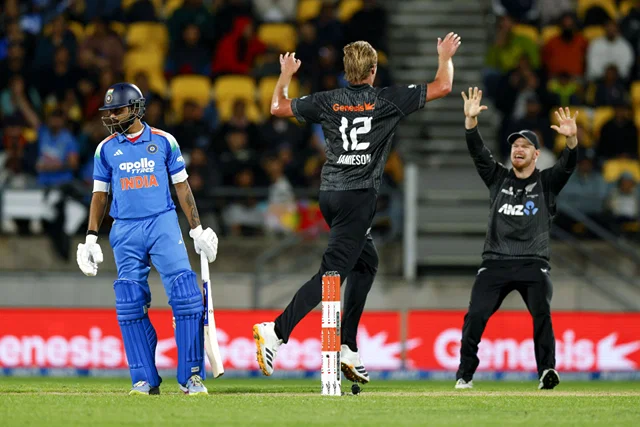
Former India batter Ambati Rayudu has defended Shreyas Iyer following another dismissal against a short-pitched delivery in the second ODI against New Zealand. Iyer scored 30 runs from 46 balls before a difficult bouncer from Kyle Jamieson ended his innings, but Rayudu believes the delivery would have troubled many batters and should not be viewed as a major concern.
Iyer’s dismissal came during India’s challenging run chase in Wellington, where New Zealand’s bowlers made effective use of the conditions. Despite losing early wickets, the middle-order batter helped stabilise the innings through an important partnership with KL Rahul before Jamieson’s short ball brought his stay at the crease to an end.
Ambati Rayudu backs Shreyas Iyer after another short-ball dismissal
Shreyas Iyer walked out to bat when India were struggling at 17 for two in the fourth over of the chase. With the top order already under pressure, he joined KL Rahul and helped rebuild the innings through a 39-run partnership from 43 deliveries.
Iyer contributed 30 runs from 46 balls, providing some stability in difficult batting conditions. However, Jamieson produced a short delivery that climbed awkwardly and moved back towards the batter.
Iyer attempted to move away from the line of the ball, but the delivery followed him, leaving him unable to get his bat or hands clear. The ball flew off the top edge, allowing wicketkeeper Tom Latham to complete the catch.
The dismissal attracted attention because Iyer had also fallen to a short-pitched delivery in the series opener in Auckland. On that occasion, he failed to execute a pull shot against a Jacob Duffy bouncer towards the end of India’s run chase.
Despite the repeated pattern, Rayudu felt the latest delivery was particularly difficult to handle and argued that Iyer’s overall contribution should be recognised rather than focusing only on how he got out.
“I don’t think you should read too much into Shreyas Iyer’s dismissal because it was a very tough ball for many batters. A short ball that is seaming in when he was actually trying to leave the ball, but it followed him. He could not get into a good position to leave the ball, and it can happen to anybody. I think that Shreyas Iyer played a very important knock, given the conditions. His 30 was very valuable in us crossing the line,” the former MI star said on Cricbuzz.
Rayudu highlighted the movement and awkward bounce of Jamieson’s delivery, suggesting that Iyer had limited options once the ball followed him. He also emphasised that the 30-run contribution was valuable in a difficult chase and helped India move closer to the target.
Murali Kartik points to difficult pitch conditions
Former India spinner Murali Kartik also felt that the conditions played a major role in Iyer’s dismissal. According to Kartik, the pitch made batting challenging throughout the contest, with several players having to deal with uncomfortable deliveries.
He noted that batters in a tricky chase sometimes need to spend time at the crease and manage the innings carefully. However, he also stressed the importance of rotating the strike during difficult periods rather than allowing pressure to build.
“I think it was just a difficult pitch. Sometimes when you are in a tricky run chase, you know that you want to bide your time. At the end of the day, you can make up for it. It is important to know what you are doing in between those expensive overs, are you at least turning the strike over? Yes, there were some difficult deliveries. Axar got a brute first up. There were times when Shreyas Iyer got tangled. So over here, maybe one player could have taken it upon himself to throw the bowlers off, but it was a tough one,” Murali Kartik added.
Kartik also referred to Axar Patel’s difficult start, noting that the all-rounder faced a challenging delivery early in his innings. His comments underlined how New Zealand’s bowlers used the conditions to create pressure and make scoring difficult for India’s batters.
Shreyas Iyer’s recent ODI numbers raise questions
Although Rayudu and Kartik defended Iyer’s latest dismissal, the batter’s recent numbers in ODI cricket have been less productive than expected. Before the second match against New Zealand, he averaged 26.00 in the format during the year, with only one half-century from 10 innings.
Those figures provide context to the discussion surrounding his batting form. However, Rayudu’s assessment suggests that individual dismissals need to be considered alongside the conditions in which they occur, particularly when the pitch offers significant assistance to fast bowlers.
Ambati Rayudu plays down India’s consecutive batting collapses
India’s batting struggles have become another talking point during the ODI series. In the second match, the team was reduced to 113 for seven when rain returned, leaving India four runs ahead of the Duckworth-Lewis-Stern (DLS) par score. With 22 runs still needed, India secured a four-run victory under the DLS method.
A similar situation had developed during the first ODI in Auckland. Iyer was dismissed for 15 by a short delivery from Jacob Duffy, after which India slipped from 114 for two to 136 for five. Naman Dhir eventually struck a boundary to complete the chase.
The pattern continued in Wellington, where India lost four wickets inside the first 13 overs. The repeated middle-order collapses raised questions about the team’s approach against New Zealand’s seam attack, particularly when batting conditions became difficult.
However, Rayudu does not believe the back-to-back batting struggles should become a major concern. He argued that India’s batting line-up is accustomed to scoring big totals and that the change in conditions has played an important role in the recent performances.
“I don’t think it is anything to worry about. It is just that we are so used to seeing this batting unit post tall totals and we have seen set batters really score big. Suddenly, when you encounter conditions like these, all you have to look at is that. Are our guys performing better than the home side?” Ambati Rayudu concluded.
Rayudu’s comments put the focus on the conditions and the overall comparison between the two teams rather than judging India’s batting performances solely by the number of wickets lost. New Zealand’s bowlers have made effective use of the conditions, while India’s players have had to adapt to a different challenge from their usual batting environment.
India take 2-0 lead ahead of third ODI in Hamilton
India have secured a near-unassailable 2-0 lead in the five-match ODI series after winning the second contest in Wellington. The team will now travel to Hamilton for the third ODI, scheduled for Tuesday, November 10.
Members of India’s Test squad will then depart to prepare for the upcoming two-match Test series. Shreyas Iyer is set to lead India in ODIs for the first time in the remaining matches, adding another responsibility to his role in the middle order.
With India holding a commanding series advantage, the remaining fixtures will offer Iyer and the rest of the batting line-up an opportunity to build confidence and adjust to New Zealand’s bowling conditions. For now, Rayudu’s assessment provides support for Iyer, emphasising that his contribution in Wellington was valuable despite the manner of his dismissal.
For breaking news and live news updates, like us on Facebook or follow us on Twitter and Instagram. Read more on Latest Cricket on thefoxdaily.com.






COMMENTS 0