The question of Messi versus Ronaldo has defined football discourse for the better part of two decades. It has been argued in stadiums, on television panels, and in every corner of the internet with an intensity that has occasionally crossed the line from passionate debate into something considerably less dignified. But the most honest answers to the question often come not from pundits or analysts, but from the players themselves, and specifically from the young players who grew up watching both men and formed their deepest football loyalties before anyone was asking them about it publicly.
Amad Diallo, the Manchester United winger and Ivory Coast international, gave one of those honest answers during an interaction with ESPN UK ahead of his first ever FIFA World Cup appearance this summer. Asked which player came to mind when he thought about the World Cup, Diallo answered immediately and without qualification: Lionel Messi. His reason was equally direct.
“Messi, because he’s my idol.”
Four words. No elaboration needed. For a player who has shared a dressing room at Old Trafford with Cristiano Ronaldo, the clarity of that answer is worth examining.
Why Messi and the World Cup Are Inseparable in the Football Imagination
The specific association between Lionel Messi and the World Cup is one of the most emotionally layered stories in modern sport, and for anyone who grew up watching football during the period when that story was being written, it is impossible to separate one from the other.
For years, the World Cup was the one trophy that Messi had not won, and the gap between his performances for Argentina and his ultimate achievement with them was the central argument used by those who questioned whether he truly belonged alongside the very greatest players in the history of the game. He carried Argentina to the final in 2014, only to lose to Germany. He was consistently brilliant in tournaments that did not result in victory. And in 2021, following Argentina’s Copa America final loss to Chile, he announced his retirement from international football before reversing that decision and returning to the national team.
The 2022 World Cup in Qatar changed everything. Messi led Argentina to the title in a tournament that produced one of the greatest individual performances in the history of the competition, culminating in a final against France that is already considered by many the greatest World Cup final ever played. He lifted the trophy. The story that had seemed like it might never have the ending it deserved received the most perfect possible conclusion.
For Amad Diallo’s generation of footballers, Messi’s World Cup journey was not historical context. It was lived experience. They watched it unfold in real time. The eight-time Ballon d’Or winner’s relationship with the World Cup, the years of pursuit and the eventual triumph, is woven into the football consciousness of every young player who grew up during that era. When Diallo says Messi is his idol and the player he thinks of when he thinks of the World Cup, he is telling you something true about what it was like to become a footballer in the decade that Messi was writing that particular chapter of his story.
Amad Diallo and His First World Cup: The Size of the Moment
The significance of Diallo’s first World Cup appearance cannot be overstated in the context of his career trajectory. The Ivory Coast international is one of 13 Manchester United players called up for the 2026 tournament, which is being held across the United States, Canada, and Mexico. For a player who has spent his career developing through the ranks and fighting for consistent first-team recognition at one of the world’s most scrutinized clubs, stepping onto a World Cup stage represents the fullest possible expression of what his talent has built toward.
His answer about Messi also reveals something about his own relationship to the game. A player who names an idol is a player who came to football with genuine emotional investment, not just as a professional avenue but as something that meant something to them before it became their livelihood. That kind of foundation tends to produce performers with a different relationship to the biggest moments, players who feel the weight of those occasions as privilege rather than pressure.
Arriving at his first World Cup having publicly named the greatest World Cup player of his lifetime as his idol is a statement of what Diallo is playing for when he pulls on the Ivory Coast shirt. The bar he has set for himself, at least in terms of the inspiration he draws from, is about as high as the game offers.
Messi’s Injury Cloud Over Argentina’s World Cup Preparation
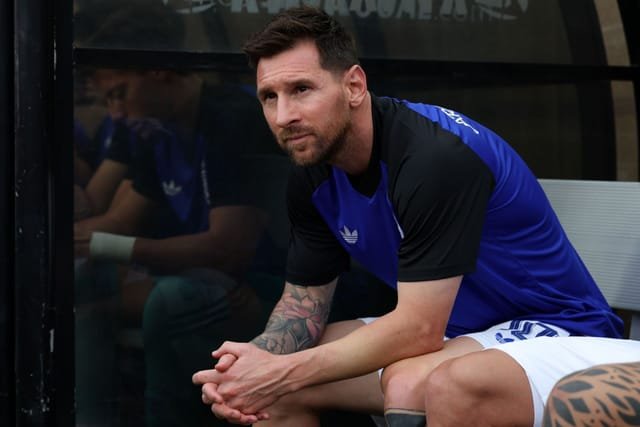
While Diallo’s admiration for Messi is unconditional, the 38-year-old’s preparation for Argentina’s title defence has been complicated by a hamstring injury that has cast uncertainty over his availability for the early stages of the tournament.
During the final match before the MLS break to accommodate the World Cup, Messi requested to be substituted off after clutching his hamstring. Inter Miami confirmed the substitution was taken as a precautionary measure, but the injury required ongoing rehabilitation work through the period when Argentina assembled their tournament squad.
When Argentina began their World Cup training camp in Kansas City, Messi was initially working separately from the main group as part of his rehabilitation program. The more positive news arrived before the warm-up match against Honduras: he had rejoined group training, which represented a meaningful step in his recovery timeline.
Argentina secured a 2-0 win over Honduras in that first pre-tournament friendly, with goals from Lautaro Martinez and Giuliano Simeone. Messi remained an unused substitute throughout the match, with manager Lionel Scaloni making no move to introduce him even as the result was already settled. The decision was clearly a conservative one, prioritizing his readiness for the tournament over any risk of setback in a meaningless preparatory game.
Argentina face Iceland in their final warm-up friendly before the tournament begins, and the expectation is that Scaloni will look to give Messi some playing time in that match, building his fitness and match sharpness before the campaign opens in earnest.
| Date | Match / Event | Messi Status |
|---|---|---|
| Pre-camp (MLS) | Final MLS match before World Cup break | Substituted off with hamstring concern (precautionary) |
| Training camp start | Argentina World Cup camp, Kansas City | Training separately for rehabilitation |
| Pre-Honduras | Training camp progression | Rejoined group training |
| vs. Honduras | First pre-World Cup friendly (2-0 Argentina win) | Unused substitute |
| vs. Iceland (upcoming) | Final pre-tournament warm-up | Expected to feature; minutes targeted |
| June 16 | Argentina vs. Algeria (Group J opener) | Expected to start if fitness confirmed |
Argentina’s Group J Campaign: The Path to Defending the Title
The reigning world champions have a manageable but not trivial group stage draw. After their opener against Algeria on June 16, Argentina face Austria on June 22 and Jordan on June 27 to complete their Group J campaign.
Algeria represent the most competitive challenge of the three, with a squad that has developed significantly in recent years and the motivation to make an impression against the defending champions in what would be a globally watched opening match. Austria have demonstrated consistency at European level in recent cycles and cannot be dismissed as straightforward opposition. Jordan, competing at a World Cup they qualified for on merit, will approach every match as a team with nothing to lose and everything to gain.
For Argentina, the priority across all three matches is to navigate the group with Messi healthy and building toward the knockout stages. The talent around him in this squad, including Martinez, Simeone, and the broader depth that Scaloni has assembled, means Argentina are not dependent on Messi functioning at peak capacity to win group games. But reaching the final and competing for the title is a different equation, and nobody on that squad or in that technical staff needs reminding of what Messi contributes when he is fit and fully engaged.
The Weight of the Number Eight: Messi at 38 and the Final Chapter
Lionel Messi is 38 years old. He has won eight Ballon d’Or awards. He has a World Cup winner’s medal. He has achieved more in the sport than almost any human being who has ever played it. And he is preparing to defend a World Cup title on the biggest stage in football, with a hamstring injury and the accumulated physical demands of a career spanning nearly two decades of elite-level competition.
The question of what Messi can contribute at 38, even allowing for his extraordinary physical maintenance and the adjustments he has made to his game as he has aged, is a legitimate one. He is not the Messi of 2012 or even 2022. His game has evolved from explosive direct running to a more positional, distributive role that leverages his reading of the game, his touch, and his ability to create and finish in tight spaces.
But for players like Amad Diallo, who grew up watching Messi redefine what was possible in football, the specifics of his current physical capacity are secondary to what he represents. He is the player who made an entire generation of footballers believe that the best possible version of their sport was something worth dedicating your life to reaching. That is what an idol is. That is what Diallo was communicating in four words.
Conclusion: A Young Player’s Idol, and a Story Still Being Written
Amad Diallo will step onto a World Cup pitch for the first time this summer carrying the Ivory Coast’s hopes and his own ambitions for a competition he has dreamed about since childhood. He will do so inspired by a player who showed the world that perseverance, craft, and an unwillingness to accept anything less than the very best from yourself can eventually produce the most complete possible version of a career.
Lionel Messi, meanwhile, will attempt to do something that has been done only twice in the history of the tournament: win it as the defending champion. He will do so at 38, managing a hamstring rehabilitation, and carrying the expectations of a nation that has already watched him achieve the impossible once.
Both men arrive at the 2026 World Cup with something to prove and something to celebrate. And for one of them, the other will always be the answer to the question of which player the tournament brings to mind.
Because he’s his idol. Four words. No elaboration needed.
For breaking news and live news updates, like us on Facebook or follow us on Twitter and Instagram. Read more on Latest Sports on thefoxdaily.com.

COMMENTS 0