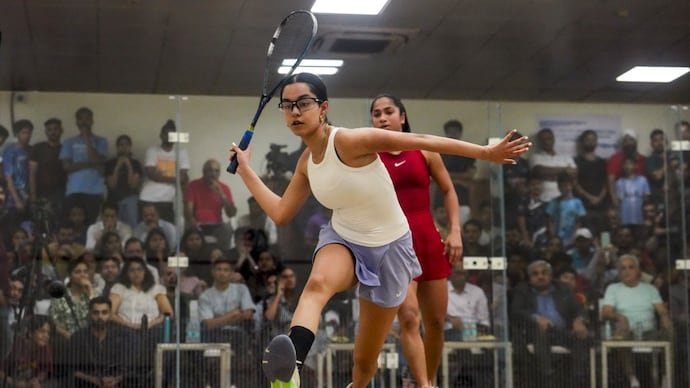
Indian squash may be on the verge of witnessing one of the most significant moments in its history. Teenage sensation Anahat Singh has stormed into the final of the World Junior Squash Championships, becoming the first Indian player since Joshna Chinappa in 2005 to reach the title clash of the prestigious tournament.
The achievement is far bigger than a single match victory. It represents the continued rise of a new generation of Indian squash talent and highlights the growing strength of the country’s development system in a sport long dominated by Egypt.
By defeating Egypt’s Barb Sameh in the semifinal, Anahat not only secured a place in the championship match but also ended a 21-year wait for an Indian finalist at the event. Now, she stands just one victory away from becoming the first Indian ever to win the World Junior Squash Championships.
Anahat Singh’s Historic Run at the World Junior Squash Championships
Entering the tournament as the top seed, Anahat carried significant expectations. However, rather than feeling burdened by the pressure, she has embraced the challenge with remarkable maturity.
Her semifinal victory showcased the qualities that have made her one of the most exciting young athletes in world squash.
After taking the opening game convincingly, she faced resistance when Barb Sameh responded strongly to level the match. Many young players struggle when momentum shifts, but Anahat demonstrated composure beyond her years.
She quickly regained control through intelligent shot selection, superior court coverage, and relentless attacking intent, ultimately securing a four-game victory and a place in the final.
| Semifinal Result | Score |
|---|---|
| Anahat Singh vs Barb Sameh | 11-3, 8-11, 11-4, 11-6 |
| Outcome | Anahat Singh advanced to the final |
Why This Achievement Matters for Indian Squash
The significance of Anahat’s achievement extends well beyond individual success.
For more than two decades, Indian squash has consistently produced talented players capable of competing at the highest level. Legends such as Saurav Ghosal, Dipika Pallikal, Joshna Chinappa, and Harinder Pal Sandhu helped establish India’s credibility on the international stage.
However, winning a World Junior Championship has remained one of the few major milestones that Indian squash has yet to achieve.
Anahat now has the opportunity to change that.
A title victory would represent:
- India’s first World Junior Squash Championship crown.
- A major breakthrough for women’s squash in India.
- Validation of India’s junior development programs.
- Increased visibility for squash among young athletes.
- A significant boost ahead of future international competitions.
In many sports, junior world titles often serve as indicators of future elite success. While nothing is guaranteed, reaching this stage demonstrates that Anahat possesses the skill set required to compete against the world’s best players.
Ending a 21-Year Wait Since Joshna Chinappa
One of the most remarkable aspects of Anahat’s achievement is the historical context surrounding it.
The last Indian player to reach the World Junior Squash Championships final was Joshna Chinappa in 2005. Chinappa later became one of India’s greatest squash players, inspiring a generation of athletes and helping elevate the sport nationally.
For 21 years, no Indian player managed to replicate that accomplishment.
Anahat’s run therefore bridges two important eras in Indian squash:
| Year | Indian Achievement |
|---|---|
| 2005 | Joshna Chinappa reaches final |
| 2025 | Anahat wins bronze medal |
| 2026 | Anahat reaches final |
The progression also demonstrates her steady improvement at the tournament. After previously falling short in the quarterfinals and semifinals and later securing bronze, she has now taken another major step forward.
The Egyptian Challenge Standing in Her Way
Although reaching the final is a major accomplishment, the toughest challenge may still lie ahead.
Anahat will face Egypt’s Ruqayya Salem in the championship match.
Egypt’s dominance in world squash is unparalleled. Over the last two decades, Egyptian players have transformed the sport through extraordinary technical ability, athleticism, and competitive depth.
At both junior and senior levels, Egypt consistently produces world champions.
This means Anahat’s final will be more than a battle between two talented teenagers. It will represent a clash between one of squash’s most dominant sporting systems and an Indian player seeking to create history.
What Makes Anahat Singh Special?
Elite athletes often reveal their potential long before reaching adulthood, and Anahat has been viewed as a future star for several years.
Her rapid rise can be attributed to several key strengths:
- Exceptional movement around the court.
- Strong tactical awareness.
- Consistency under pressure.
- Aggressive but controlled shot-making.
- Mental resilience during difficult moments.
These qualities were evident throughout her semifinal victory.
Even when momentum briefly shifted in favor of her opponent, she remained calm and focused on executing her game plan.
That ability to respond positively under pressure often separates good players from future champions.
From Promising Talent to Global Contender
Perhaps the most exciting aspect of Anahat’s journey is that she is already competing successfully at the professional level while still eligible for junior competition.
Her rise on the PSA Tour has been equally impressive.
Currently ranked among the world’s top players, she has collected multiple professional titles and gained valuable experience against senior competitors.
This dual exposure provides several advantages:
- Higher-quality match experience.
- Greater tactical development.
- Improved physical conditioning.
- Enhanced mental toughness.
- Confidence against elite opposition.
Many successful champions follow a similar pathway, balancing junior dominance with early professional development.
The Growing Strength of Indian Women’s Squash
Anahat’s success also reflects a broader trend within Indian squash.
Over the last two decades, Indian women’s squash has experienced significant growth.
Players such as Joshna Chinappa and Dipika Pallikal helped establish a foundation that inspired younger athletes to pursue the sport seriously.
The impact of those pioneers is now becoming increasingly visible.
Young Indian players are entering international tournaments with greater confidence, better coaching support, and improved access to world-class training environments.
Anahat represents the latest and perhaps most exciting example of this evolution.
Why Junior World Titles Matter
While senior championships ultimately define careers, junior world events often serve as important indicators of future excellence.
Many of squash’s greatest champions first announced themselves through outstanding performances at junior world tournaments.
Success at this level demonstrates the ability to:
- Handle international competition.
- Perform under pressure.
- Adapt to different playing styles.
- Maintain consistency throughout a tournament.
- Compete against the world’s best young talents.
Regardless of the final result, Anahat has already shown she belongs among the sport’s most promising future stars.
The Mental Side of Her Success
One detail that stands out from Anahat’s post-match comments is her perspective.
Despite reaching the biggest final of her junior career, she emphasized that the tournament was not over.
That mindset reflects a hallmark of elite performers.
Rather than becoming satisfied with reaching the final, she remains focused on the ultimate objective.
Champions often distinguish themselves through their ability to stay present and avoid becoming distracted by the magnitude of the occasion.
Anahat’s comments suggest she understands that principle remarkably well for an 18-year-old athlete.
What a Title Would Mean for Indian Sport
If Anahat wins the final, the implications could extend far beyond squash.
India has increasingly emerged as a multi-sport nation, producing elite athletes across badminton, wrestling, boxing, shooting, athletics, chess, and hockey.
A World Junior Squash Championship title would add another milestone to that growing list.
It could also:
- Increase grassroots participation.
- Attract greater sponsorship support.
- Improve infrastructure investment.
- Create new role models for young players.
- Raise India’s profile in global squash.
Major sporting breakthroughs often inspire future generations, creating long-term benefits that extend well beyond a single tournament.
Future Outlook: A Star on the Rise
Regardless of the outcome of the final, Anahat Singh’s future appears exceptionally bright.
At just 18 years old, she has already established herself as one of the most promising talents in international squash. Her combination of technical skill, athletic ability, and competitive maturity suggests she could become a major force in the professional game over the coming years.
The challenge now will be continuing her development while managing the expectations that inevitably accompany success.
Conclusion
Anahat Singh’s run to the World Junior Squash Championships final represents one of the most significant achievements in recent Indian squash history. By becoming the first Indian finalist in 21 years, she has already secured her place in the tournament’s history and provided a major boost to the sport in India.
Yet the biggest opportunity still lies ahead. One victory against Egypt’s Ruqayya Salem would make Anahat the first Indian ever to win the World Junior Squash Championships, a milestone that could transform the landscape of Indian squash.
Whether she lifts the trophy or not, her journey in Canada has confirmed what many observers already believed: Indian squash has found a new star capable of competing with the very best in the world.
For breaking news and live news updates, like us on Facebook or follow us on Twitter and Instagram. Read more on Latest Sports on thefoxdaily.com.


COMMENTS 0