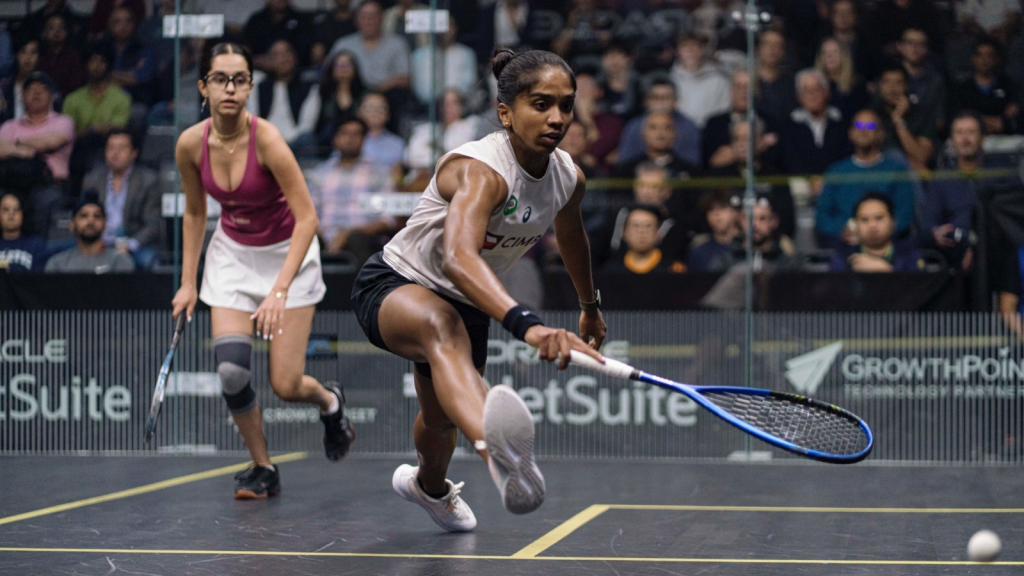
India’s rising Squash star Anahat Singh produced another impressive run at the Silicon Valley Open before running into a familiar obstacle in the semifinals. Malaysia’s Sivasangari Subramaniam recovered from a slow start to defeat the 18-year-old 5-11, 11-6, 11-4, 11-7 in 37 minutes, extending her winning streak against the Indian to four consecutive matches.
Anahat entered the semifinal after defeating Egypt’s eight-time world champion Nour El Sherbini and fellow Egyptian Salma Hany in the earlier rounds. Those victories demonstrated her ability to challenge established names on the professional circuit, but Sivasangari presented a different tactical challenge.
The Malaysian, ranked world No. 4 in the supplied report, adjusted her game after losing the opening game and gradually took control of the contest. Her disciplined play from the back of the court limited Anahat’s opportunities to attack, allowing her to win three successive games and secure a place in the final.
Although the defeat ended Anahat’s campaign, the result was not without significance for Indian squash. The junior world champion recorded her best-ever finish at a Professional Squash Association (PSA) Gold-level tournament, an important milestone as she continues to develop against higher-ranked opponents.
How Sivasangari Turned the Semifinal Around
The semifinal began with Anahat taking the initiative. Sivasangari appeared short of her usual rhythm in the opening game, leaving gaps that the Indian exploited with aggressive shot-making and clever use of the front of the court.
Anahat used sharp drops and boasts to force her opponent into difficult positions. In squash, a boast sends the ball off a side wall before it reaches the front wall, creating angles that can make retrieval more demanding. When executed well, the shot can pull an opponent away from the ideal position and open space elsewhere on the court.
The Indian’s early attacking approach worked particularly well because Sivasangari was not yet establishing the consistent structure that usually characterises her game. Anahat created six game balls and converted the second to take the opening game 11-5.
The start suggested that the teenager could make the Malaysian uncomfortable by playing at a high tempo and preventing her from settling into longer rallies. However, maintaining that advantage against a player of Sivasangari’s quality required more than an explosive opening.
Game Two: The Malaysian Finds Her Rhythm
Sivasangari responded by improving her shot selection and using the full court more effectively. Rather than relying on individual attacking shots, she began building rallies with greater patience, moving Anahat around and reducing the space available for direct attacks.
The tactical adjustment changed the balance of the match. Anahat was pushed farther back than she would have preferred, making it harder for her to attack the front of the court consistently.
When a player is forced to retrieve from the back, attempting a delicate attacking shot can become riskier. The ball may sit too high, the angle may be less favourable, or the opponent may have enough time to anticipate the response. Anahat began making errors as she tried to create opportunities from less comfortable positions.
Sivasangari capitalised on those mistakes and took the second game 11-6. More importantly, she had established a pattern that would shape the rest of the semifinal: use consistent length, control the middle of the court and wait for Anahat to attempt an increasingly difficult attacking shot.
Why Anahat Singh Struggled Against Sivasangari
Anahat is known for her attacking instincts and ability to use angles to unsettle opponents. Her early performance showed why that approach can be effective, even against a player ranked among the world’s best.
However, attacking squash depends heavily on creating the right conditions. A player must move the opponent away from the ball, establish a favourable position and then choose a shot that is difficult to retrieve. When the opponent controls the rally from the back of the court, those opportunities become less frequent.
Sivasangari gradually denied Anahat the time and space needed to launch her preferred attacks. Her consistency meant that the Indian had to work harder for openings, while the Malaysian could concentrate on maintaining court position and extending rallies until an opportunity appeared.
The distinction between the two approaches became clearer in the third game. Anahat continued to show flashes of excellent angle play, but those moments were less frequent than in the opener. Sivasangari maintained pressure from the back and prevented her opponent from establishing a sustained attacking rhythm.
The Malaysian won the third game 11-4, moving one game away from victory.
Consistency Proves More Effective Than Risky Attacks
The semifinal illustrated a familiar tactical challenge in squash: an aggressive player may produce spectacular winners, but a more consistent opponent can neutralise that threat by controlling the rally’s length and direction.
For Anahat, the problem was not a complete inability to find attacking opportunities. Rather, she struggled to create them often enough once Sivasangari settled into the contest.
When the Indian attempted to force openings from defensive positions, the margin for error narrowed. Shots that might have been effective earlier in the match became easier to anticipate or failed to reach the intended target.
Sivasangari’s approach also reduced the value of Anahat’s strongest weapon: her ability to change the direction of a rally with a sudden attacking shot. By keeping the ball deep and maintaining control of the central area, the Malaysian made it more difficult for the teenager to move forward and take the initiative.
This does not mean Anahat must abandon her attacking style. Instead, the match offers a useful indication of the tactical adjustments she may need against opponents who can absorb pressure without losing their structure.
Fourth Consecutive Win Extends Sivasangari’s Dominance
The semifinal result marked Sivasangari’s fourth consecutive victory over Anahat, reinforcing the Malaysian’s status as a particularly difficult opponent for the Indian teenager.
Their contrasting styles help explain the challenge. Anahat looks to create openings through attacking shots and sharp changes of angle, while Sivasangari demonstrated the ability to use measured all-round play and consistent length to restrict those opportunities.
The supplied report also contrasts the semifinal with the pair’s meeting in the Asian Games final, where Anahat’s performance had followed a different pattern. In California, the Indian began strongly, but Sivasangari’s tactical adjustment prevented that momentum from carrying through the match.
Repeated defeats against the same opponent can offer valuable information for a developing player. They reveal not only the areas in which an opponent is stronger but also the situations in which a particular game plan stops working.
For Anahat, the challenge will be to identify ways to disrupt Sivasangari’s rhythm without sacrificing the attacking qualities that make her dangerous. That could involve improving the depth of her defensive shots, choosing more selective moments to attack and finding ways to regain the front of the court during extended rallies.
These are tactical considerations rather than confirmed changes to her training programme. The semifinal provides evidence of the problems she faced, but it does not establish what adjustments she or her coaching team will make next.
Anahat’s Best-Ever PSA Gold-Level Finish Marks Progress
Despite missing out on the final, Anahat left the Silicon Valley Open with a significant personal achievement. Her semifinal appearance represented her best-ever finish at a PSA Gold-level tournament.
Gold-level events form part of the professional squash tour’s tournament structure and provide opportunities for players to compete against established international opponents. Reaching the latter stages requires a player to navigate multiple matches and maintain performance across different tactical challenges.
Anahat’s route to the semifinals was particularly noteworthy because it included victories over two experienced Egyptian players. Beating Nour El Sherbini, an eight-time world champion according to the supplied report, was a significant test of her ability to compete against elite opposition. Her subsequent win over Salma Hany carried her into the final four.
Those victories provide a broader measure of her performance than the semifinal defeat alone. While Sivasangari exposed areas in which Anahat can improve, the earlier rounds demonstrated that she can produce results against high-level opponents.
The next step is to translate that ability into more consistent performances across an entire tournament. A strong opening game is valuable, but matches against experienced players often require tactical flexibility when the initial plan stops working.
For a young player, the difference between reaching a semifinal and progressing to a final can come down to how effectively she responds when an opponent changes the pattern of a contest. The Silicon Valley Open provided Anahat with precisely that kind of test.
Right-Knee Strapping Raises a Question but Does Not Explain the Defeat
Anahat played the semifinal with strapping around her right knee, reportedly following an awkward fall during her quarterfinal match against Salma Hany.
The strapping was visible, but the supplied report indicated that it did not appear to have a clear impact on her movement around the court. Anahat made a strong start and was able to execute her attacking game effectively during the opening stages.
It would therefore be premature to attribute the loss to an injury. The match’s progression showed a clear tactical shift after the first game, with Sivasangari improving her consistency and controlling the rallies more effectively.
At the same time, the presence of knee strapping is a relevant detail because squash places considerable physical demands on players. Rapid changes of direction, lunges and repeated movements towards the front and back of the court require strength, balance and mobility.
Without further information about the condition of Anahat’s knee, however, its significance cannot be established. The available details do not confirm the severity of any injury or whether it affected her preparation for the semifinal.
Sivasangari Reaches Another Final in California
While Anahat’s campaign ended in the semifinals, Sivasangari continued her strong run in California by reaching a second consecutive final in the state, according to the supplied report.
Her recovery after losing the first game demonstrated her ability to make adjustments during a match. Rather than allowing Anahat’s early aggression to dictate the contest, she returned to a more controlled approach and gradually reduced the Indian’s attacking opportunities.
That response was central to the result. Sivasangari did not need to dominate every rally from the beginning. She needed to recognise why the opening game had gone against her and change the conditions under which the points were being played.
After winning the semifinal, the Malaysian praised Anahat’s ability and attacking threat. She acknowledged that the Indian had already beaten several top players and described herself as pleased with the way she recovered from a slow start to finish the match in four games.
The comments recognised both the challenge Anahat posed and the importance of Sivasangari’s own adjustment. The victory was not simply a consequence of the opening game’s result being reversed; it was built on a change in consistency and court control.
What the Silicon Valley Open Result Means for Indian Squash
Anahat’s semifinal exit presents a mixed but encouraging picture. She showed that she could defeat experienced international opponents and reach the last four of a Gold-level event, while the loss to Sivasangari highlighted the difficulty of sustaining an attacking game against a player capable of controlling rallies.
For Indian squash, the result offers a reason to follow her progress without treating a single tournament as a definitive measure of her future. Development at the professional level involves learning to handle different playing styles, managing physical demands and finding solutions when an opponent successfully neutralises a preferred tactic.
The match also demonstrates why head-to-head records can matter. Sivasangari’s fourth straight win gives her a clear recent advantage in this particular matchup, but it does not mean future contests are predetermined. Changes in fitness, tactical preparation and match execution can alter the outcome of subsequent meetings.
Anahat’s next opportunity will be to build on the positives from her run while addressing the problems exposed in the semifinal. Her wins over El Sherbini and Hany show that she can compete against formidable opposition; the contest with Sivasangari showed how much precision and patience are required to turn that ability into a place in the final.
The Silicon Valley Open ultimately ended with Sivasangari advancing and Anahat bowing out, but the two players leave the tournament with different measures of progress. The Malaysian strengthened her record against a recurring rival and secured another final appearance in California. Anahat, meanwhile, achieved the best result of her career at a PSA Gold-level event and gained another opportunity to learn from one of the tour’s most challenging opponents.
For breaking news and live news updates, like us on Facebook or follow us on Twitter and Instagram. Read more on Latest Sports on thefoxdaily.com.






COMMENTS 0