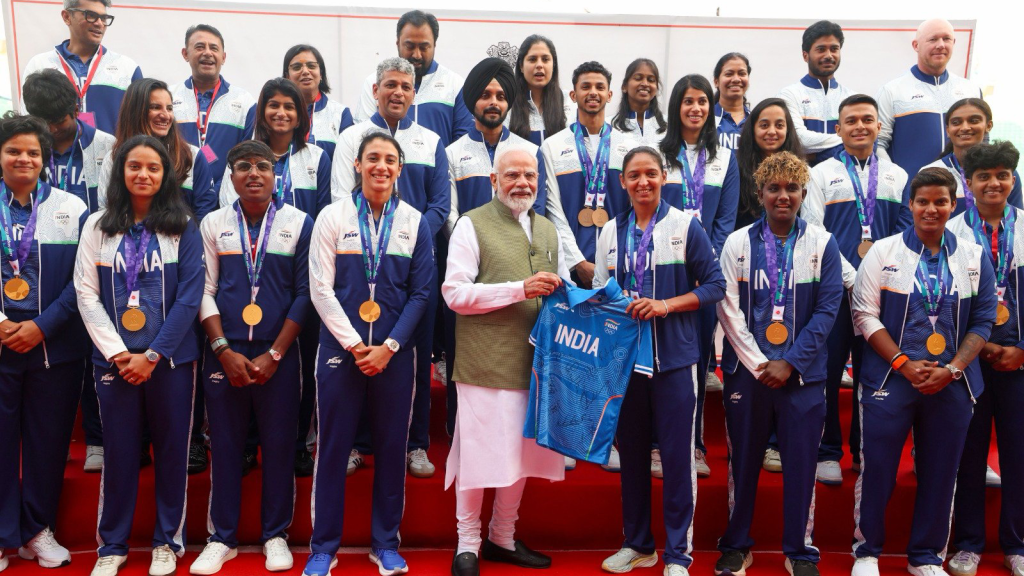
Prime Minister Narendra Modi has urged India’s Asian Games medal-winners to visit schools, playgrounds and their hometowns to inspire the next generation of athletes. Addressing the country’s sporting stars at a felicitation ceremony in New Delhi on Thursday, October 15, Modi emphasised that athletes with international experience have a responsibility to encourage young people who dream of representing India.
India’s contingent returned from the Asian Games in Aichi-Nagoya with 85 medals, including 21 gold. While the overall tally was lower than the 106 medals secured at the previous edition in Hangzhou, the performance of debutants offered encouragement, with first-time participants contributing 41 medals.
Modi’s message went beyond celebrating these achievements. He asked the medal-winners to share their experiences with children, particularly those who are beginning their sporting journeys, and highlighted the importance of inspiring young talent as India pursues its ambition of hosting the 2036 Olympic Games.
PM Modi Asks Asian Games Medal-Winners to Inspire Young Athletes
During his interaction with the medal-winning contingent, Modi encouraged athletes to reconnect with the places where their sporting journeys began. He said their international experience could help young players understand what it takes to pursue their ambitions and compete at the highest level.
Addressing the athletes, the Prime Minister said: “We should also take the responsibility of helping the younger generation flourish. All of you now have international experience. That’s why I want to urge you to spend some time with young kids who dream the same dreams you did when you were young.”
He also asked them to visit schools and local playgrounds whenever possible, stressing that even a brief interaction could influence a child’s attitude towards sport.
“Whenever you get the chance, meet kids from your village or city. Go and visit schools. Definitely go to the playgrounds where you started playing. Your experiences might help those kids. Maybe one small thing you say might inspire a kid to get serious about sport.”
The appeal places the spotlight on the role established athletes can play beyond competition. By sharing their personal experiences, medal-winners can give aspiring players examples of how sporting ambitions can develop into opportunities to compete internationally.
Why Modi Wants Athletes to Visit Schools and Playgrounds
Modi’s request centres on the potential influence of athletes who have already experienced international competition. Young players often begin their sporting journeys in school competitions, neighbourhood playgrounds and local training environments. Meeting someone who has progressed from similar beginnings to winning medals on a major international stage can make those ambitions feel more achievable.
The Prime Minister specifically mentioned villages, cities and schools, encouraging athletes to connect with children in the communities where they grew up. His message suggests that inspiration does not always require a formal programme or a lengthy speech. A personal story, a practical lesson or an account of overcoming difficulties could encourage a young athlete to take sport more seriously.
His appeal also highlights the responsibility that accompanies sporting success. Medal-winners have gained experience that younger players may not yet possess, including an understanding of international competition and the commitment required to reach that level. Sharing those experiences can help the next generation learn from athletes who have already travelled that path.
For India, developing young talent is particularly relevant as the country seeks to strengthen its position in international sport. Encouraging children to participate, helping them recognise sporting opportunities and connecting them with successful athletes are all part of the broader conversation about building a stronger sporting culture.
PM Modi Praises India’s Female Athletes for Their Medal Contribution
Alongside his appeal to inspire young players, Modi singled out India’s women athletes for their contribution to the country’s Asian Games performance. Female competitors accounted for 38 of India’s 85 medals, including 11 gold medals.
“I especially want to congratulate our women athletes, they contributed 38 medals to our tally and 11 of those medals were gold,” Modi said at the ceremony held at the Major Dhyan Chand Stadium in New Delhi.
The recognition highlighted the important role women played in India’s medal-winning campaign. Their achievements also provide examples for younger athletes who are considering competitive sport and looking for role models across different disciplines.
The Prime Minister’s remarks placed the achievements of the women’s contingent within the wider success of Indian sport. Their medal contributions formed a substantial part of the national tally and reinforced the importance of recognising athletes across disciplines.
India Wins 85 Medals at the Asian Games, Including 21 Gold
India finished the Asian Games with 85 medals, comprising 21 gold medals and a total that was below the 106 medals won at the previous edition in Hangzhou.
Although the overall count declined, the contribution of debutants stood out. Athletes competing at the Games for the first time won 41 medals, providing an encouraging sign for India’s future sporting campaigns.
The performance also brought together athletes from a wide range of sports, including cricket, hockey, kabaddi, archery and golf. Their achievements were recognised at the New Delhi ceremony, where the Prime Minister met members of the contingent and posed for photographs with the medal-winners.
The results offer a broader picture of India’s sporting development: established athletes continued to contribute, while newcomers also demonstrated their ability to compete successfully at the international level.
Modi’s call for medal-winners to engage with young athletes connects these results with the challenge of sustaining progress. The achievements of the current generation, he indicated, should also help motivate those hoping to represent India in future competitions.
India’s Ambition to Host the 2036 Olympic Games
Modi reiterated India’s ambition to host the Olympic Games in 2036, describing the country as an emerging destination for international sporting events.
“India is emerging in establishing itself as a credible and hospitable country for international sports events. We are bidding for 2036 Olympics and it is our resolve that we will host the games,” Modi said.
The statement underlined the government’s ambition to bring one of the world’s biggest sporting events to India. Hosting the Olympics would require the country to demonstrate its ability to stage an event involving athletes and teams from across the globe.
In that context, developing the next generation of Indian athletes remains an important part of the wider sporting conversation. Encouraging children to participate in sport and learn from established medal-winners could help strengthen the culture surrounding competitive athletics.
Modi’s request to visit schools and playgrounds was therefore closely connected to his broader message about India’s sporting future. The country’s international ambitions depend not only on hosting events but also on continuing to identify, support and develop athletes capable of competing at the highest level.
Asian Games Medal-Winners Present Special Memorabilia to PM Modi
The felicitation ceremony also featured presentations from members of the medal-winning contingent. Modi posed for photographs with the athletes and received memorabilia representing their achievements across different sports.
One of the notable presentations came from 17-year-old recurve archer Kumkum Mohod. She presented the Prime Minister with a bow after winning three medals at the Asian Games: gold in the individual event, gold in the women’s team event and silver in the mixed team event.
Her performance made her one of the young athletes whose achievements reflected the contribution of emerging talent to India’s campaign. Her presence at the ceremony also complemented Modi’s message about encouraging younger generations to pursue sporting ambitions.
Former India captain Harmanpreet Kaur presented Modi with a jersey signed by the medal-winning team. The Indian cricket team had won gold at the Asian Games, and the signed jersey served as a memento of that achievement.
Golfer Pranavi Urs also presented the Prime Minister with her glove and a golf ball displayed in a frame, adding another sporting discipline to the collection of memorabilia presented during the interaction.
The presentations offered a personal dimension to the ceremony, bringing together athletes from different sports to celebrate India’s performance and share reminders of their journeys to the international stage.
Senior Sports Officials Accompany India’s Medal-Winning Contingent
The contingent was accompanied by senior representatives from their respective sporting organisations. Among those present were International Cricket Council chairman Jay Shah and Indian Olympic Association president P. T. Usha.
The participation of officials from India’s sporting bodies reflected the broad representation at the event. Athletes from multiple disciplines gathered with their governing-body representatives as the Prime Minister acknowledged their achievements.
The ceremony also provided an opportunity to discuss the future of Indian sport, with Modi urging successful athletes to become role models for children and reiterating the country’s intention to host the 2036 Olympics.
What Modi’s Message Means for the Next Generation of Indian Athletes
The Prime Minister’s appeal places athletes in a position to influence young people who may be at the beginning of their sporting careers. By returning to their schools, hometowns and playgrounds, medal-winners can offer encouragement grounded in their own experiences.
Such interactions can help children understand that international sporting achievements often begin with small steps. A young player might start by joining a school team or practising in a local playground before progressing to more competitive levels.
Meeting successful athletes can also expose children to different sporting disciplines and demonstrate that opportunities exist beyond the sports they commonly see. India’s Asian Games contingent included medal-winners from cricket, hockey, kabaddi, archery and golf, among other sports.
Modi’s message was ultimately a call for athletes to share their success rather than keep their experiences within the world of elite competition. Their stories, he suggested, could encourage children to pursue their goals and take their interest in sport more seriously.
As India continues to pursue its Olympic ambitions, the challenge will be to turn inspiration into sustained opportunities for young players. The medal-winners’ experiences can help spark that interest, while the country’s wider sporting ecosystem will be important in supporting athletes as they develop.
Frequently Asked Questions
Why did PM Narendra Modi ask Asian Games medal-winners to visit schools and playgrounds?
Modi urged medal-winners to meet young athletes and share their experiences. He believes their stories could inspire children to take sport seriously and pursue their sporting ambitions.
How many medals did India win at the Asian Games?
India won 85 medals, including 21 gold medals, at the Asian Games.
How many medals did India’s female athletes contribute?
According to Modi, India’s women athletes contributed 38 medals to the national tally, including 11 gold medals.
How many medals did India’s Asian Games debutants win?
Athletes making their Asian Games debut won 41 medals for India.
What is India’s ambition regarding the 2036 Olympics?
India is bidding to host the 2036 Olympic Games. Modi reiterated the country’s resolve to host the event and described India as an emerging destination for international sports competitions.
What did Kumkum Mohod present to PM Modi?
Seventeen-year-old recurve archer Kumkum Mohod presented Modi with a bow. She won two gold medals and one silver medal at the Asian Games.
Conclusion
PM Narendra Modi’s message to India’s Asian Games medal-winners was about making sporting success meaningful for the next generation. He encouraged athletes to visit their hometowns, schools and former playgrounds to share their experiences with children who dream of competing internationally.
With India having won 85 medals at the Games and reaffirmed its ambition to host the 2036 Olympics, the Prime Minister’s appeal highlighted the importance of nurturing young talent. The achievements of today’s medal-winners, he suggested, could become a source of motivation for tomorrow’s sporting stars.
For breaking news and live news updates, like us on Facebook or follow us on Twitter and Instagram. Read more on Latest Sports on thefoxdaily.com.



COMMENTS 0