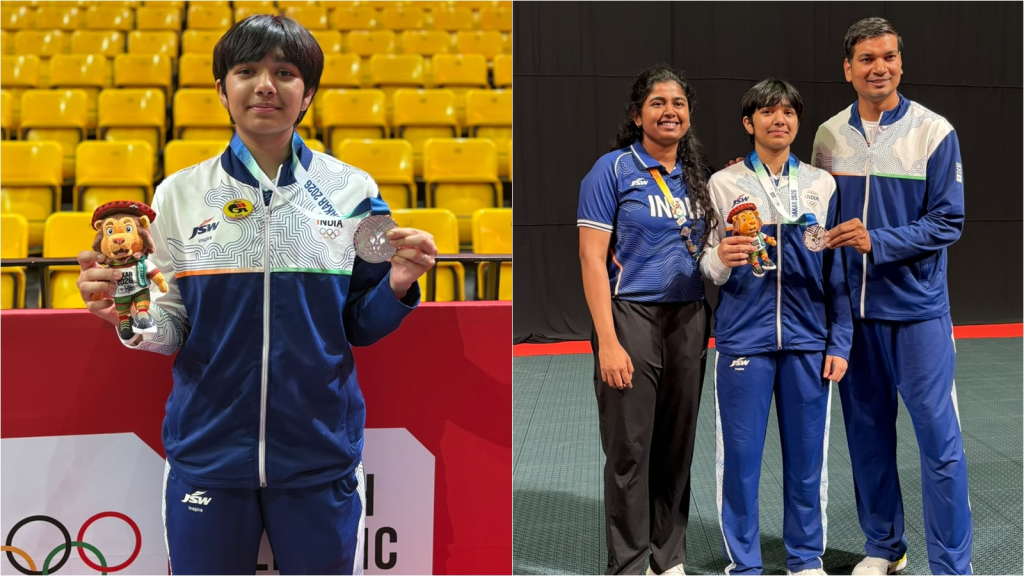
Indian badminton teenager Tanvi Patri‘s silver medal at the Youth Olympics came after a remarkable performance on court, but her journey to Dakar, Senegal, was filled with challenges away from the game. Long travel schedules, illness, mosquitoes and rooms without air conditioning added to the difficulties faced by the 15-year-old during the tournament.
Tanvi narrowly missed out on the gold medal after an 82-minute final against China’s Junior World Champion Zang Yi Xin. She fought back from 10-19 down in the deciding game and saved six match points before eventually losing 21-15, 13-21, 24-26.
Her performance earned widespread praise, but her father, Rabinarayan Patri, believes the focus should not be limited to celebrating the result. He has highlighted the importance of athlete comfort, better travel arrangements, proper nutrition and adequate rest, arguing that unnecessary logistical difficulties can affect young players’ performances.
Tanvi Patri’s Youth Olympics silver follows a demanding final
Tanvi’s three-game battle against 17-year-old Zang Yi Xin was one of the standout moments of her Youth Olympics campaign. Despite facing an opponent who holds the Junior World Champion title, the Indian teenager continued fighting even when she appeared close to defeat.
Trailing 10-19 in the deciding game, Tanvi produced a determined comeback and saved six match points. However, Zang eventually secured the victory, winning 21-15, 13-21, 24-26.
For Rabinarayan Patri, the silver medal was an expected milestone rather than a reason for an extended celebration. He believes his daughter has a long journey ahead and should remain focused on future goals rather than becoming satisfied with early achievements.
“Silver was expected, so that’s ok,” Rabi said.
He also expressed concern about the conditions surrounding the tournament, particularly the time Tanvi spent travelling to international competitions.
“Her total travel time to World Juniors in Egypt was 28 hours. For the Youth Olympics, it was 44. Complaining never helps and I can’t blame anyone, but if we don’t look at comfort of athletes from this generation, they get irritated and it doesn’t work,” Rabi said.
Travel fatigue and accommodation problems in Dakar
According to her father, Tanvi’s journey to the Youth Olympics took approximately 44 hours from Bengaluru to Dakar. The extended transit, combined with administrative delays and difficult accommodation conditions, created additional pressure during an important international competition.
Tanvi contacted her father on the first day of the Games to report mosquitoes in the accommodation and the absence of air conditioning in the rooms. These conditions became another source of discomfort for the young athlete as she prepared for her matches.
Her father said she had developed considerable endurance through training in Odisha, where she experienced temperatures reaching 50 degrees and intense humidity. However, he believes that athletes should not have to deal with avoidable discomfort during major competitions.
“She would train with temperatures reaching 50 degrees and insane humidity which built her endurance. She won’t shy away from hard work. But at Dakar, she called up on Day 1 to say there were mosquitoes and no A/C in the rooms. And the long travel really affects her,” Rabi added.
He later brought additional supplies, including All-Out and mosquito repellents, to help her manage the problem. Tanvi had also settled into the accommodation, although her triple-layered blanket and bedsheet were reportedly stolen from the Games Village.
Rabi said there was little value in repeatedly complaining about the situation and stressed the importance of being prepared for unexpected problems.
Illness and difficult travel before the World Junior Championships
Tanvi’s travel difficulties were not limited to the Youth Olympics. She had already experienced a demanding journey ahead of the Badminton World Junior Championships, held from October 5 to 17.
According to her father, funding arrangements for the event did not come through on time, forcing the Indian squad to make last-minute travel arrangements. The journey from Guwahati to Delhi alone took between 12 and 15 hours.
After reaching Delhi, the team faced another six to seven hours on the main flight, followed by a wait of approximately four and a half hours at the airport for transport arranged by the organisers. Rabi said the players had no food or water during that wait.
He believes the combination of long travel and a lack of basic refreshments affected Tanvi’s health. She became dehydrated and subsequently suffered from a fever for seven days.
“First the journey from Guwahati to Delhi went 12-15 hours, then 6-7 hours main flight, and then they waited at airport for organisers transport without food or water. She got dehydrated and ran fever for 7 days,” he recalled.
The illness meant Tanvi was already dealing with physical challenges before travelling to Dakar. Her father said she had been recovering from seven days of illness ahead of the Youth Olympics, making the additional travel burden particularly difficult.
Administrative delays extended the journey to Dakar
The journey for the November 1-5 Youth Olympics was even more complicated. Tanvi travelled with academy coach Umendra Singh Rana and her physiotherapist, who were available to support her during the trip.
However, the Indian contingent faced an administrative delay in Delhi after documents belonging to someone in the team were misplaced. According to Rabi, Tanvi left Bengaluru at 8 am and remained at administrative offices in Delhi until 10 pm before the journey continued.
The flight to Dakar then took 21 hours. When the entire journey was considered, the travel time from Bengaluru to Senegal reached approximately 44 hours.
“She started from Bangalore at 8 a.m, then they were at administration offices in Delhi till 10 pm, because documents of someone from Indian contingent were misplaced. Then the flight took 21 hours to get to Dakar,” Rabi said.
For her father, the experience highlighted the need for better coordination and more efficient travel planning for young athletes representing India internationally.
“We need to minimise transit times and plan better. Athletes don’t function well this way,” he stressed.
Rabinarayan Patri wants greater focus on athlete comfort
Rabi’s concerns go beyond Tanvi’s individual experience. He believes the needs of younger athletes must be considered when planning international travel, accommodation and tournament schedules.
He does not suggest that athletes should avoid hard work or difficult training conditions. Instead, he distinguishes between the physical demands of badminton and logistical problems that can leave players exhausted before they even step onto the court.
Tanvi’s experience in Odisha helped her develop endurance, but her father believes long journeys, dehydration and poor accommodation can affect concentration and performance. His message is that better planning can allow athletes to focus more fully on competition.
His approach also reflects his belief that celebrations should not come at the expense of recovery. After Tanvi’s silver medal, he emphasised eating properly and resting rather than organising an extended celebration.
“If she celebrates this, what will she leave to celebrate for the big Olympic medal?” he said.
He added that the result should be treated as an early step in her development rather than a major career achievement. His approach is influenced by the Chinese sporting system, which he believes avoids excessive hype around junior-level success.
Balancing badminton with Tanvi’s Class 10 examinations
Despite her growing badminton commitments, Tanvi will also need to focus on her education. From January, she is expected to spend a short period preparing for her Class 10 board examinations.
Rabi said he has tried to reduce the pressure surrounding her academic performance, making it clear that her examinations should not become another source of unnecessary stress.
“I’ve told her, ‘If you fail also, it’s fine’. In fact it will be good,” he said.
His comments reflect an approach that prioritises balance while allowing Tanvi to continue developing as a badminton player. He believes the expectations placed on athletes from the younger generation need to account for their individual routines and preferences.
Parenting a young athlete in a different generation
Rabi believes that supporting Gen Alpha athletes requires a different approach from traditional methods of discipline. He says Tanvi does not like waking up very early, and forcing her to follow a rigid schedule can make her irritated.
Rather than insisting that she wake up at 5 am and attend a team meeting at 8:30 am, he allows her to sleep until around 8 or 9 am. The focus is then on having a good breakfast before attending training.
“See, Tanvi hates waking up early. If you expect her to wake up at 5 am, and attend team meeting at 8.30, she gets irritated. I let her sleep till 8-9. Then good breakfast and then good training. For this generation, that’s how it’s going to work,” Rabi said.
His approach places importance on rest, food and a positive training environment. He believes that young athletes are more likely to respond well when their routines are planned around their needs rather than relying entirely on strict schedules.
Preparing Tanvi for the mental challenges of badminton
While Rabi takes a flexible approach to Tanvi’s daily routine, he remains strict about certain aspects of her behaviour on court. He has deliberately tried to test her patience and help her manage emotional reactions during difficult situations.
He believes controlling anger and learning to ignore comments from opponents or others are important parts of becoming a mature competitor.
“Sometimes I deliberately irritate her and tell her she needs to master her anger. Control reacting to words, no matter what anyone says,” he said.
He has also taught her to maintain discipline and respect for opponents, regardless of the result. His advice is to avoid shouting or celebrating individual points because doing so can increase frustration if the match eventually ends in defeat.
“Always respect your opponent. Never scream or celebrate points. Because if you lose, it builds frustration at the end. Learn to ignore,” Rabi added.
These lessons are intended to help Tanvi develop emotional control alongside her technical and physical abilities. Her comeback against Zang, despite eventually losing the final, demonstrated her determination in a high-pressure situation.
Tanvi Patri’s sophisticated game and future development
Reaching a Youth Olympics final at just 15 has strengthened Tanvi’s reputation as a promising young badminton player. Her game is described as sophisticated, and her performance against the Junior World Champion demonstrated her ability to compete at a high level.
However, physical strength remains an important area of concern as she continues developing. Her father also faces questions about how frequently she should compete, particularly after she played eight tournaments in the past few months following a five-month injury layoff.
Rabi understands the need to manage her tournament schedule more carefully, although he has acknowledged that making changes may take time.
“I understand. Maybe next year will be easy.”
Reducing the number of competitions could give Tanvi more time to focus on training, recovery and physical development. Her recent schedule, which included a long injury break followed by several tournaments, has made workload management an important consideration.
Indonesia Challenge trip and a reward for the silver medal
Despite highlighting the difficulties caused by international travel, Rabi has already arranged Tanvi’s next journey, with a place booked on a flight to the Indonesia Challenge. The trip will include a long stopover in Singapore.
This time, he has considered the stopover as an opportunity for Tanvi to relax and enjoy herself rather than simply endure another airport wait.
“That airport has good malls. So she can roam around and shop freely.”
He has also considered a reward for her Youth Olympics silver medal. Tanvi has been asking for an iPad, and her father is open to the idea because he wants to move her away from using smaller phone screens.
“She’s been asking for an iPad. I want to wean her away from phones because small letters ruin eyesight, so a big screen is OK. Athletes need good eyes, and she is still a teenager,” Rabi said.
A promising badminton journey beyond the silver medal
Tanvi Patri’s Youth Olympics campaign combined a memorable performance with difficult experiences away from the court. Her six saved match points against Zang Yi Xin demonstrated her fighting spirit, but her father’s account has also drawn attention to the travel, health and accommodation challenges surrounding young athletes at international competitions.
Rabi’s message is that success should be supported by better planning, adequate rest, good food and an environment that allows young players to concentrate on their sport. He wants Tanvi to keep working hard without treating avoidable logistical problems as a necessary part of becoming a successful athlete.
With her Class 10 examinations approaching, further tournaments ahead and physical development still a priority, Tanvi has several important stages in her journey. Her silver medal in Dakar is a significant milestone, but her father believes the greater ambitions should remain ahead of her.
For breaking news and live news updates, like us on Facebook or follow us on Twitter and Instagram. Read more on Latest Sports on thefoxdaily.com.






COMMENTS 0