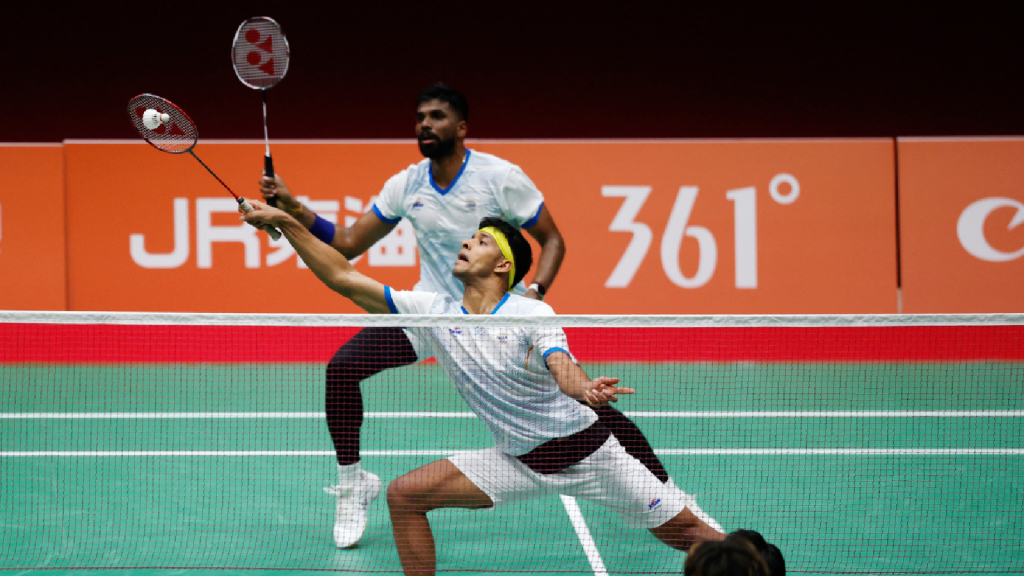
India’s men’s doubles pair Satwiksairaj Rankireddy and Chirag Shetty have reached their fourth tour semifinal of 2026 after defeating China’s Hu Ke Yuan and Lin Xian Yi in the quarterfinals of the Hong Kong Open. The World No. 6 Indian duo secured a hard-fought 21-12, 13-21, 21-16 victory on Friday, showcasing a tactical adjustment that has strengthened their defensive game this season.
The key change has been their increasingly compact receiving stance. By standing closer to each other while preparing to receive serves, Satwik and Chirag have reduced the vulnerable spaces between them, particularly around the centre of the court. This adjustment has helped the Indians deal more effectively with spin serves and opponents attempting to exploit gaps in their formation.
Satwik-Chirag’s compact receiving stance makes the difference
In badminton doubles, players have a wider court to defend than in singles. Covering that space requires excellent coordination, quick reactions and clear communication between partners. Satwik and Chirag, however, have increasingly focused on protecting the areas where opponents can place the shuttle just beyond their reach.
Throughout 2026, the Indian pair have gradually moved closer together while receiving serves. Their positioning now brings them almost within handshaking distance, allowing them to guard the middle of the court more effectively. The compact formation limits the openings opponents can target and makes it harder to split the Indian combination with shots directed through the centre.
The approach was clearly visible against Hu Ke Yuan and Lin Xian Yi. The Chinese youngsters, who are Junior World Championships silver medallists, tested the Indians with fast exchanges and attacking variations. However, Satwik and Chirag maintained a disciplined defensive structure, using their positioning to cover the central areas and respond quickly to the shuttle.
Defensive improvements strengthen their overall combination
Their progress is not limited to serve reception. Despite spending considerable periods of the season dealing with injuries and absences, Satwik and Chirag appear to have developed a more dependable combination across different phases of the game.
Their defence close to the net has become stronger, while their drive game has also looked more stable. The pair are increasingly comfortable in fast, flat exchanges, where players have very little time to react and must rely on instinctive movement and precise racket control.
Another noticeable improvement has been their ability to turn defensive situations into attacking opportunities. Instead of simply returning difficult shots, the Indians have been quicker to regain control of rallies and create chances to attack. Their reactions and coordination have helped them transition more efficiently from defence to offence.
Against the Chinese pair, Satwik and Chirag frequently used a diagonal defensive stance, keeping their rackets positioned horizontally to handle quick parallel exchanges. Their compact movement and sharp responses made it difficult for Hu and Lin to find consistent openings.
How the Indians controlled the Hong Kong Open quarterfinal
The match was decided in three games, with the Indian pair taking the opening game 21-12 before losing the second 13-21. They responded strongly in the decider, winning 21-16 to book their place in the semifinals.
For much of the contest, Satwik and Chirag controlled the central section of the court, particularly the area near the net where many doubles rallies are decided. Their positioning helped them cover parallel drives and quick attacking shots without leaving significant gaps between them.
The Indians also showed that their defensive structure could remain effective during longer rallies. On occasions when Satwik had to move towards the back of the court, Chirag was able to complete the attacking sequence with the final smash. Even during these exchanges, the pair stayed close enough to avoid leaving the middle exposed.
Their ability to maintain the lead and prevent the Chinese players from taking control was an important feature of the performance. The opening and deciding games were particularly significant because the Indians managed to establish control early and maintain their advantage rather than allowing their opponents to build sustained momentum.
Serve-clock warnings briefly added pressure
The match was not entirely comfortable for the Indian pair. Keeping their opponents under pressure also involved managing the service rules, with both Satwiksairaj Rankireddy and Chirag Shetty receiving serve-clock warnings during the contest.
Satwik was warned first, followed by Chirag. The situation eventually resulted in a point being docked against the Indians as they approached the closing stages of the match.
However, the penalty did not change the overall direction of the deciding game. Rather than allowing the interruption to affect their focus, the Indian combination continued to play aggressively and remained committed to their attacking approach.
Chirag, in particular, responded with visible intensity. His aggression increased as the match progressed, and he helped drive the pair towards victory in the deciding game. The Indians eventually completed the 21-16 win to secure their semifinal position.
Injury interruptions have not stopped their progress
The 2026 season has included several challenges for Satwik and Chirag. Injuries and extended periods away from competition have interrupted their campaign, while their results have not always matched the expectations associated with one of India’s leading badminton combinations.
Their journey has also included disappointing moments, including the absence of a World Championships medal and an early exit at the Asian Games. Those results raised questions about their consistency and the direction of their season.
However, their recent performances suggest that the partnership continues to develop in important areas. Their improved under-net defence, stronger drive exchanges and more coordinated positioning indicate that the combination is becoming more reliable even when the players are not at their best physically or competitively.
The Hong Kong Open quarterfinal provided another example of how tactical adjustments can make a difference. Rather than relying only on their attacking power, the Indians used disciplined positioning and quick defensive reactions to control the match against a younger Chinese combination.
Satwik-Chirag face Malaysian challenge in the semifinals
The Indian pair will next face Malaysia’s Man Wei Chong and Kai Wun Tee for a place in the Hong Kong Open final. The Malaysian combination, ranked World No. 9, will present another difficult challenge for Satwik and Chirag.
Man Wei Chong and Kai Wun Tee are aged 27 and 29 respectively and have established themselves as a competitive pairing on the international circuit. Their experience and current ranking make them a serious test for the Indian duo.
The Malaysians also have a recent result in their favour. They defeated Satwik and Chirag in the quarterfinals of the Indonesia tournament in 2025, giving the upcoming semifinal an additional competitive edge.
For the Indians, the match will be an opportunity to demonstrate that their improved defensive structure can work against another established international pairing. Their compact receiving stance could again become an important factor, particularly if the Malaysians attempt to use quick serves, flat drives and central attacks to disrupt their formation.
Third title of 2026 remains within reach
Satwiksairaj Rankireddy and Chirag Shetty are also chasing their third title of the 2026 season. The Indian pair have already won the Singapore Open and China Masters, and another title in Hong Kong would add to their achievements this year.
Reaching the semifinals is another positive step after a season interrupted by injuries and inconsistent results. More importantly, their performance against Hu Ke Yuan and Lin Xian Yi highlighted the tactical improvements they have made while continuing to develop their partnership.
Their closer receiving position, stronger defence around the net and improved ability to convert defensive rallies into attacks have given them additional options on court. These changes could prove important as they face increasingly difficult opponents in the remaining rounds.
What the new stance means for Satwik and Chirag
The biggest takeaway from the Indian pair’s Hong Kong Open performance is that their progress is not based solely on power or aggressive shot-making. Their increasingly compact receiving stance has helped them protect the centre of the court, reduce gaps and respond more effectively to opponents’ attacking strategies.
Against the Chinese combination, the adjustment helped them manage fast exchanges and maintain a solid defensive shape across three games. Their response after losing the second game also demonstrated their ability to regain control under pressure.
The upcoming semifinal against Man Wei Chong and Kai Wun Tee will offer another test of this approach. With a third title of the season in sight, Satwik and Chirag will look to carry their improved coordination and defensive discipline into the next round of the Hong Kong Open.
For breaking news and live news updates, like us on Facebook or follow us on Twitter and Instagram. Read more on Latest Sports on thefoxdaily.com.




COMMENTS 0