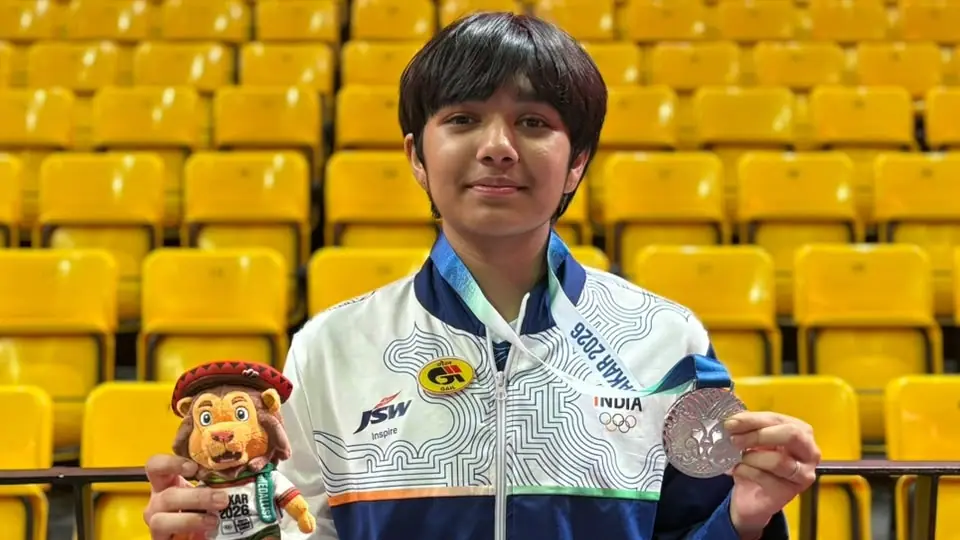
Indian badminton teenager Tanvi Patri announced herself on the international stage with a remarkable silver medal at the Youth Olympic Games in Dakar, Senegal. The 15-year-old displayed extraordinary determination in the women’s singles final, challenging China’s reigning junior world champion Zhang Yi Xin in a gripping contest that lasted one hour and 22 minutes.
Despite trailing 19-10 in the deciding game, Tanvi refused to give up. She saved six championship points, fought her way back into contention and created three match-point opportunities of her own before eventually losing 24-26 in a dramatic finish.
Although the gold medal went to China, Tanvi’s silver represented a historic achievement for Indian badminton. She became the first Indian woman to win a women’s singles badminton silver medal at the Youth Olympic Games and only the third Indian shuttler to claim a medal at the competition, following HS Prannoy in 2010 and Lakshya Sen in 2018.
Behind this achievement is an unusual journey that began in China when Tanvi was just seven and a half years old. Those early experiences, combined with disciplined coaching, unconventional sporting activities and her determination to overcome injuries and illness, helped shape the young athlete she is today.
How Tanvi Patri’s Badminton Journey Began in China
Tanvi’s introduction to badminton came through her father, who was working in China at the time. As a young child, she would accompany him to evening badminton club sessions where he regularly played doubles.
Those visits gradually developed into an interest in the sport. China also offered Tanvi an opportunity to experience a sporting environment where access to facilities played an important role in her early development.
Speaking in an interaction facilitated by the Badminton Association of India (BAI), Tanvi explained how the availability of infrastructure helped shape her experience.
“In China, all the big infrastructure is allowed for everyone,” Tanvi said.
One of the most important influences during those formative years was her first Chinese coach, Xu, who passed away last year. His approach focused on building correct technique rather than simply increasing the number of shots a player practised.
“My first Chinese coach, Xu (who passed away last year) taught me a fundamental lesson: ‘Always focus on your technique first. Don’t just go play 100 shuttles at a time. Perfect your actions step by step.’”
That lesson became an important part of Tanvi’s badminton development. Instead of concentrating only on repetition, she learned to pay attention to the quality of her movements and the technical details behind every shot.
Figure Skating Helped Develop Her Balance and Footwork
Tanvi’s early sporting experiences in China were not limited to badminton. On Saturdays and Sundays, she often went figure-skating with her friends.
Although it was a recreational activity, figure skating helped develop physical abilities that would later become useful on the badminton court. The sport required balance, coordination and control, while also strengthening her core and improving the agility of her footwork.
These skills are particularly important in badminton, where players must move quickly in different directions, maintain their balance while changing positions and recover efficiently after each shot.
Tanvi’s experience shows how activities outside a primary sport can contribute to an athlete’s overall development. Her time on the ice provided a different kind of physical training during the years when her badminton foundations were being built.
Returning to India and Joining the Prakash Padukone Badminton Academy
The Covid-19 pandemic brought a major change in Tanvi’s journey. When the family returned to India in 2020, she continued her badminton training in Odisha for approximately one and a half years.
Her next important opportunity came through a scouting camp that opened the doors to the renowned Prakash Padukone Badminton Academy (PPBA) in Bengaluru in 2022. The institution is now known as the Centre of Badminton Excellence.
Joining the academy marked another important stage in her development. Training under experienced coaches, including Vimal Kumar, helped accelerate her progress and exposed her to a more advanced training environment.
The transition from early coaching in China to structured training in India brought together different experiences that contributed to her playing style. The technical lessons she learned as a child continued to form part of her foundation, while her development in Bengaluru helped her progress towards international competition.
Injuries and Illness Made Tanvi’s Youth Olympics Silver Even More Special
Tanvi’s silver medal in Dakar was particularly impressive because her preparation for the tournament had been disrupted by physical problems.
Earlier in the year, she had been dealing with a back injury. Her preparation was further affected by a debilitating fever shortly before the World Junior Championships in Egypt in October.
By the time she reached Senegal for the Youth Olympic Games, she had completed barely two days of training. That left her with limited preparation ahead of a demanding international competition.
The conditions in Dakar added another challenge. The tropical climate brought intense heat and humidity, while the players’ village and athlete accommodation lacked air conditioning. Mosquitoes also made the environment uncomfortable for the young competitors.
Tanvi spoke openly about the difficulties she experienced before and during the event.
“Before going, I was sick and just did two days of training. The village and athlete house were really nice but the heat and humidity were tough. Also, there were mosquitoes,” the teenager said.
Despite those obstacles, she managed to reach the women’s singles final and push one of the world’s leading junior players to the limit. Her performance demonstrated not only her technical ability but also the mental strength required to compete under difficult circumstances.
A Dramatic Final Against China’s Zhang Yi Xin
The women’s singles final against Zhang Yi Xin became the defining moment of Tanvi’s Youth Olympic campaign. Zhang entered the match as the reigning junior world champion and presented a formidable challenge with her sharp and consistent game.
After a contest lasting one hour and 22 minutes, the match reached a decisive stage in which Tanvi found herself trailing 19-10. With the gold medal within reach for her Chinese opponent, the Indian teenager faced an enormous challenge.
Rather than accepting defeat, Tanvi produced a remarkable comeback. She saved six championship points and continued fighting until she had created three match-point opportunities of her own.
Her comeback brought the contest to a thrilling conclusion, but Zhang eventually secured the deciding game 26-24.
Although Tanvi narrowly missed the gold medal, her performance under pressure became one of the defining stories of the tournament. Recovering from such a large deficit against a reigning junior world champion showed the competitive spirit that has become a major part of her identity as a player.
PV Sindhu’s Praise Gives Tanvi a Special Confidence Boost
Tanvi’s performance also attracted recognition from Indian badminton icon PV Sindhu. The Olympic medallist praised the teenager’s skills and never-say-die attitude, offering encouragement to a young player beginning to make her mark internationally.
For Tanvi, receiving appreciation from someone she looks up to was a meaningful moment.
“Hearing those nice words from her… it means a lot to me,” Tanvi said.
Recognition from an established Indian badminton star can be an important source of motivation for a young athlete. Tanvi’s response reflected how much the encouragement meant to her as she continues working towards higher levels of competition.
The Road Ahead: Asian Championships, World Juniors and LA 2028
Despite the importance of her Youth Olympic silver medal, Tanvi is already looking beyond Dakar. The teenager has set ambitious targets for the coming years and wants to establish herself among the leading players in international badminton.
Her goals for next year include winning the Under-19 Asian Junior Championships and claiming gold at the World Junior Championships. She also wants to break into the top 20 of the senior Badminton World Federation (BWF) rankings.
Beyond junior competitions, Tanvi has a bigger ambition: qualifying for the 2028 Los Angeles Olympic Games.
She draws inspiration from several established international badminton stars, including Viktor Axelsen, Lin Dan, Tai Tzu Ying and An Se Young. Their patience, technical precision and composure are qualities she wants to develop in her own game.
These targets reflect a player who is not satisfied with one major achievement. Her Youth Olympic silver has provided an important platform, but the next challenge will be maintaining consistency and progressing against senior-level competition.
Balancing Badminton Training With Class 10 Board Exams
Outside badminton, Tanvi faces a challenge familiar to many Indian teenagers: balancing school responsibilities with a demanding training schedule.
The 15-year-old is currently in Class 10 and preparing for her board examinations in February. Managing academic commitments alongside professional-level badminton training is not always easy, especially when long practice sessions leave her physically exhausted.
Tanvi admitted that studying after training can be difficult and that she sometimes struggles to stay awake when she opens her books.
“It’s hard to manage school and badminton,” she said. “After training sessions, I get so tired. If I open a book, I feel sleepy! I study forcefully because I have Boards in February. I really don’t like getting up early because I love to sleep.”
Her comments reveal another side of the young athlete. While she competes with remarkable intensity on the court, she is also dealing with the everyday pressures of school, examinations and maintaining a balanced routine.
Nano-Blocks, Lego and Puzzles: Tanvi’s Life Away From Badminton
When she gets free time away from training and schoolwork, Tanvi enjoys activities that require creativity and concentration. She spends time with nano-blocks, Lego sets and intricate puzzles.
These hobbies offer a contrast to the intensity of competitive badminton. Building small structures and solving puzzles give her an opportunity to focus on something different from the demands of training and tournament preparation.
However, once she returns to the badminton court, her playful side gives way to the determination of a serious competitor.
Tanvi Patri’s Journey Reflects the Making of a Future Indian Badminton Star
Tanvi Patri’s rise to the Youth Olympic silver medal has been shaped by experiences across different countries, coaching environments and sporting activities. Her badminton journey began in China, where she learned the importance of technique and developed physical skills through figure skating.
Her return to India, training in Odisha and eventual move to the Centre of Badminton Excellence in Bengaluru helped her take the next steps towards international success. Along the way, she has dealt with injuries, illness, difficult playing conditions and the challenge of balancing education with elite-level sport.
Her dramatic comeback against Zhang Yi Xin in Dakar offered a glimpse of her determination. Saving six championship points and creating three match-point chances after trailing 19-10 was a remarkable achievement, even though the gold medal ultimately went to China.
At just 15, Tanvi has already secured a place in Indian badminton history. With the Asian Junior Championships, World Junior Championships, senior rankings and the 2028 Los Angeles Olympics among her ambitions, her journey is only beginning.
The silver medal in Dakar is an important milestone, but Tanvi’s story is ultimately about the foundations built over years of learning, adapting and refusing to give up.
For breaking news and live news updates, like us on Facebook or follow us on Twitter and Instagram. Read more on Latest Sports on thefoxdaily.com.






COMMENTS 0