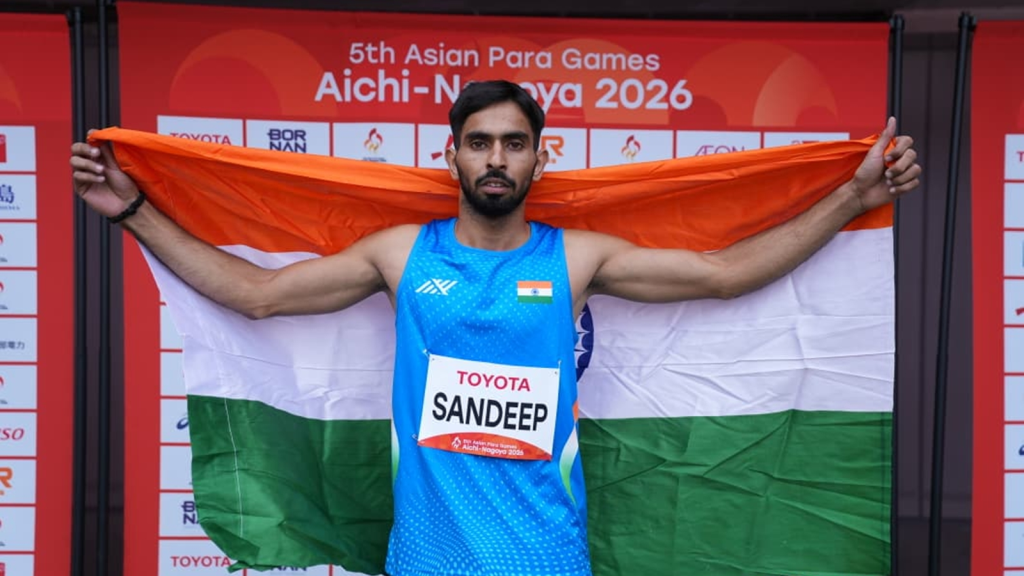
India crossed the 100-medal mark at the 2026 Asian Para Games in Aichi-Nagoya, Japan, on Friday, october 23, marking the second consecutive edition in which the country has reached the century milestone. The achievement was highlighted by an outstanding performance from para-athlete Sandeep, who broke the world record in the men’s 400m T64 event to claim gold, while compatriot Ajay Kumar secured bronze in the same race.
Sandeep clocked 52.28 seconds in his first appearance at the Asian Para Games, producing a record-breaking performance on one of the competition’s biggest stages. Ajay completed the race in 53.61 seconds, also finishing faster than the previous Asian Para Games record. Their double podium finish provided a significant boost to India’s medal campaign as the competition entered its final days.
The milestone reflects India’s continued presence among Asia’s leading para-sporting nations. After recording a historic medal haul at the previous edition in Hangzhou, the Indian contingent has once again demonstrated its ability to win medals across multiple disciplines, including para athletics, archery, badminton, shooting, swimming and other sports.
Sandeep’s World Record Headlines India’s 100-Medal Achievement
The men’s 400m T64 final delivered one of the most significant moments of India’s campaign at the Aichi-Nagoya 2026 Asian Para Games. Sandeep combined speed and sustained pace to finish in 52.28 seconds, breaking the existing world record and securing the gold medal.
The result was particularly noteworthy because this was Sandeep’s first appearance at the Asian Para Games. Making a debut at a major continental competition can bring additional pressure, but the Indian athlete produced a performance that established him as one of the standout competitors of the event.
The 400 metres is a demanding race that requires athletes to balance acceleration with the ability to maintain speed through the final stages. Unlike shorter sprint events, it leaves little room for a runner to lose rhythm or expend energy inefficiently. Sandeep’s record-setting time therefore represented not simply a victory over his rivals, but a new benchmark for the men’s T64 category.
His performance also helped India reach the symbolic milestone of 100 medals at the Games. While a century of medals is an important measure of a nation’s campaign, a world record adds another dimension to the achievement by demonstrating excellence beyond the immediate competition.
Ajay Kumar Adds Bronze in the Men’s 400m T64
India’s success in the event extended beyond Sandeep’s gold medal. Ajay Kumar crossed the finish line in 53.61 seconds to win bronze, giving India two places on the podium in the same final.
Ajay’s time was also faster than the previous Asian Para Games record, making the result a strong individual achievement despite his finishing position behind the gold and silver medallists. His performance underlined the competitive depth within India’s para-athletics contingent.
Winning multiple medals in one event can be particularly valuable at a multi-sport competition. It rewards the performances of individual athletes while adding to the country’s overall tally. In this case, India’s two-medal return from the men’s 400m T64 reinforced the importance of para athletics to the national campaign.
The result also illustrated why medal counts do not tell the whole story of a sporting achievement. Sandeep’s world record attracted attention, but Ajay’s performance against the previous Games benchmark deserves recognition in its own right. Both athletes contributed to an exceptional race for India.
India Reaches the 100-Medal Mark for the Second Consecutive Asian Para Games
Crossing 100 medals in Aichi-Nagoya marks a significant continuation of India’s progress at the Asian Para Games. The country also surpassed the century mark at the previous edition in Hangzhou, where Indian athletes delivered the nation’s then-best performance at the competition.
India’s historical results illustrate the scale of that progress. The country won 14 medals at the 2010 Asian Para Games, followed by 33 in 2014 and 72 in 2018. At Hangzhou, held in 2023 after being postponed from 2022, India won a record 111 medals, including 29 gold medals.
The 2026 campaign has now ensured that India’s medal tally has again crossed 100, extending a sequence of strong performances at the continental event.
Repeatedly reaching this level matters because it suggests that India’s results are not limited to one exceptional edition. A strong overall tally depends on athletes qualifying for competitions, performing consistently across several days and converting opportunities into podium finishes in different sports.
However, the milestone should not be confused with confirmation that India has surpassed its previous record. The 111 medals won at Hangzhou remain the established benchmark cited in official background information. India’s final tally in Aichi-Nagoya will determine whether the team improves on that performance.
How India’s Asian Para Games Performance Has Evolved
The progression of India’s medal totals provides useful context for understanding the significance of the latest milestone.
| Asian Para Games edition | Location | India’s total medals |
|---|---|---|
| 2010 | Guangzhou, China | 14 |
| 2014 | Incheon, South Korea | 33 |
| 2018 | Jakarta, Indonesia | 72 |
| 2022 edition, held in 2023 | Hangzhou, China | 111 |
| 2026 | Aichi-Nagoya, Japan | More than 100 |
The figures show a substantial increase from the 14 medals India won in 2010 to the 111-medal record at Hangzhou. The latest achievement continues that broader upward trajectory, although the reasons behind the improvement cannot be reduced to medal totals alone.
Progress at a multi-sport event reflects a combination of individual preparation, competitive experience, coaching, access to facilities and the ability to perform under pressure. Medal results provide a visible measure of success, but they do not independently establish how much each factor contributed.
India’s performance across successive editions nevertheless gives the country a strong foundation on which to assess its progress. The final results from Aichi-Nagoya will offer a more complete picture of how the current contingent compares with the record-setting team at Hangzhou.
Para Athletics Continues to Deliver Important Results for India
Sandeep’s world-record run highlights the contribution of para athletics to India’s medal campaign. Track and field events offer opportunities across sprinting, middle-distance running, jumping and throwing disciplines, with athletes competing in classifications designed to group competitors according to relevant activity limitations.
The men’s 400m T64 is a track event for athletes with qualifying lower-limb impairments who compete under the T64 classification. Classification is a central feature of para sport because it establishes the competition categories used to support fairer comparisons between athletes with eligible impairments.
Within these categories, athletes must still demonstrate the same fundamental qualities required in elite athletics: speed, technique, physical preparation, tactical awareness and consistency. Sandeep’s record-breaking performance illustrates how an athlete can combine these elements to produce a result that advances the standard of competition.
Ajay Kumar’s bronze medal provides a complementary example of the depth required for a successful national campaign. India’s ability to place two athletes on the podium in one event adds to the significance of the result and demonstrates that the medal contribution was not dependent on a single performance.
Para athletics is only one part of the wider Asian Para Games programme, however. India has also competed in disciplines such as para archery, para badminton, para swimming, para shooting and para table tennis. Success across these sports helps reduce dependence on any one discipline and broadens the range of opportunities available to athletes.
India’s Campaign Extends Beyond a Single Record-Breaking Race
Although Sandeep’s world record and Ajay’s bronze medal were central to the 100-medal milestone, India’s broader campaign has included achievements in several sports.
Para archery has attracted attention through the performances of athletes such as sheetal Devi, while para athletics has contributed medals in track events, jumps and throws. Indian competitors have also collected medals in shooting, swimming, badminton and other disciplines during the competition.
This variety matters because the Asian Para Games bring together athletes with different sporting backgrounds, impairment classifications and preparation requirements. A country’s overall result depends on its ability to support competitors across that range rather than relying exclusively on a few established medal prospects.
A multi-sport event also offers athletes opportunities to gain experience against leading competitors from across Asia. For younger or less experienced participants, that exposure can be valuable even when they do not finish on the podium. Competition at this level provides a demanding test of preparation and can help athletes identify areas for improvement.
The medal count remains the most immediately visible measure of a country’s performance, but the wider significance of a campaign also lies in the number of athletes who compete, the quality of their performances and the experience they gain for future international events.
Why the 100-Medal Milestone Matters for Indian Para Sport
India crossing 100 medals for a second consecutive Asian Para Games is an important sporting milestone, but its longer-term significance will depend on whether strong performances can be sustained across future competitions.
One useful way to evaluate progress is to look beyond the overall total and examine the distribution of medals. Gold medals indicate victories in individual events, while silver and bronze medals reflect additional podium finishes. Considering all three categories gives a broader picture of competitive performance across the programme.
Another consideration is the range of sports in which medals are won. A strong showing across several disciplines can indicate that a country’s competitive opportunities extend beyond a small group of athletes or events. It also gives coaches and administrators more areas in which to assess preparation and identify potential future medal contenders.
At the same time, medal totals should be interpreted carefully. The number of events, participating athletes and available medal opportunities can vary between competitions. A comparison between editions is therefore most useful when the wider competition context is also considered.
For India, the immediate achievement is clear: the team has again surpassed 100 medals at the Asian Para Games. The next measure of success will be the final tally, the number of gold medals and whether the contingent can challenge its previous record of 111 medals.
What Comes Next at Aichi-Nagoya 2026?
The 2026 Asian Para Games are scheduled to run from October 18 to 24 in Aichi-Nagoya, Japan. With competition continuing on October 23, the medal standings remain an evolving picture as athletes contest the remaining events.
India’s immediate focus will be on converting further opportunities into medals and maintaining the standard demonstrated by athletes such as Sandeep and Ajay Kumar. Additional performances across athletics and other sports could influence the country’s final position and determine whether the team improves on its previous best total.
The distinction between crossing 100 medals and breaking the national record is important. The first milestone has been achieved, while surpassing the Hangzhou total of 111 requires India to finish with at least 112 medals. The final standings will establish whether that further target is reached.
For individual athletes, the remaining competition also offers opportunities to secure personal milestones, improve performances and finish their campaigns on a high note. For India, each result will contribute to the final assessment of a campaign that has already delivered another century of medals.
Conclusion: Sandeep Leads India Into Another Landmark Asian Para Games Campaign
India’s achievement of crossing 100 medals at the Aichi-Nagoya 2026 Asian Para Games for the second consecutive edition is a major moment for the country’s para-sporting contingent. Sandeep’s world-record 52.28-second performance in the men’s 400m T64 final provided the headline result, while Ajay Kumar’s bronze in 53.61 seconds gave India a second medal in the event.
The result continues India’s progression from 14 medals in 2010 to a record 111 at Hangzhou, held in 2023. It also reinforces the contribution of para athletics to a campaign that has produced medals across multiple sports.
India has already secured the century milestone, but the competition is not yet complete. The final medal count will show whether the contingent can improve on its Hangzhou record. Regardless of that outcome, Sandeep’s world record and India’s second consecutive 100-medal achievement have made Aichi-Nagoya 2026 another significant chapter in the country’s Asian Para Games history.
For breaking news and live news updates, like us on Facebook or follow us on Twitter and Instagram. Read more on Latest Sports on thefoxdaily.com.






COMMENTS 0