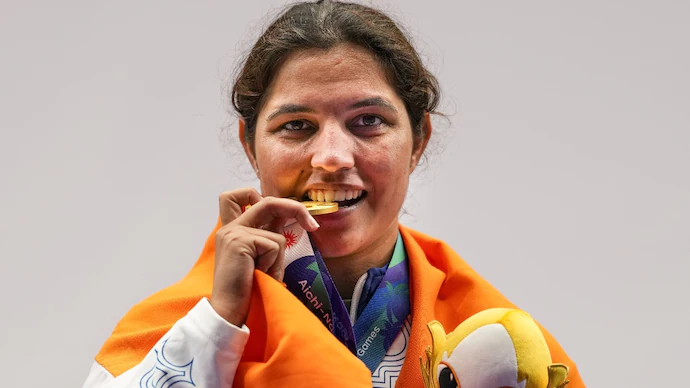
Asian Games gold medallist Neeru Dhanda, badminton star PV Sindhu, Olympic medallist Mirabai Chanu and Indian men’s hockey captain Harmanpreet Singh are among the prominent athletes included in the Indian Olympic Association’s (IOA) 34-member electoral college for the upcoming Athletes Commission elections.
The election, scheduled for November 3, will determine the 10 members of the IOA Athletes Commission for the 2026-2030 term. The electoral college comprises two athlete representatives each from 17 national sports federations (NSFs), although four federations, including the All India Football Federation (AIFF), do not have representatives on the published list.
The electoral roll was released on Friday by Sanjay K Srivastava, the electoral officer appointed by the IOA. The announcement marks an important step in the process of selecting the next Athletes Commission, which will represent athletes’ interests within India’s national Olympic governing body.
The new nominations also signal a change in leadership for the commission. Sindhu and Mirabai, who served on the outgoing body, have been nominated again, while former chairperson Mary Kom and vice-chairperson Achanta Sharath Kamal will not be part of the commission for the 2026-2030 term under the announced nominations.
Neeru Dhanda, PV Sindhu and Harmanpreet Singh Feature on the Electoral Roll
The 34-member electoral college includes athletes from several prominent Olympic sports, reflecting the participation of national federations in the selection process. The representatives will vote to elect five men and five women to the new Athletes Commission.
Neeru Dhanda, an Asian Games gold medallist in shooting, is among the key names on the list. She has been nominated alongside Swapnil Kushare to represent shooting, giving the sport two representatives in the electoral college.
Badminton star PV Sindhu has also been nominated by the Badminton Association of India, alongside K Srikanth. Sindhu is one of India’s most prominent international badminton players and previously served on the outgoing Athletes Commission.
Olympic medallist Mirabai Chanu has been selected by the Indian Weightlifting Federation. Her inclusion brings an experienced international athlete into the electoral process for the next commission.
Indian men’s hockey captain Harmanpreet Singh and women’s team captain Salima Tete have been nominated by Hockey India. Their inclusion provides representation from both the men’s and women’s national hockey teams.
Other notable nominees include wrestler Aman Sehrawat, fencer Bhavani Devi, and athletes Sudha Singh and Tajinderpal Singh Toor, who will represent the Athletics Federation of India.
The list brings together athletes from different sporting disciplines, including shooting, badminton, weightlifting, wrestling, hockey, fencing and athletics. Their participation is intended to help determine who will represent athletes’ interests within the IOA during the next four-year term.
Four National Sports Federations Have No Representatives
Despite the range of sports represented, four national federations do not have nominees in the electoral college: the All India Football Federation (AIFF), All India Tennis Association (AITA), Boxing Federation of India (BFI) and Table Tennis Federation of India (TTFI).
The absence of these federations means that their athletes will not have representatives participating in this particular electoral college through the announced nomination process.
According to the supplied report, the AIFF does not have an elected Athletes Commission. This is significant because the IOA’s rules require participating national federation members to have an established Athletes Commission to appoint representatives through that body.
The Boxing Federation of India is also absent from the list because it is not recognised by either the IOA or the Ministry of Youth Affairs and Sports, according to the report.
The absence of the AIFF, AITA, BFI and TTFI highlights the importance of governance structures within national sports federations. Under the IOA’s rules, the nomination process is tied to the existence of a properly constituted Athletes Commission, rather than simply to a federation’s participation in a particular sport.
The development also underlines the role of institutional recognition and compliance in determining how athletes participate in Olympic governance. Federations that do not meet the relevant requirements may be unable to nominate representatives through the prescribed procedure.
IOA Athletes Commission Elections: Key Dates and Numbers
- Electoral college: 34 athlete representatives.
- Participating federations: 17 national sports federations.
- Representatives per federation: Two nominees, one male and one female.
- Athletes Commission election: November 3.
- Term of the new commission: 2026-2030.
- Positions to be elected: 10 members, comprising five men and five women.
- Nomination deadline for candidates: 5 pm on October 21.
- Federations without representatives: AIFF, AITA, BFI and TTFI.
How the IOA Electoral College Was Formed
The electoral college has been constituted under Article 10 of the IOA Athletes Commission Rules, which were ratified in September. Under Article 10.3, each participating national sports federation member can nominate two athlete representatives through its Athletes Commission.
The nominations must consist of one male and one female athlete representing the sport affiliated with the respective federation to the IOA.
The rules state:
“Only those NSF Members which have established an Athletes Commission shall be allowed to appoint their athletes’ representatives through their respective Athletes Commissions.”
This provision establishes a formal mechanism for athlete representation. Instead of allowing federations to make nominations without an established athlete body, the rules require participating organisations to use their Athletes Commissions to select representatives.
The approach is intended to ensure that athletes have a defined role in choosing representatives who will participate in the commission’s election. It also makes the establishment and functioning of Athletes Commissions an important requirement for national federations seeking to participate in the process.
The IOA had earlier asked national sports federations to nominate two athlete representatives through their duly constituted Athletes Commissions by 2 pm on October 11.
The deadline was announced alongside the appointment of the returning officer for the national Olympic body’s December 5 executive council elections. The electoral roll’s publication represents a further stage in the IOA’s wider election-related activities.
Mary Kom and Sharath Kamal Set to Leave the Commission
The new nominations will bring changes to the composition of the IOA Athletes Commission. Mary Kom, the celebrated Indian boxer who currently serves as chairperson, and Achanta Sharath Kamal, one of India’s leading table tennis players and the outgoing vice-chairperson, will not be part of the commission for the 2026-2030 term under the announced nominations.
Both athletes have been prominent figures in Indian sport, making their departure a notable development in the commission’s transition.
PV Sindhu and Mirabai Chanu, meanwhile, were members of the outgoing commission and have been nominated again by their respective federations. Their inclusion could provide continuity as the IOA moves towards selecting the next group of athlete representatives.
The election will determine the commission’s full membership, so the final composition will depend on the voting process and the eligibility criteria established under the IOA rules.
The Athletes Commission serves as a formal platform for athletes within the Olympic movement. Its composition is important because the body also has responsibilities connected to the IOA’s broader governance structure, including the selection of representatives for the General House and Executive Council.
Candidate Nominations Open Until October 21
With the electoral college now announced, eligible athlete representatives can begin the formal process of contesting the November 3 election.
Athletes seeking election to the commission must submit their nomination papers by 5 pm on October 21. Applications must be submitted through the concerned national sports federation member in the format prescribed by the electoral officer.
Article 10.1 of the IOA Athletes Commission Rules explains how the electoral process is organised:
“Members of the (IOA) Athletes Commission shall be elected by, and from amongst, a pool of eligible athlete representatives which shall constitute the electoral college for such election, constituted in accordance with this Rule.”
The provision establishes that the commission’s members will be chosen from the pool of eligible athlete representatives who make up the electoral college.
Article 10.4 further specifies the application process:
“Any eligible athlete representative from among this pool seeking election as a member of the (IOA) Athletes Commission shall submit an application through the concerned NSF Member in the format prescribed by the Electoral Officer.”
These provisions set out the formal route for candidates to enter the election. Athletes must meet the prescribed eligibility requirements and follow the nomination procedure rather than applying independently outside the established framework.
Eligibility Criteria for Athletes Commission Candidates
The IOA has established specific eligibility requirements for athletes seeking a position on the Athletes Commission. Candidates must be Indian citizens and at least 18 years old on the date of nomination.
They must also meet the integrity requirements set out in the rules. Candidates cannot have a history of sanctions for violations of the World Anti-Doping Code, the National Anti-Doping Act, 2022, or applicable integrity regulations.
In addition, candidates must never have faced sanctions for violating the IOA Constitution, its bye-laws or its rules and regulations.
These requirements place emphasis on citizenship, age and compliance with anti-doping and sports-governance standards. They are designed to ensure that those seeking to represent athletes meet the formal conditions for participation in the commission’s election.
Meeting the basic eligibility requirements, however, does not automatically guarantee election. Candidates must also complete the nomination process through their respective national federation and secure the necessary support in the electoral college.
Olympic Experience and Major Medals Will Shape the Commission
The IOA Athletes Commission will consist of 10 elected members, with specific eligibility criteria governing the distribution of positions. The rules require at least six members, comprising three men and three women, to have participated in one of the last three editions of the Olympic Games at the time of their election.
The remaining four positions, consisting of two men and two women, are reserved for athletes who have won at least one medal at any of the last three editions of the Asian Games, Commonwealth Games, World Championship or World Cup, or the National Games.
This structure provides two pathways for athletes to qualify for the commission: recent Olympic participation or medal-winning achievements at specified major sporting events.
The criteria also establish a gender balance, requiring equal numbers of men and women across the 10 elected positions. The arrangement aims to ensure that the commission includes athletes with different sporting experiences while maintaining equal representation.
By combining Olympic experience with achievements at other major competitions, the eligibility framework allows the commission to draw on a wider range of sporting backgrounds.
Rajeshwari Kumari to Join as an Ex-Officio Member
Trap shooter Rajeshwari Kumari will join the IOA Athletes Commission as an ex-officio member with voting rights. She was elected to the Olympic Council of Asia’s Athletes Commission during the Aichi-Nagoya Asian Games, according to the supplied report.
Her inclusion adds another element to the commission’s structure beyond the 10 members elected through the IOA electoral process.
Ex-officio membership recognises a person’s position or role within a relevant organisation. In this case, Kumari’s position on the Olympic Council of Asia’s Athletes Commission is the basis for her participation in the IOA body, as described in the report.
Her voting rights mean that her role will extend beyond simply attending commission discussions. The commission’s work will therefore include both the elected members and the ex-officio participation specified under the applicable arrangements.
How the Athletes Commission Will Influence IOA Governance
The Athletes Commission has responsibilities that extend beyond representing athletes’ interests within the Olympic movement. It also plays a role in determining the composition of the IOA General House, which participates in the election of the national Olympic body’s Executive Council.
The commission will select eight Sportspersons of Merit (SOMs), comprising four men and four women. These individuals will become members of the IOA General House and participate in the election of the new Executive Council.
Of those eight Sportspersons of Merit, two people one man and one woman will subsequently be elected to the IOA Executive Council.
The process gives the Athletes Commission a connection to the wider governance structure of Indian Olympic sport. Its decisions on Sportspersons of Merit can influence which athletes become part of the General House and participate in the Executive Council election.
Two members of the Athletes Commission one man and one woman will also be included in the IOA Executive Council. This arrangement provides a direct route for athlete representatives to participate in the national Olympic body’s executive-level governance.
The commission’s composition is therefore significant not only for athlete representation but also for the wider process of selecting leadership within the IOA.
Why the November 3 Election Matters for Indian Sport
The upcoming election represents an important stage in determining how athletes will be represented within India’s Olympic administration for the 2026-2030 term.
Athletes often have direct experience of the practical challenges involved in training, competing internationally and preparing for major sporting events. A formal commission provides a mechanism for those experiences and concerns to be represented within the national Olympic structure.
The presence of prominent athletes such as PV Sindhu, Mirabai Chanu, Harmanpreet Singh and Neeru Dhanda on the electoral roll adds visibility to the process. However, the final commission will be determined by the election, rather than by the prominence of the athletes already nominated to the electoral college.
The absence of four federations also demonstrates the importance of meeting the procedural requirements established under the IOA rules. The formation of Athletes Commissions within national federations is central to the nomination mechanism described in Article 10.3.
With candidate nominations due by October 21 and voting scheduled for November 3, the coming weeks will determine who competes for positions on the new commission and who ultimately secures a place on the body.
Conclusion
Neeru Dhanda, PV Sindhu, Mirabai Chanu and Harmanpreet Singh are among the leading athletes included in the IOA’s 34-member electoral college for the November 3 Athletes Commission elections. The representatives, nominated by 17 national sports federations, will elect 10 members five men and five women for the 2026-2030 term.
The absence of the AIFF, AITA, BFI and TTFI highlights the importance of the IOA’s nomination rules, particularly the requirement for participating federations to have established Athletes Commissions. Meanwhile, Mary Kom and Achanta Sharath Kamal will not be part of the next commission under the announced nominations, while Sindhu and Mirabai have been nominated again.
Eligible candidates must submit their nomination papers by 5 pm on October 21 and satisfy the citizenship, age, anti-doping and integrity requirements. Beyond electing the commission’s members, the process will influence athlete representation in the IOA’s wider governance structure, including the selection of Sportspersons of Merit and participation in Executive Council elections.
For breaking news and live news updates, like us on Facebook or follow us on Twitter and Instagram. Read more on Latest Sports on thefoxdaily.com.

COMMENTS 0