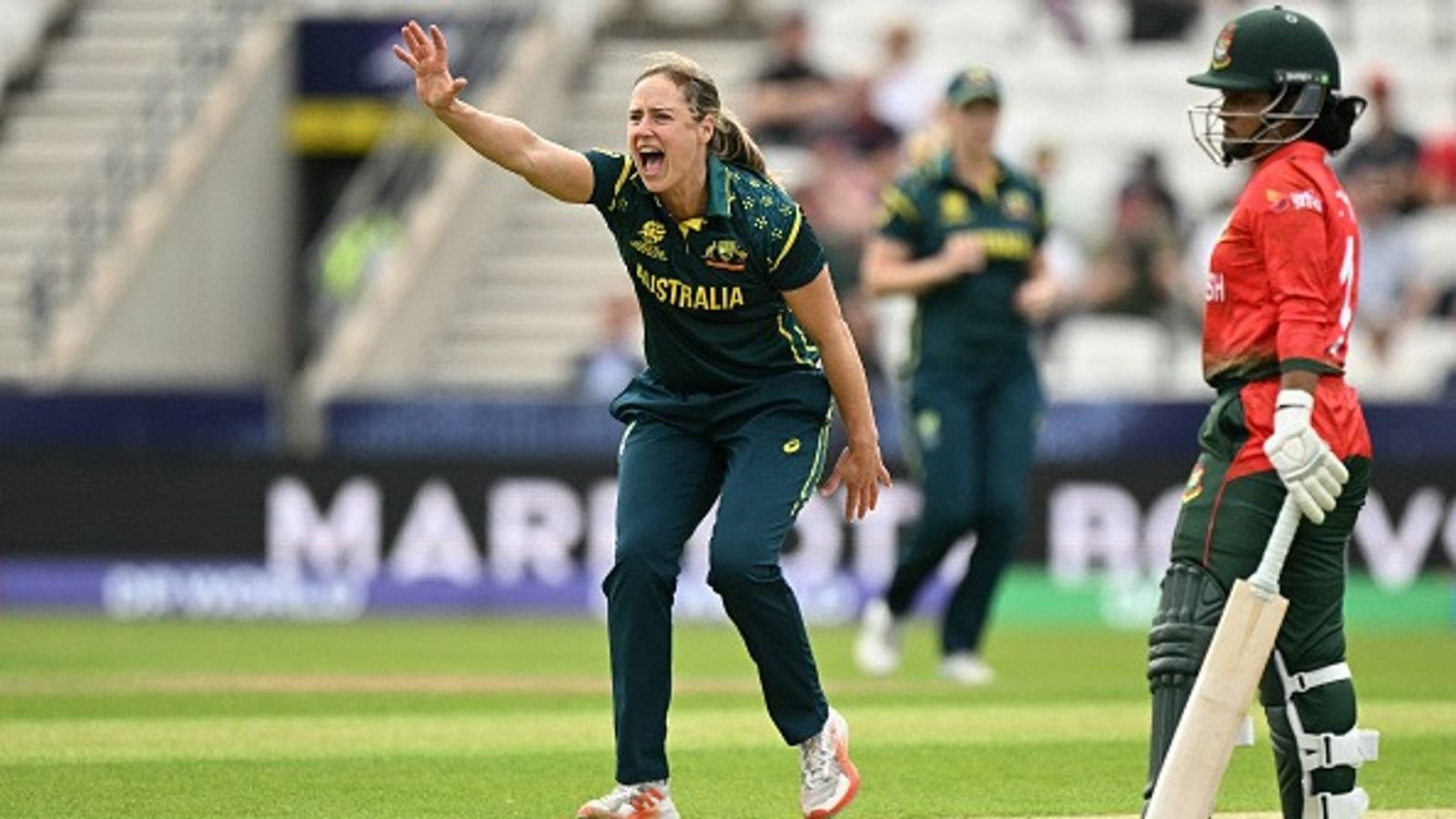
Australia Women sent a powerful message to the rest of the field at the Women’s T20 World Cup 2026, dismantling Bangladesh by nine wickets in a one-sided Group 1 encounter at Headingley, Leeds.
Chasing a modest target of 78, the six-time champions raced to victory in just 9.3 overs with 63 balls to spare, significantly boosting their net run rate to +3.875 and strengthening their position at the top of the group standings.
While the result itself was hardly surprising given Australia’s pedigree in global tournaments, the manner of the victory highlighted why they remain the team to beat despite entering the competition without several first-choice players.
Missing explosive opener Phoebe Litchfield due to a quad injury and without star all-rounder Ashleigh Gardner, Australia still delivered a performance defined by depth, adaptability and ruthless efficiency.
Australia’s Winning Formula: Depth Beyond the Starting XI
One of Australia’s greatest strengths has always been their ability to maintain elite standards regardless of personnel changes.
Many teams struggle when key players are unavailable, but Australia’s domestic structure continues to produce international-ready replacements.
The absence of Litchfield and Gardner could have disrupted the balance of most sides. Instead, Australia barely missed a beat.
Georgia Voll stepped into the opening role seamlessly, while the bowling unit shared responsibilities effectively to ensure Bangladesh never found momentum.
This depth has become Australia’s defining advantage in global tournaments.
Rather than relying on a handful of superstars, they operate with a squad capable of adapting to different conditions and match situations.
Kim Garth Sets the Tone with the New Ball
After electing to field first, Australia wasted no time asserting control.
Kim Garth struck twice inside the opening four overs, removing Dilara Akter and Juairiya Ferdous to reduce Bangladesh to 15/2.
Those early breakthroughs immediately shifted the pressure onto Bangladesh’s inexperienced middle order.
Garth’s disciplined lengths and ability to generate subtle movement made scoring difficult from the outset.
Her spell demonstrated a key principle of successful T20 cricket: early wickets often matter more than dot balls.
By attacking with the new ball, Australia denied Bangladesh any opportunity to establish a platform.
Sophie Molineux and Ellyse Perry Tighten the Grip
If Garth created the opening, Australia’s experienced all-rounders ensured there was no route back into the contest.
Captain Sophie Molineux led from the front with a composed spell that combined tactical awareness with precise execution.
Ellyse Perry, one of the most decorated cricketers in the history of the women’s game, once again showcased her value as a multi-dimensional player.
Both bowlers claimed two wickets each, consistently forcing Bangladesh’s batters into low-percentage scoring options.
Annabel Sutherland and Georgia Wareham also contributed with a wicket apiece, underlining the collective nature of Australia’s bowling performance.
Remarkably, none of Australia’s seven bowlers conceded more than five runs per over.
| Australia Bowlers | Wickets | Impact |
|---|---|---|
| Kim Garth | 2 | Early breakthroughs with the new ball |
| Sophie Molineux | 2 | Controlled middle overs |
| Ellyse Perry | 2 | Key wickets and pressure building |
| Annabel Sutherland | 1 | Maintained scoring restrictions |
| Georgia Wareham | 1 | Effective spin control |
Bangladesh Struggle Against Relentless Pressure
Bangladesh entered the match hoping to challenge the defending champions with disciplined batting and smart game management.
Instead, they found themselves overwhelmed by Australia’s relentless intensity.
The team managed only 77/8 in 20 overs, the lowest total recorded in the Women’s T20 World Cup 2026 so far.
Captain Nigar Sultana fought hard for her 27 off 47 balls, while Ritu Moni added 16 runs, but no other batter managed to make a meaningful contribution.
The innings exposed a key challenge facing emerging teams in global tournaments: converting starts into substantial partnerships against world-class bowling attacks.
Bangladesh lost wickets at regular intervals and never developed the momentum required to post a competitive score.
| Bangladesh Top Scorers | Runs | Balls |
|---|---|---|
| Nigar Sultana | 27 | 47 |
| Ritu Moni | 16 | – |
Georgia Voll Seizes Her Opportunity
Australia’s batting innings may have been brief, but it offered another glimpse into the team’s remarkable bench strength.
Opening batter Georgia Voll embraced her opportunity with an unbeaten 45 off 32 balls, combining composure with controlled aggression.
Her innings ensured Australia completed the chase quickly enough to maximise their net run rate advantage.
After Beth Mooney was dismissed in the fifth over by Marufa Akter, there was little sign of panic.
Voll and Ellyse Perry stitched together an unbroken 47-run partnership to guide Australia home with ease.
The pair accelerated smoothly after the powerplay, demonstrating the calmness that has become synonymous with Australian cricket.
Why Net Run Rate Could Prove Crucial
In major ICC tournaments, dominant victories often provide benefits beyond the two points earned.
Australia’s emphatic win elevated their net run rate to +3.875, creating valuable breathing space in Group 1.
With competitive teams battling for semi-final spots, net run rate frequently becomes a deciding factor when sides finish level on points.
By completing the chase with 63 balls remaining, Australia strengthened their position significantly ahead of tougher fixtures later in the tournament.
This approach reflects Australia’s long-term tournament strategy: win decisively whenever opportunities arise.
Australia Continue to Set the Standard in Women’s Cricket
The gap between Australia and the rest of the field remains one of the defining narratives of modern women’s cricket.
Their sustained success is built on more than talent alone.
Investment in domestic pathways, elite coaching structures and a winning culture has created a system capable of producing world-class players consistently.
Even when key names are unavailable, replacements enter the side with clear roles and the confidence to perform.
That level of preparation explains why Australia continue to dominate across formats and conditions.
For other nations, closing the gap will require long-term investment rather than short-term solutions.
Can Anyone Stop Australia at the Women’s T20 World Cup 2026?
After two matches, Australia have looked every bit like favourites to defend their title.
Their bowling attack has been disciplined, their batting has been efficient and their squad depth remains unmatched.
Perhaps most importantly, they continue to find different match-winners in every game.
Against South Africa, one group of players stepped up. Against Bangladesh, Garth, Molineux, Perry and Voll took centre stage.
That unpredictability makes Australia exceptionally difficult to prepare for.
However, tougher tests await.
As the tournament progresses, stronger batting line-ups and knockout pressure will challenge the defending champions in different ways.
For now, though, Australia appear firmly in control of their World Cup campaign.
What Lies Ahead?
Australia will next face the Netherlands on June 20, aiming to extend their winning streak and secure early qualification for the knockout stage.
Bangladesh, meanwhile, must regroup quickly and address their batting struggles if they hope to remain competitive in the tournament.
Building partnerships and finding greater intent in the middle overs will be critical to their chances in upcoming matches.
Conclusion
Australia’s nine-wicket demolition of Bangladesh was a reminder of why they remain the benchmark in women’s cricket.
From Kim Garth’s early breakthroughs to the controlled spells of Sophie Molineux and Ellyse Perry, followed by Georgia Voll’s composed chase, the performance showcased every quality required to win major tournaments.
More importantly, it highlighted Australia’s extraordinary depth and adaptability.
With two wins from two matches and a soaring net run rate, the defending champions have made an emphatic start to their Women’s T20 World Cup 2026 campaign.
If their opening performances are any indication, the road to the trophy may once again run through Australia.
For breaking news and live news updates, like us on Facebook or follow us on Twitter and Instagram. Read more on Latest Sports on thefoxdaily.com.






COMMENTS 0