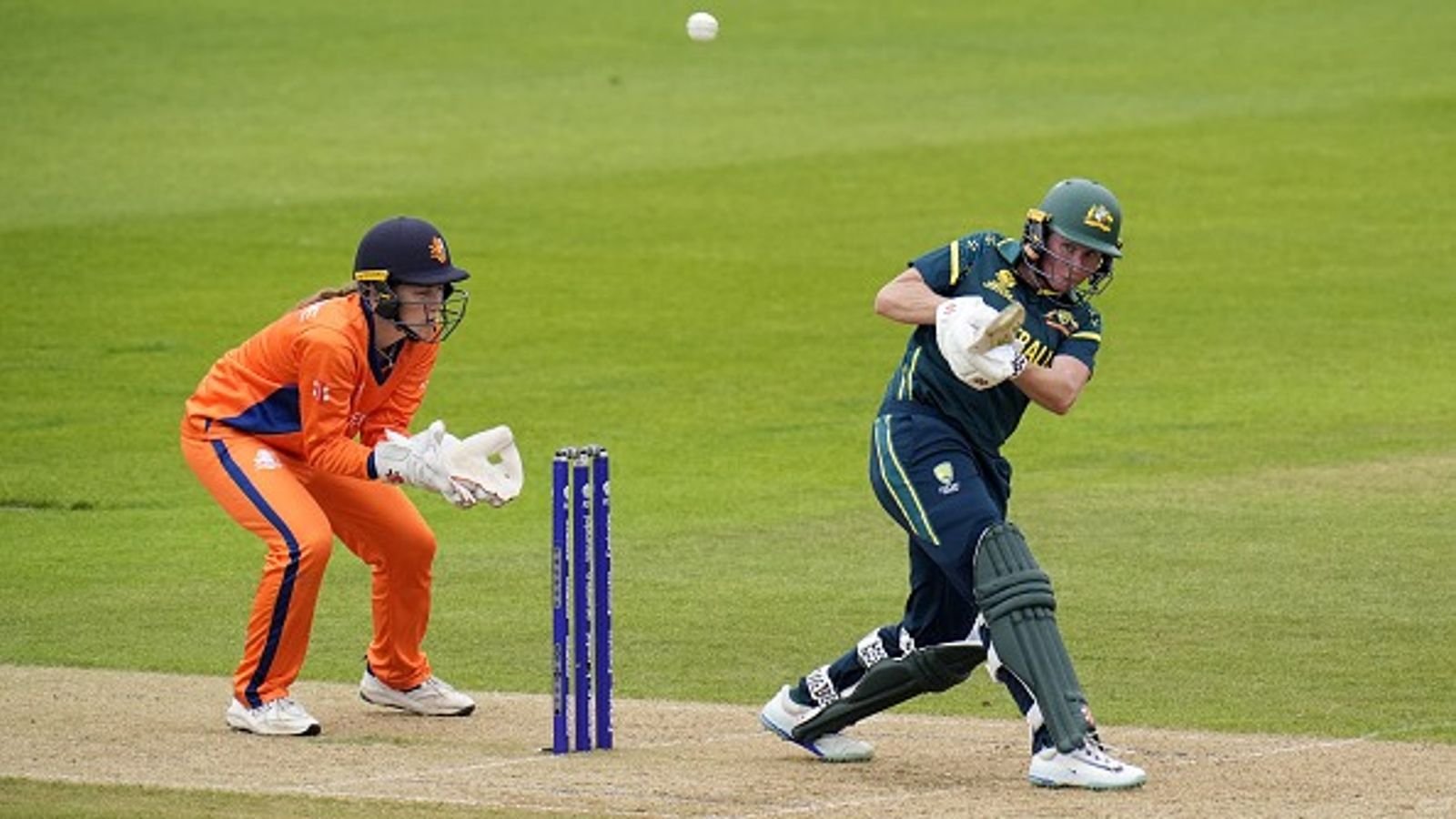
Australia’s march toward another Women’s T20 World Cup title gathered further momentum as the six-time champions dismantled the Netherlands by 98 runs in a one-sided Group A encounter at the Hampshire Bowl. The victory marked Australia’s third straight win of the tournament and reinforced why they remain the benchmark in women’s cricket.
In a competition where momentum often determines championship success, Australia has quickly established itself as the team to beat. Their comprehensive performance against the Netherlands showcased not only their batting firepower but also the squad depth and tactical discipline that have defined their dominance over the past decade.
While the final margin reflected Australia’s superiority, the match also provided valuable insights into the growing competitiveness of women’s cricket and the challenges emerging nations face when confronting established powerhouses.
Australia’s Batting Machine Fires Again
After being asked to bat first, Australia wasted little time asserting control. The batting unit produced a commanding total of 219/6, matching one of the highest team scores in Women’s T20 World Cup history.
From the outset, the Australian approach was clear: attack relentlessly and deny the opposition any opportunity to settle.
The innings was built around an outstanding knock from Beth Mooney, who delivered another reminder of why she remains one of the most reliable batters in world cricket. Her aggressive 74 from just 42 deliveries combined elegance with power, allowing Australia to maintain a scoring rate that consistently kept the Dutch bowlers under pressure.
Even after being forced to retire hurt due to a stiff back, Mooney had already laid the foundation for a massive total.
Beth Mooney Continues to Lead Australia’s World Cup Charge
Every successful tournament campaign requires players capable of setting the tone, and Mooney has embraced that responsibility once again.
Her innings highlighted several qualities that make her such a valuable asset:
- Exceptional shot selection under pressure.
- Ability to score against both pace and spin.
- Quick acceleration during powerplay overs.
- Consistent strike rotation.
- Leadership through performance.
Beyond the runs themselves, Mooney’s influence extends throughout the batting lineup. Her ability to dominate early allows middle-order players to attack freely without the burden of rebuilding an innings.
If Australia continues its unbeaten run, Mooney’s contributions are likely to remain central to their success.
Ashleigh Gardner and Georgia Wareham Add the Finishing Touches
Australia’s batting strength lies not only in star performers but also in the number of players capable of producing match-changing contributions.
Ashleigh Gardner once again demonstrated her value as one of the world’s premier all-rounders, smashing a rapid half-century that accelerated Australia’s scoring during the middle overs.
Meanwhile, Georgia Wareham provided the finishing flourish with an energetic innings that ensured the Netherlands faced an almost impossible chase.
The trio of Mooney, Gardner, and Wareham combined to expose the gap between an experienced championship-winning side and a developing international team still adjusting to the highest level.
219 Runs: What Makes Australia’s Total So Significant?
Scoring more than 200 runs in T20 cricket remains a major achievement, even in an era of increasingly aggressive batting.
Australia’s total carried significance beyond the scoreboard because it highlighted the evolution of women’s cricket.
Modern women’s teams are increasingly capable of posting totals that were once considered extraordinary. Improved fitness standards, advanced coaching techniques, and enhanced professional structures have transformed the sport’s scoring patterns.
Australia continues to lead that evolution.
Their ability to consistently produce massive totals demonstrates the effectiveness of a system that prioritizes both technical excellence and fearless cricket.
Netherlands Show Resilience Despite Heavy Defeat
Although the result was overwhelmingly in Australia’s favor, the Netherlands delivered moments that offered encouragement for the future.
The standout performer was Babette de Leede, who marked her 100th T20 International appearance with a determined unbeaten half-century.
Her innings showcased composure and resilience against one of the strongest bowling attacks in the tournament.
Partnering with Sterre Kalis, she helped the Netherlands avoid a collapse and demonstrated the team’s growing ability to compete for extended periods against elite opposition.
While the required run rate remained out of reach, the partnership provided valuable experience that could benefit Dutch cricket in future tournaments.
The Importance of Babette de Leede’s Milestone Performance
Individual achievements often become defining moments for emerging cricket nations, and de Leede’s performance was one such example.
Reaching 100 T20I appearances is a remarkable accomplishment in itself, but producing an unbeaten fifty against Australia elevated the occasion further.
For younger Dutch cricketers watching, performances like this provide evidence that players from associate and developing nations can compete on the global stage.
As women’s cricket continues expanding internationally, role models such as de Leede play a crucial role in inspiring the next generation.
Australia’s Bowling Attack Never Allowed a Comeback
Defending a massive total can sometimes lead to complacency, but Australia’s bowlers remained disciplined throughout the innings.
Kim Garth and Annabel Sutherland led the attack with intelligent spells that ensured the Netherlands never threatened the target.
Rather than chasing wickets recklessly, Australia’s bowlers focused on controlling scoring opportunities and maintaining pressure.
This tactical maturity has become a hallmark of successful Australian teams across formats.
Even when wickets are not falling regularly, the ability to dictate the tempo of a chase often proves equally valuable.
Group A Standings: Australia Strengthen Their Position
With three consecutive victories, Australia has placed itself in a commanding position within Group A.
| Australia’s Tournament Journey | Result |
|---|---|
| vs South Africa | Won |
| vs Bangladesh | Won |
| vs Netherlands | Won by 98 runs |
The unbeaten start not only boosts confidence but also enhances Australia’s chances of securing a favorable route through the knockout stages.
Historically, teams that build momentum early in major tournaments often perform better when pressure intensifies later in the competition.
What Australia’s Dominance Reveals About Women’s Cricket
The match also highlights an important trend in the modern women’s game: the widening gap between established powers and emerging teams.
Nations such as Australia, England, and India benefit from professional domestic structures, extensive player development pathways, and substantial investment.
Emerging nations are improving rapidly but often lack the same depth and infrastructure.
This gap can result in one-sided contests, particularly during global tournaments.
However, exposure to elite competition remains essential for long-term growth. Every match against top-ranked teams accelerates development and helps emerging nations identify areas for improvement.
Can Anyone Stop Australia?
After three convincing victories, the question naturally arises: who can challenge Australia for the title?
The team appears strong across every department:
- Explosive opening batters.
- Powerful middle order.
- Versatile all-rounders.
- Experienced bowling attack.
- Championship-winning mentality.
Perhaps most importantly, Australia possesses extraordinary squad depth. Even when individual players have quiet matches, others consistently step forward.
That depth often separates good teams from tournament champions.
Key Challenges Ahead
Despite their dominant form, Australia will remain cautious.
T20 cricket is unpredictable, and knockout matches frequently produce surprises. A single poor performance can end an otherwise flawless campaign.
The fitness of key players, including Beth Mooney after her retirement hurt against the Netherlands, will also be closely monitored.
Maintaining momentum while managing player workloads could become an important factor as the tournament progresses.
Looking Ahead: Australia vs Pakistan and Netherlands vs South Africa
Australia’s next challenge comes against Pakistan, a team capable of producing disciplined performances and upsetting stronger opponents on their day.
The match will provide another opportunity for the Australians to refine their combinations ahead of the knockout rounds.
Meanwhile, the Netherlands will turn its attention to South Africa, seeking its first victory of the tournament and aiming to translate valuable lessons from facing Australia into improved performances.
Conclusion
Australia’s emphatic 98-run victory over the Netherlands was another demonstration of the qualities that have made them the most successful team in Women’s T20 World Cup history. Powered by Beth Mooney’s explosive batting, valuable contributions from Ashleigh Gardner and Georgia Wareham, and a disciplined bowling effort, the six-time champions continued their unbeaten march through the tournament.
For the Netherlands, the result was disappointing, but the determined performances of Babette de Leede and Sterre Kalis offered encouraging signs for the future.
As the tournament progresses, Australia’s combination of experience, talent, and depth continues to set the standard. If current form is any indication, the road to the Women’s T20 World Cup trophy may once again run through the Australian camp.
For breaking news and live news updates, like us on Facebook or follow us on Twitter and Instagram. Read more on Latest Sports on thefoxdaily.com.






COMMENTS 0