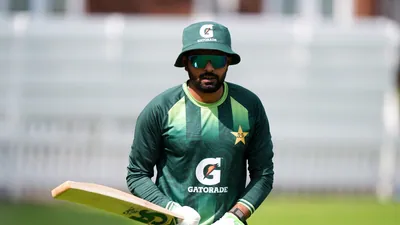
Babar Azam’s return for the Lord’s Test gives Pakistan a timely boost after their disappointing start to the three-match series against England. The experienced batter has declared himself 90 per cent fit and is expected to return to the playing XI for the second Test, which begins on August 27.
Babar missed the opening Test at Headingley because of a finger injury that had originally occurred during Pakistan’s tour of the West Indies before being aggravated after he was struck on the glove during a warm-up match in England.
After returning to batting in training and completing further practice sessions, Babar has indicated that he is ready to play. His availability could also see him resume the captaincy, with Salman Ali Agha having led Pakistan in his absence during the first Test.
The timing of Babar’s comeback could hardly be more important. Pakistan were comprehensively beaten at Headingley, losing by an innings and 103 runs after being dismissed for 171 in their first innings and 135 in the second.
The Lord’s Test therefore represents more than the second match of the series. It is an opportunity for Pakistan to demonstrate that their Headingley performance was an aberration rather than an indication of a deeper problem with their batting and bowling.
Why Babar Azam’s return matters so much for Pakistan
Pakistan’s batting struggled badly in the series opener, and the absence of one of their most experienced batters was noticeable.
Babar’s value extends beyond his reputation. He has extensive experience of Test Cricket, has played successfully in England and possesses the technique required to construct innings in challenging conditions.
His return at No. 4 would provide Pakistan with an established batter in the middle order who can potentially absorb pressure after the openers and build partnerships with the lower middle order.
That stability is particularly important after Pakistan’s collapse at Headingley. The visitors need players capable of staying at the crease long enough to prevent England from controlling the game through repeated bursts of wickets.
However, Babar’s presence should not be viewed as a one-player solution. His return strengthens Pakistan, but the entire batting unit must improve if the visitors are to compete with England over five days.
Babar says he is 90 per cent fit
Babar confirmed ahead of the match that he had completed further practice sessions and considered himself 90 per cent fit.
That assessment will naturally attract attention because finger injuries can be particularly troublesome for batters. The hands are constantly involved in controlling the bat, especially when facing fast bowling or attempting defensive shots.
For Pakistan, the important question is not simply whether Babar can take the field. It is whether he can bat without the injury significantly affecting his technique, shot selection or confidence.
Lord’s can provide a demanding examination because English conditions can encourage movement for seam bowlers. If Babar is not completely comfortable with his grip, England’s attack may test him with deliveries aimed at the body and outside edge.
His claim of being 90 per cent fit suggests confidence, but his workload during the match will still need to be monitored.
Pakistan need a completely different batting performance
Pakistan’s Headingley defeat was not caused by one poor session. Their batting failed in both innings.
They managed only 171 in the first innings before being dismissed for 135 in their second attempt. Such a performance gives England enormous control because the bowling side does not need to take excessive risks when defending or building a large advantage.
The biggest challenge for Pakistan at Lord’s will therefore be constructing partnerships.
Individual brilliance can change a Test match, but sustained partnerships are what prevent an opposition from repeatedly attacking with close fielders and fresh bowlers.
Babar’s return should help in this area, but players around him must also take responsibility. Pakistan cannot afford to expect one batter to rescue the innings every time the top order collapses.
Babar has encouraging numbers in England
One reason for Pakistan to remain optimistic is Babar’s previous record in English conditions.
He averages 65.75 from six Test innings in England, with three half-centuries according to the figures available before the Lord’s Test.
His record against England overall is also strong, with an average of 53.83 from 14 innings, including one century and six fifties.
| Category | Babar Azam’s reported record |
|---|---|
| Fitness ahead of Lord’s | 90 per cent |
| Recent West Indies Test series | 193 runs |
| Test average in England | 65.75 |
| Test innings in England | 6 |
| Half-centuries in England | 3 |
| Average against England | 53.83 |
| Centuries against England | 1 |
| Fifties against England | 6 |
Those numbers offer a reason for Pakistan supporters to expect an improvement. Babar has previously demonstrated that he can adapt to English conditions and build substantial innings against England’s bowlers.
But past success is not a guarantee of future performance. England will have studied his technique carefully, and Babar will need to deal with the specific conditions at Lord’s rather than relying on his previous record.
Babar was Pakistan’s leading run-scorer against West Indies
Babar also enters the Lord’s Test with useful recent form. During Pakistan’s preceding two-Test series against the West Indies, he scored 193 runs, making him the team’s leading run-scorer in that series.
That run of form makes his return even more significant. Pakistan are not simply bringing back an experienced player; they are restoring a batter who had recently been producing important contributions.
If he can carry that confidence into Lord’s, Pakistan’s middle order could look considerably more stable than it did at Headingley.
Pakistan have not finalised their playing XI
Babar’s return creates an immediate selection problem for Pakistan.
The visitors had not formally announced their final XI at the time of Babar’s pre-match press conference, with the team management waiting for another assessment of the Lord’s surface.
The return of a major batter means someone else could lose their place. Azan Awais is among the players whose position could come under pressure, while Shan Masood or Abdullah Shafique could potentially move higher in the order to accommodate Babar at No. 4.
This is an important tactical decision because batting positions are not simply numbers on a team sheet. Moving an opener into another role or changing the opening combination can alter how a batting lineup approaches the new ball.
Lord’s conditions could influence Pakistan’s selection
The surface at Lord’s will be a major factor in Pakistan’s final combination.
If the pitch offers significant assistance to seam bowling, Pakistan may prefer an attack containing additional pace. If conditions are more favorable to spin later in the match, the team could place greater emphasis on its slower-bowling options.
Young fast bowler Ubaid Shah is reportedly among the alternatives being considered if Pakistan want additional pace.
The decision will be particularly important after England’s dominance at Headingley. Pakistan’s bowlers need to create pressure early rather than allowing England’s batters to dictate the tempo.
Salman Ali Agha could still provide balance
Even with Babar expected to return to leadership duties, Salman Ali Agha remains an important part of Pakistan’s tactical options.
Babar has indicated that Salman can continue to provide a second-spin option if the Lord’s conditions require it.
This kind of flexibility can be valuable in Test cricket. A player who contributes with both bat and ball gives the captain additional options when managing a long innings.
Pakistan therefore have to consider the overall balance of the XI rather than simply selecting their most recognizable names.
Pakistan’s senior players are under pressure
The Headingley defeat inevitably increases scrutiny on Pakistan’s experienced players.
Babar acknowledged the importance of backing established performers while also recognizing that repeated failures can eventually lead to selection changes.
This is one of the difficult decisions facing Pakistan. Senior players offer experience and knowledge, but a team cannot continue indefinitely with the same combination if results do not improve.
The Lord’s Test could therefore become an important evaluation point.
A strong performance from the senior core would reinforce the argument for stability. Another major failure could increase pressure for younger players to receive opportunities.
England have the psychological advantage
Pakistan enter Lord’s with the disadvantage of being 1-0 down and having suffered a heavy defeat in the opening match.
England, meanwhile, can approach the second Test with greater confidence. Their innings-and-103-run victory means they have already demonstrated that their bowling attack can expose weaknesses in Pakistan’s batting.
That creates a psychological battle as well as a technical one.
Pakistan must avoid allowing the Headingley result to influence their decision-making. A defensive mindset could allow England to maintain control, while excessive aggression could produce another collapse.
The ideal response would be disciplined aggression: respecting good deliveries while taking advantage of scoring opportunities.
What Babar needs to do at Lord’s
Babar’s individual role will be closely watched, but he does not need to produce a huge score immediately to have a positive influence.
The first priority will be to spend time at the crease and demonstrate that his finger is not restricting his batting.
From there, his experience should allow him to build an innings according to the conditions. Against a strong English attack, leaving the ball well outside off stump and resisting unnecessary strokes could be just as important as scoring boundaries.
If Babar can establish a partnership of significance, Pakistan’s entire batting order could benefit from the increased confidence.
The bigger question: Can Pakistan force a series turnaround?
The Lord’s Test presents Pakistan with an opportunity to reset the series.
A victory would level the three-match contest and completely change the atmosphere around the team. A defeat, however, would hand England an unassailable 2-0 lead and leave Pakistan playing the final Test primarily to avoid a series whitewash.
That makes the second Test arguably the defining match of the series for Pakistan.
Babar’s return gives them an experienced leader and proven batter, but the visitors will need collective improvement. Their bowlers must create sustained pressure, their top order must survive longer and the middle order must convert starts into meaningful contributions.
Prediction: Babar’s return can improve Pakistan, but England remain in control
Babar’s availability should make Pakistan more competitive than they were at Headingley, particularly because his record in England suggests he is comfortable in these conditions.
However, Pakistan’s problems in the first Test were broad enough that one returning player cannot automatically solve them.
If the visitors can avoid another early collapse and their bowlers find consistent movement, Lord’s could become a much closer contest. England, however, will begin with the confidence of a team that already knows its strategy worked in the opening match.
Conclusion: Babar Azam gives Pakistan the boost they desperately needed
Babar Azam’s return for the Lord’s Test is arguably Pakistan’s most significant positive development after their innings defeat at Headingley.
The 31-year-old has declared himself 90 per cent fit after recovering from a finger injury and has returned to batting during training. His previous record in England and against England provides further reason for optimism.
But Pakistan’s challenge goes beyond Babar. The team must correct the batting failures that resulted in scores of 171 and 135 in the opening Test, while the bowling attack must find ways to prevent England from controlling matches for long periods.
The selection of the final XI will also be crucial, particularly with Babar expected to return at No. 4 and the team considering changes to both its batting order and bowling combination.
Lord’s therefore offers Pakistan a chance to respond rather than simply recover. If Babar can lead from the front and the rest of the side raises its level, the series can still become competitive. If the same weaknesses appear again, England could move one step closer to completing a series victory.
For breaking news and live news updates, like us on Facebook or follow us on Twitter and Instagram. Read more on Latest Cricket on thefoxdaily.com.






COMMENTS 0