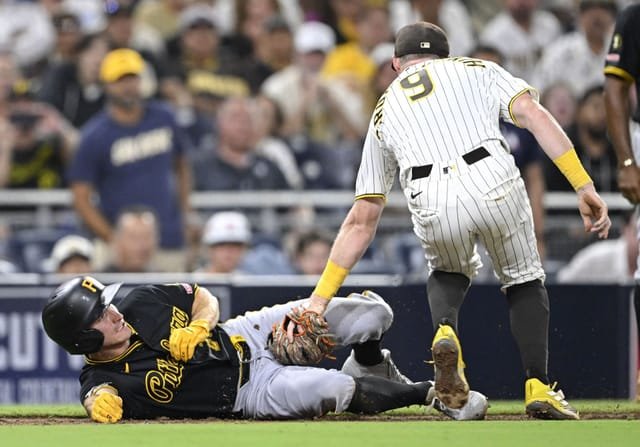
The Braxton Ashcraft balk controversy became one of the biggest talking points from the Pittsburgh Pirates‘ dramatic 3-2 victory over the San Diego Padres. What began as a strong pitching performance from Ashcraft turned into a tense late-game battle after an umpire’s balk decision helped San Diego create a crucial scoring opportunity.
The disputed ruling arrived during a critical stage of the game, with Pittsburgh holding a lead and Ashcraft having kept the Padres’ offense under control for much of his outing. The pitcher visibly reacted to the call, while the Pirates’ dugout also expressed its disagreement. Fans quickly took the debate to social media, with several describing the ruling as one of the worst balk calls they had seen.
Yet the controversy did not determine the final result. Pittsburgh recovered from San Diego’s comeback, survived extra innings and eventually won when Nick Gonzales delivered the decisive hit in the 12th inning. The result gave the Pirates another extra-inning victory and highlighted an important feature of baseball: one disputed moment can dominate the conversation without necessarily deciding the entire game.
Why the Braxton Ashcraft Balk Call Became Such a Big Story
Balk calls are among baseball’s more complicated rules because they involve a pitcher’s movements rather than an obvious contact play. A pitcher working with runners on base is required to follow specific restrictions designed to prevent deceptive movements and protect the fairness of the baserunning situation.
That complexity can make certain balk decisions difficult for fans to understand. Unlike a home run or strikeout, where the result is usually immediately visible, a balk can depend on the precise sequence and timing of a pitcher’s movements.
That was what made the Ashcraft incident so contentious. From the perspective of many viewers, the movement did not appear sufficient to justify the ruling. Several fans questioned where the balk had occurred, while others called the decision ridiculous or absurd.
The reaction was intensified because the call came during a competitive game in which every baserunner mattered. When an umpiring decision changes the position of a runner or contributes to a scoring opportunity, its impact can be much greater than a routine call earlier in the game.
What Is a Balk and Why Can It Change a Game?
A balk is a violation committed by a pitcher while runners are on base. Baseball’s rules contain several situations in which a pitcher’s movement or failure to properly complete a pitching motion can result in a balk.
The purpose of the rule is primarily to prevent pitchers from deceiving baserunners through illegal movements. It therefore connects three important parts of baseball: pitching mechanics, baserunning strategy and umpire judgment.
This makes balks particularly difficult to evaluate from a television replay alone. A pitcher may make a movement that looks completely natural to a viewer, while an umpire positioned on the field may interpret that movement differently based on the pitcher’s actions and the location of the runners.
The Ashcraft controversy illustrates why balks remain among the more debated calls in baseball. A seemingly small movement can potentially change the position of a runner, alter the pitcher’s situation and create a scoring opportunity.
Braxton Ashcraft’s Strong Outing Added More Weight to the Controversy
Before the disputed moment became the headline, Ashcraft had provided Pittsburgh with an excellent start. He completed six innings and allowed only one earned run, keeping San Diego’s lineup from producing sustained offensive pressure.
His recent form also provided important context. According to the game information, Ashcraft had allowed only three earned runs across his previous 23 innings, producing a 1.17 ERA during that stretch. He also entered the contest with a reported 1.91 ERA and 0.67 WHIP in August.
Those numbers help explain why Pittsburgh valued his performance so highly. Ashcraft had been building momentum after a difficult July, and his ability to limit San Diego was a major reason the Pirates were able to establish an early advantage.
Rather than losing control because of poor pitching, Pittsburgh found itself dealing with a game that became increasingly complicated after San Diego began finding opportunities late.
How the Pirates Built Their 2-0 Advantage
Pittsburgh established control of the game before San Diego’s comeback. The Pirates scored twice in the middle innings, with Esmerlyn Valdez and Rafael Flores Jr. providing important offensive contributions.
Valdez hit a solo home run to put Pittsburgh on the scoreboard, while Flores Jr. followed with an RBI double. Those plays gave the Pirates a 2-0 advantage and rewarded Ashcraft for his work on the mound.
The early lead was significant because the game was being played as a low-scoring contest. When runs are difficult to produce, a two-run advantage can feel much larger than it would in a high-scoring matchup.
But baseball rarely allows a team to relax simply because it has a lead. The Padres continued searching for an opening, and eventually the game shifted from a controlled Pittsburgh performance into a tense battle.
The Padres Turned a Pitching Duel Into a Late Thriller
San Diego’s ability to remain competitive became one of the defining elements of the game. Jake Cronenworth praised Ashcraft’s performance while also pointing to the Padres’ tendency to take advantage when an opponent begins to show signs of vulnerability.
“Once we get a guy on the ropes, we kind of come back in the game and that little sliver of hope that seems like we take advantage of it.”
That comment provides a useful way to understand the game’s momentum. The controversial balk call may have created an important opportunity, but San Diego still had to convert that opportunity into runs.
This distinction matters when evaluating controversial officiating. An umpiring decision can influence a game, but it does not automatically determine the outcome. Players still have to execute afterward, and the Padres did exactly that by refusing to let Pittsburgh’s early advantage stand.
Why Fans Were So Angry About the Umpiring Decision
Social media reactions showed how quickly a disputed MLB call can become a major story. Fans described the decision as “ridiculous,” “absurd” and among the worst balk calls they had seen.
Some supporters also referenced another balk decision involving the same umpire, arguing that the incident deserved closer scrutiny. Such comparisons can intensify online debate, although they do not by themselves establish whether the Ashcraft ruling was correct.
The larger issue is that baseball fans increasingly expect transparency when an officiating decision has a direct effect on the scoreboard. When a call is difficult to understand, viewers naturally want to know what specific movement or rule produced it.
That is especially true in the modern MLB environment, where fans can immediately watch replays, slow-motion clips and multiple camera angles. A decision that might once have been discussed only inside the stadium can now become a league-wide conversation within minutes.
Don Kelly’s Reaction Showed the Pirates’ Frustration
Pittsburgh manager Don Kelly also argued the ruling, reflecting how important the situation had become for the Pirates.
Managers have to balance emotion with strategy during controversial moments. Challenging or questioning an umpire’s decision can sometimes help protect a team’s interests, but it can also increase tension during a game where maintaining concentration is essential.
For Pittsburgh, the key challenge was not allowing the disputed call to become an excuse for losing control of the contest. The Pirates eventually responded exactly as they needed to, taking the game deep into extra innings.
The Biggest Insight: The Balk Call Was Not the Final Decider
The most interesting angle from the game is that the controversial balk ultimately became a storyline rather than the final deciding play.
San Diego managed to bring the game level, but Pittsburgh still had multiple opportunities to win later. Both teams had to navigate the pressure of extra innings, where one mistake or one well-executed at-bat can end a long night immediately.
This provides an important comparison between the game’s two defining moments. The balk call generated the loudest debate, while Nick Gonzales’ 12th-inning hit produced the outcome that actually settled the contest.
| Game moment | Impact |
|---|---|
| Braxton Ashcraft’s pitching | Kept San Diego’s offense under pressure and gave Pittsburgh an early advantage. |
| Controversial balk call | Created a major momentum swing and helped the Padres fight back. |
| Extra innings | Forced both teams to manage late-game pressure and limited opportunities. |
| Nick Gonzales’ 12th-inning hit | Scored Jared Triolo and gave Pittsburgh the 3-2 victory. |
Nick Gonzales Delivered When the Pirates Needed Him Most
After the controversy, the game still had to be won on the field. Pittsburgh’s decisive moment finally arrived in the 12th inning when Nick Gonzales lined a full-count fastball into center field.
The hit scored Jared Triolo and ended the marathon contest with Pittsburgh on top 3-2.
Gonzales’ contribution is important because it shifted attention away from the earlier controversy and back toward execution. Extra-inning games often create enormous pressure because every plate appearance carries increased importance, and Gonzales delivered when the Pirates had their opportunity.
The victory also demonstrated Pittsburgh’s resilience. The Pirates had seen their lead disappear, watched the Padres generate momentum and still managed to finish the game successfully.
Pittsburgh’s Bullpen Helped Preserve the Victory
The Pirates also needed important contributions from their bullpen to survive the late stages.
Kirby Yates escaped an 11th-inning jam, preventing San Diego from taking control at a critical point. Yohan Ramirez then handled the 12th inning effectively before Gonzales’ offensive heroics completed the comeback from Pittsburgh’s perspective.
That sequence shows why the final result cannot be reduced to the balk decision. The Pirates needed pitching in high-pressure situations, defensive execution and one final offensive breakthrough.
What the Game Says About Pittsburgh’s Late-Game Resilience
Pittsburgh’s 3-2 win was its sixth extra-inning victory of the season according to the supplied game report. That statistic gives the result additional context.
Extra-inning victories are often less about dominance and more about surviving difficult situations. Teams must manage pitching changes, baserunners and increasingly limited offensive opportunities while maintaining concentration.
The Pirates accomplished that against San Diego. Even after losing their initial advantage, they remained competitive long enough for Gonzales to produce the decisive hit.
That resilience could be more meaningful for Pittsburgh than the controversial call itself. A single umpiring decision will be debated for days, but the ability to win games after momentum swings can have a much longer-term value over a season.
Why the Controversy Matters Beyond One Game
The Ashcraft incident raises a broader question about how MLB communicates complicated umpiring decisions to its audience.
Baseball already uses extensive replay technology, but not every disputed decision is easy for viewers to interpret. When a balk is called, fans may see the result without immediately understanding the precise rule that was applied.
That creates an opportunity for better communication. Clear explanations of complicated calls could reduce confusion and help fans understand why an umpire made a particular decision, even when they disagree with it.
Better explanation would not eliminate arguments. Baseball fans are probably going to argue about calls forever; that is practically part of the sport’s furniture. But greater transparency could make those arguments more informed.
What Comes Next for Braxton Ashcraft?
The most important takeaway for Ashcraft should be his pitching performance rather than the disputed ruling.
His recent statistical form indicates that he has been effective during August, and the six-inning performance against San Diego continued that trend. The Pirates will need that consistency as they navigate the remainder of the season.
The controversy may attract more attention in the short term, but pitchers are ultimately judged over a much larger sample. If Ashcraft continues limiting opponents and producing efficient outings, the balk incident will eventually become a footnote in a much broader season narrative.
Conclusion: A Controversial Call, But Pittsburgh Had the Final Word
The Braxton Ashcraft balk call transformed a tightly controlled Pirates performance into one of the most debated moments of the Padres-Pirates matchup. Fans questioned the decision, Ashcraft showed his frustration and Pittsburgh manager Don Kelly argued the ruling.
But the Pirates refused to let the controversy decide their night.
After San Diego fought back and forced extra innings, Pittsburgh remained composed. Kirby Yates helped escape a critical 11th-inning situation, Yohan Ramirez handled the 12th, and Nick Gonzales ultimately delivered the game-winning hit to score Jared Triolo.
The result was a 3-2 Pirates victory and their sixth extra-inning win of the season.
The bigger lesson is simple: controversial officiating can change momentum, but it does not always determine the winner. Pittsburgh’s ability to recover after losing its lead may ultimately be the most important story from the game.
:::
For breaking news and live news updates, like us on Facebook or follow us on Twitter and Instagram. Read more on Latest MLB on thefoxdaily.com.




COMMENTS 0