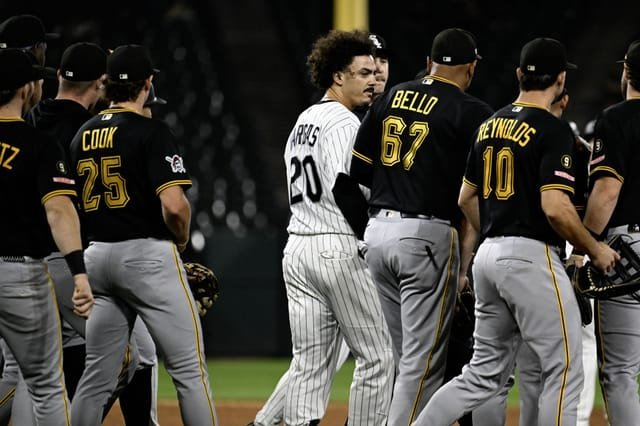
Sam Antonacci and Brandon Lowe collision became the unexpected talking point from Wednesday’s matchup between the Pittsburgh Pirates and Chicago White Sox. What initially appeared to be a competitive play around second base quickly developed into a heated confrontation, with players from both teams becoming involved.
The incident occurred during the seventh inning as Antonacci attempted to reach second base while Lowe was completing his follow-through after turning a double play. The two players made contact, and Lowe immediately appeared unhappy with the collision.
The situation escalated when Lowe confronted Antonacci. Pirates infielder Jared Triolo also became involved, and the tension eventually resulted in both dugouts and bullpens clearing.
Although the confrontation created plenty of discussion among fans, the game itself ultimately belonged to Pittsburgh. The Pirates scored three runs in the seventh inning and held Chicago to two runs over the final three innings to secure a 4-2 victory.
How the Antonacci-Lowe confrontation started
The incident developed during a fast-moving seventh-inning play. Antonacci was attempting to advance toward second base while Lowe was involved in the defensive sequence.
As Lowe completed his follow-through after helping turn a double play, Antonacci made contact with him. The collision immediately drew Lowe’s attention, and the White Sox player confronted the Pirates runner.
From there, emotions escalated quickly.
Triolo became involved on Antonacci’s side, and players from both teams began moving toward the confrontation. What could have remained a brief argument eventually turned into a benches-clearing incident.
The situation did not appear to develop into a prolonged physical altercation, but the presence of both teams’ players and the subsequent disciplinary action ensured that the moment became a major talking point after the game.
MLB fans question why the collision became such a big story
Fans on social media had sharply different reactions to the confrontation. A significant portion of the online response focused on the belief that the collision was simply part of normal baseball competition.
Some supporters argued that Antonacci was attempting to disrupt the defensive play rather than deliberately injure Lowe. Others questioned why the situation escalated when the actual contact appeared relatively limited.
Several fans described the incident as insignificant compared with the much more intense confrontations historically associated with professional baseball.
However, social-media reactions should be viewed as opinions rather than definitive judgments about the players’ intentions. Neither a fan’s interpretation nor a heated online comment establishes whether either player deliberately attempted to cause harm.
Why second-base collisions can create tension
Plays around second base are among the most complicated defensive situations in baseball. Middle infielders often have to complete a double play while simultaneously avoiding a runner attempting to reach or disrupt the play.
That creates a narrow margin for error.
A runner’s movement can affect a fielder’s ability to throw, while the fielder’s momentum can place the runner in an awkward position. Even when nobody intends to cause an injury, contact can occur because both players are moving quickly and reacting to the same play.
This is why determining intent is important when evaluating a controversial collision.
A legal attempt to reach a base, a defensive player’s natural follow-through and an intentional attempt to interfere with an opponent are not necessarily the same thing.
Benches and bullpens clear after the confrontation
The disagreement between Antonacci and Lowe did not remain limited to the two players.
Triolo became involved, and players from both teams responded by leaving their respective dugouts. The bullpens also emptied, creating a large gathering around the area of the confrontation.
Benches-clearing incidents traditionally attract significant attention because they can quickly become difficult for officials to control. Even a relatively minor disagreement can escalate when dozens of players arrive simultaneously.
In this case, there were ejections and warnings for both sides following the incident.
The disciplinary response demonstrated that officials considered the situation serious enough to warrant action, even though the confrontation itself did not define the outcome of the game.
Pirates answer the drama with a seventh-inning rally
While the confrontation dominated the conversation, Pittsburgh’s performance in the seventh inning ultimately proved more important.
The Pirates scored three runs during the frame, turning the contest in their favor and establishing the lead they would eventually protect.
Chicago managed to score two runs over the final three innings, but the White Sox could not produce enough offense to complete a comeback.
Pittsburgh therefore walked away with a 4-2 victory and made it two consecutive wins over Chicago in the series.
| Game factor | Outcome |
|---|---|
| Final score | Pirates 4, White Sox 2 |
| Key inning | Seventh inning |
| Pirates seventh-inning scoring | Three runs |
| White Sox final three innings | Two runs |
| Series result | Pittsburgh won consecutive games |
| Post-collision discipline | Warnings and ejections for both sides |
Was Antonacci trying to interfere with the play?
One of the central questions surrounding the incident is whether Antonacci’s movement was simply part of his attempt to reach second base or whether he was intentionally trying to interfere with Lowe.
The supplied report does not establish that Antonacci intended to injure Lowe. Fans who defended the Pirates player argued that attempting to disrupt a double play is part of the competitive nature of baseball.
At the same time, Lowe’s reaction shows why defensive players can become frustrated when contact affects their ability to complete a play.
The distinction between aggressive baserunning and illegal interference is ultimately determined by the rules and the judgment of officials, rather than by social-media reactions.
Why the incident divided MLB fans
The disagreement exposed a broader divide among baseball fans about how much physical confrontation should be tolerated in modern MLB.
Some supporters prefer an old-school style of baseball in which players are expected to accept physical contact and competitive intimidation as part of the sport. Others believe today’s game should place greater emphasis on player safety and preventing unnecessary collisions.
That difference in perspective explains why the same incident can generate completely opposite reactions.
One fan may view the collision as an ordinary baseball play, while another may see the confrontation afterward as an unnecessary escalation.
The online response surrounding Antonacci and Lowe reflected that divide, with some fans dismissing the incident entirely while others defended the decision to confront the opposing player.
Modern MLB places greater emphasis on player safety
Baseball has changed considerably over the years, particularly regarding collisions and player safety. Rules and enforcement have increasingly focused on reducing avoidable contact while still allowing runners and defenders to compete aggressively.
That evolution means comparisons with previous eras can be misleading.
What may once have been accepted as normal baseball behavior can receive greater scrutiny today. Players are also much more likely to see controversial incidents replayed from multiple angles and discussed immediately across social media.
As a result, even a brief confrontation can become a significant storyline within minutes.
The baseball outcome matters more for the Pirates
For Pittsburgh, the most important development from the game was not the confrontation but the victory.
The Pirates scored four runs and limited the White Sox to two, demonstrating the ability to create separation late in the game and protect their advantage.
The three-run seventh inning was especially important because it gave Pittsburgh the offensive cushion needed to withstand Chicago’s response during the closing innings.
Winning consecutive games in the series also gives the Pirates momentum against the White Sox, regardless of the attention generated by the Antonacci-Lowe dispute.
Pirates vs White Sox: What decided the game?
The final score shows that Pittsburgh’s late offensive push was the decisive factor. Chicago remained competitive, but the White Sox could not match the Pirates’ seventh-inning production.
| Area | Pittsburgh | Chicago |
|---|---|---|
| Total runs | 4 | 2 |
| Seventh inning | Three-run rally | Could not match Pittsburgh’s surge |
| Late-game scoring | Protected its advantage | Scored two runs over final three innings |
| Series momentum | Second straight win | Second straight loss to Pittsburgh |
What happens next for Antonacci and Lowe?
The immediate disciplinary response included warnings and ejections involving both sides. Beyond that, the incident is unlikely to overshadow the larger MLB season unless the rivalry produces another confrontation.
For Antonacci, the focus will return to his offensive and baserunning contributions. For Lowe, attention will shift back toward his defensive responsibilities and overall production for Chicago.
The most important lesson may be for both teams to avoid allowing a single collision to distract from the broader objective of winning games.
Baseball is filled with moments in which players compete at high speed and emotions rise. The ability to reset quickly after such incidents can be just as important as the original play.
Why social media amplified the controversy
The Antonacci-Lowe incident also demonstrates how modern sports coverage can transform a brief on-field exchange into a major discussion.
Clips of confrontations can circulate quickly, often without the full context of what happened before or after the collision. Fans then interpret the footage differently depending on their allegiance and personal view of the sport.
That can produce strong reactions even when the underlying incident is relatively limited.
In this case, comments describing the confrontation as either completely harmless or excessively dramatic illustrate how differently viewers perceived the same moment.
Final Verdict
The Sam Antonacci and Brandon Lowe collision created an unexpected flashpoint during the Pirates’ 4-2 victory over the White Sox. The seventh-inning contact led to a confrontation, both benches and bullpens clearing, and disciplinary action involving both teams.
MLB fans were divided over the incident, with many arguing that the contact was simply part of competitive baserunning and double-play action. Others believed the confrontation justified a stronger response from the players involved.
Without established evidence of malicious intent, the safest conclusion is that the incident was a tense baseball moment that escalated beyond the original play. Pittsburgh ultimately made the bigger statement where it mattered most, scoring three runs in the seventh inning and securing its second straight victory over Chicago.
The controversy may generate headlines, but the Pirates’ late-game execution remains the more meaningful takeaway from the contest.
For breaking news and live news updates, like us on Facebook or follow us on Twitter and Instagram. Read more on Latest MLB on thefoxdaily.com.



COMMENTS 0