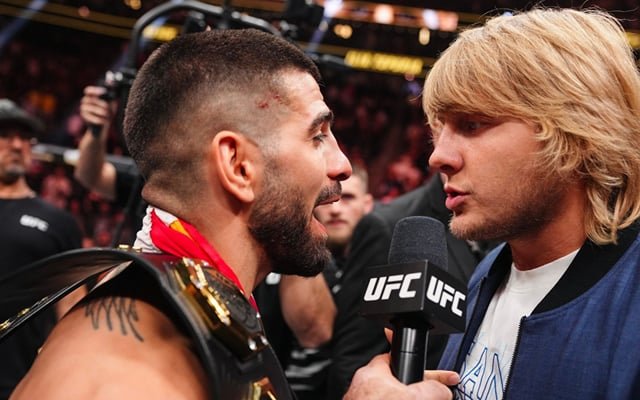
Ilia Topuria’s lightweight journey has entered a more complicated phase after his stoppage defeat to Justin Gaethje at UFC Freedom 250. The former featherweight champion had built much of his reputation around his power, pressure and ability to physically impose himself on opponents, but his first major setback at 155 pounds has prompted fresh discussion about whether he is naturally suited to the division.
Former UFC heavyweight Brendan Schaub believes Topuria’s size could become an increasingly important factor as he faces larger lightweight contenders. Speaking on his YouTube channel, Schaub argued that the physical difference was visible against Gaethje and suggested it could become even more noticeable if Topuria eventually meets Paddy Pimblett.
The discussion comes at a significant point in Topuria’s career. His move from featherweight to lightweight was accompanied by expectations that his punching power and technical ability would translate successfully. However, the Gaethje fight has given analysts a new set of questions to consider before assessing his future at 155 pounds.
Brendan Schaub Identifies Size as a Potential Issue for Topuria
Schaub’s central argument is that Topuria may be undersized compared with some of the leading fighters in the lightweight division. According to the former UFC heavyweight, Topuria’s previous success against established names at featherweight helped create an image of him as an overwhelming force at lightweight before he had faced the division’s biggest physical challenges.
That perception changed during his matchup with Gaethje, in Schaub’s view. He suggested that the physical differences between the two fighters became more noticeable during the contest and believes a similar issue could arise against Pimblett.
Pimblett is frequently viewed as a physically larger lightweight, making the hypothetical matchup an interesting test of Topuria’s ability to deal with size, reach, strength and overall physical presence. Schaub specifically highlighted Pimblett as an opponent who could make the issue more obvious than it was against Gaethje.
Importantly, Schaub’s comments are an analysis of the matchup rather than an established conclusion that Topuria cannot compete successfully at lightweight. Fighters can overcome physical disadvantages through timing, technique, conditioning and tactical adjustments, and Topuria’s previous career has demonstrated his ability to win against highly regarded opposition.
What Justin Gaethje’s Victory Changed for the Lightweight Discussion
Before facing Gaethje, Topuria’s reputation was built largely around dominance and finishing ability. His success at featherweight established him as one of the division’s most dangerous offensive fighters, while his move to lightweight created expectations that his power would remain a major advantage.
The Gaethje fight offered a different picture.
Instead of simply discussing whether Topuria could carry his knockout threat into a heavier division, analysts now have to consider how he performs when facing a naturally established lightweight with considerable physical strength and experience at the weight.
That distinction matters because lightweight is one of the UFC’s deepest divisions. The 155-pound category contains fighters with different physical profiles, from compact power punchers to tall, rangy strikers and physically strong grapplers.
Topuria’s challenge, therefore, may not be limited to one particular opponent. If he remains at lightweight, he could repeatedly encounter fighters who are naturally comfortable competing at the division’s upper physical range.
Why a Potential Paddy Pimblett Fight Would Be Different
A potential fight between Topuria and Pimblett would create an intriguing stylistic and physical contrast.
Pimblett has competed at lightweight throughout his UFC career and has established himself as one of the division’s recognizable names. His physical frame is larger than Topuria’s former featherweight profile, which is precisely why Schaub believes the matchup could provide another test of Topuria’s ability to compete against bigger lightweights.
From a technical perspective, the fight would also involve different questions from those presented by Gaethje.
- Physicality: Topuria would have to deal with Pimblett’s larger frame and overall strength.
- Range: The distance and positioning could influence how effectively Topuria gets his preferred attacks into range.
- Grappling: Pimblett could provide different problems in extended grappling exchanges.
- Power: Topuria’s ability to create damaging exchanges would remain an important part of the matchup.
- Adaptation: The fight would test whether Topuria can adjust his approach against a larger opponent.
These factors do not automatically determine the outcome of a hypothetical contest. They simply explain why the matchup has become relevant to the wider conversation about Topuria’s future at 155 pounds.
Topuria’s Lightweight Challenge Is Bigger Than One Physical Mismatch
The most significant point raised by Schaub is not necessarily that Topuria lacks the physical attributes required for lightweight. Instead, his comments highlight how different the competitive environment can become after moving up a division.
At featherweight, Topuria had the opportunity to combine his technical skills with a physical profile that was much more naturally suited to the weight class. At lightweight, the same attributes must be tested against opponents who have spent more of their careers competing at 155 pounds.
This creates a different competitive equation.
A fighter moving up in weight does not necessarily lose his technical advantages, but some of the physical advantages that previously helped him control fights can become less pronounced. Opponents may be stronger in clinches, harder to move, more durable in exchanges or better equipped to absorb physical pressure.
That is why the Gaethje result has generated so much discussion about Topuria’s future. It provides an example of what can happen when an elite former featherweight meets a highly experienced lightweight with a different physical profile.
Paddy Pimblett Also Responds to Topuria’s Gaethje Allegations
The discussion around Topuria and Pimblett is not limited to the potential physical matchup. Pimblett has also commented on the controversy surrounding Topuria’s defeat to Gaethje.
Following the fight, Topuria alleged that Gaethje had used loaded gloves. The accusation became part of the post-fight discussion, with Topuria questioning the circumstances surrounding the hand-wrapping and equipment used for the contest.
Pimblett rejected those allegations in comments on his YouTube channel. He pointed to the involvement of athletic commissions in supervising the hand-wrapping process and argued that the accusation should not be treated as evidence that Gaethje had violated the rules.
Because the claims involve competing interpretations of events, it is important to distinguish between an allegation and an established finding. Topuria made the accusation, while Pimblett disputed it. The supplied report does not establish that Gaethje used prohibited equipment or that any commission found evidence of wrongdoing.
Why the Gaethje Defeat Matters for Topuria’s Next Move
Topuria’s next step at lightweight will be closely watched because the loss creates a new stage in his career. A defeat after moving up in weight does not by itself establish that the move was unsuccessful, but it does provide useful information about the challenges he faces in the division.
The biggest question is whether Topuria can adjust.
Elite fighters often respond to setbacks by changing their tactics, improving specific areas of their game or altering the types of opponents they pursue. For Topuria, the challenge is particularly interesting because his reputation was built around imposing his own style rather than simply surviving difficult matchups.
If he remains at lightweight, his ability to deal with larger opponents could become a recurring theme. The division offers a wide range of physical and stylistic challenges, meaning the Gaethje fight may serve as a reference point for future matchups rather than an isolated event.
Topuria’s Lightweight Profile Compared With Gaethje and Pimblett
| Factor | Ilia Topuria | Justin Gaethje | Paddy Pimblett |
|---|---|---|---|
| Division context | Former featherweight champion competing at lightweight | Established lightweight contender | Established UFC lightweight |
| Key discussion point | Adaptation to 155 pounds | Physicality and experience at lightweight | Size and physical matchup with Topuria |
| Recent relevance | Defeated by Gaethje at UFC Freedom 250 | Stopped Topuria at UFC Freedom 250 | Has publicly discussed the Topuria-Gaethje controversy |
| Potential matchup question | Can his skills translate against larger lightweights? | How his victory affects the lightweight landscape | How his physical profile would challenge Topuria |
What Schaub’s Comments Mean for a Potential Topuria-Pimblett Fight
Schaub’s analysis places physical size at the center of a potential Topuria-Pimblett matchup. If the fight happens, observers would likely examine whether Topuria can reproduce the speed, power and pressure that made him so successful at featherweight against a naturally larger opponent.
However, physical dimensions would only represent one part of the equation.
Fight outcomes are influenced by striking accuracy, defensive reactions, wrestling exchanges, cardio, tactical decisions and the ability to make adjustments during the contest. A larger fighter does not automatically neutralize a smaller opponent, just as a smaller fighter does not automatically lose because of a physical disadvantage.
For that reason, the potential fight should be viewed as a test of Topuria’s lightweight adaptation rather than simply a size-versus-skill contest.
The Bigger Picture for Topuria at 155 Pounds
Topuria’s move to lightweight has always carried an important question: can the fighter who looked physically imposing at featherweight maintain the same level of dominance against bigger opponents?
His defeat to Gaethje means that question now has greater relevance. Schaub’s comments add another layer by identifying Pimblett as a matchup in which the physical difference could become even more visible.
At the same time, one fight should not erase Topuria’s previous accomplishments. His success at featherweight remains an important part of his career record, while his ability to compete at lightweight will require further evidence across multiple matchups.
The division also gives him opportunities to demonstrate whether he can evolve. If Topuria adjusts his approach, improves his physical preparation for the weight class and finds ways to consistently impose his strengths against larger opponents, the size discussion could develop differently over time.
Final Verdict
Brendan Schaub’s assessment has added to the ongoing discussion surrounding Ilia Topuria’s future at lightweight. His argument is that the physical disadvantage became noticeable against Justin Gaethje and could be even more apparent against Paddy Pimblett, whose larger frame presents a different type of challenge.
For now, the size question remains a topic of analysis rather than a settled conclusion about Topuria’s ability to succeed at 155 pounds. The Gaethje defeat provides one important data point, while a future matchup against a larger lightweight such as Pimblett would offer another opportunity to examine how effectively Topuria’s skills translate to the division.
The controversy surrounding Topuria’s allegations about Gaethje’s gloves has also become part of the conversation, although Pimblett has rejected those claims and the supplied report does not establish any wrongdoing by Gaethje. Ultimately, Topuria’s future at lightweight will be defined by what he does in the Octagon in subsequent fights, not solely by outside assessments of his size.
For breaking news and live news updates, like us on Facebook or follow us on Twitter and Instagram. Read more on Latest MMA on thefoxdaily.com.






COMMENTS 0