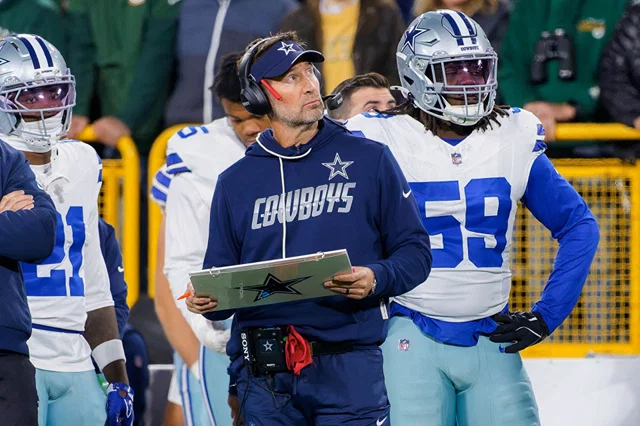
Dallas Cowboys head coach Brian Schottenheimer is facing mounting criticism from supporters after firmly rejecting the possibility of handing over offensive play-calling duties amid questions about the team’s performance. Schottenheimer made his position clear during a Friday appearance on 105.3 The Fan, expressing confidence in his ability to turn the offense around rather than delegate responsibility to offensive coordinator Klayton Adams.
His comments quickly became a talking point among NFL fans, many of whom questioned whether the head coach was recognising the team’s problems or refusing to acknowledge the need for change. Some supporters called for his dismissal, while others argued that his confidence in his play-calling had become difficult to justify amid the Cowboys’ struggles.
Schottenheimer, however, showed no intention of stepping aside from his current responsibilities. He maintained that Dallas still possessed an explosive offense with multiple weapons and insisted that he retained the ability to call plays at an elite level.
The controversy comes amid wider scrutiny of the Cowboys’ offensive direction and Schottenheimer’s handling of personnel. His recent criticism of wide receiver George Pickens over run-blocking responsibilities has also attracted attention, with Pickens responding by emphasising that he was following the instructions given to him by the coaching staff.
With Dallas preparing to face the Philadelphia Eagles on Monday, the pressure is on Schottenheimer and his team to produce a convincing performance. For a franchise that regularly attracts intense scrutiny, the debate over play-calling has become another test of the head coach’s credibility and leadership.
Brian Schottenheimer Rejects Calls to Hand Over Play-Calling Duties
During his Friday appearance on 105.3 The Fan, Schottenheimer was asked directly whether he would consider delegating offensive play-calling responsibilities to Klayton Adams.
His answer left little room for interpretation.
“No, absolutely not.”
The response made clear that Schottenheimer intends to retain direct control over the Cowboys’ offensive play-calling rather than allow his coordinator to take over that aspect of the game plan.
For NFL teams, play-calling responsibilities can be structured in different ways. Some head coaches call offensive plays themselves, while others delegate the task to their offensive coordinators. Neither arrangement guarantees success, as the effectiveness of a system depends on the quality of its design, the players executing it and the adjustments made during games.
Handing over play-calling duties can nevertheless provide a head coach with an opportunity to reassess the offense from a broader perspective. It can also allow a coordinator to introduce different ideas or take greater responsibility for adjustments.
Schottenheimer’s refusal to consider such a change means that he remains personally accountable for the offensive decisions made under his leadership. If the unit continues to struggle, the debate over whether he should retain those duties is likely to remain part of the broader discussion surrounding the Cowboys.
However, the decision does not automatically establish that delegation would improve Dallas’s performance. A change in play-calling could produce a different approach, but its success would depend on the coordinator’s methods, the players’ execution and the team’s ability to adapt.
Schottenheimer Calls Himself an Elite Play-Caller
Schottenheimer did more than reject the possibility of delegating his responsibilities. He also defended his offensive approach and expressed strong confidence in his own abilities.
“I have incredible confidence in our offense. … We haven’t changed who we are. We’re still a good explosive offense with weapons. We can hurt you a lot of different ways. (I) certainly have not lost the ability to call plays. I’m an elite play-caller in this league, and I think that I can turn it around quickly.”
The comments reflect his belief that the Cowboys’ offensive problems can be addressed without changing who makes the play-calling decisions. Schottenheimer argued that the team still possesses the personnel and offensive capabilities needed to cause problems for opponents.
His emphasis on the offense’s existing identity suggests that he does not view a fundamental change in play-calling leadership as necessary at this stage. Instead, his position indicates that he believes the current approach can produce better results with improved execution.
That distinction matters because poor offensive performances can have several causes. A team may struggle because its play selection is predictable, because players fail to execute assignments, because protection breaks down or because opposing defenses successfully exploit weaknesses in the system.
These problems can overlap, making it difficult to determine whether changing the play-caller would address the underlying issues. A coordinator might offer different concepts and adjustments, but even a new approach requires players to execute their assignments effectively.
Schottenheimer’s confidence may be intended to reinforce his belief in the team’s ability to recover. However, strong declarations also create expectations. When a coach describes himself as elite, supporters naturally expect the offense to demonstrate the consistency and effectiveness associated with that assessment.
The central question is therefore not simply whether Schottenheimer believes in his abilities. It is whether the Cowboys can translate that confidence into better performances on the field.
NFL Fans React Angrily to the Cowboys Coach’s Comments
Schottenheimer’s refusal to relinquish play-calling responsibilities triggered a wave of criticism on social media. Several fans expressed frustration with his confidence and argued that Dallas needed a more substantial response to its offensive struggles.
One supporter demanded:
“Just fire the guy already. My gosh,”
Another questioned whether the coach was recognising the situation clearly, writing:
“Fool is in denial,”
A third fan took aim at Schottenheimer’s assessment of his own coaching ability:
“This guy really thinks he’s a great coach and play caller,”
Another supporter suggested that the offense’s effectiveness might be overstated:
“Someone needs to tell him his offense only works on his own defense,”
Some reactions focused on the potential consequences if the Cowboys fail to improve. One fan warned:
“Get those mock drafts ready,”
Another expressed frustration with what they viewed as excessive pride:
“Welp, that pride officially seals it; can’t get out of his own way,”
The comments reflect a section of the fanbase that wants visible changes rather than assurances that the current approach will eventually work. For supporters, a coach’s confidence carries less weight when it is not accompanied by convincing results.
Nevertheless, social media reactions are not a comprehensive measure of fan opinion. The comments demonstrate frustration among the users who responded, but they do not establish that every Cowboys supporter shares the same view.
Nor do the reactions prove that Schottenheimer’s play-calling is the sole cause of Dallas’s difficulties. Assessing that question would require a closer examination of game performances, offensive efficiency, personnel decisions and the quality of execution.
Even so, the intensity of the criticism highlights the scrutiny that comes with coaching one of the NFL’s most closely followed franchises. Every public statement can become part of a wider debate about whether the team is moving in the right direction.
Why Giving Up Play-Calling Could Become a Major Coaching Decision
Play-calling is one of the most visible responsibilities in an NFL offense. The person making those decisions influences the balance between running and passing, the use of personnel, the pace of the game and the adjustments made against opposing defenses.
When an offense struggles, changing the play-caller can become an appealing option because it offers the possibility of a different tactical approach without necessarily changing the roster.
However, the decision is more complicated than simply replacing one voice with another. A head coach who calls plays must balance game management, communication with assistants, player development and adjustments to the opposition. Delegating offensive duties can create more time for those responsibilities, but it also changes the distribution of authority within the coaching staff.
For Schottenheimer, handing the role to Adams would mean allowing another coach to take primary responsibility for a central part of the Cowboys’ offensive operation. Retaining the role, by contrast, keeps the decision-making structure intact and gives Schottenheimer direct control over adjustments.
Neither option is inherently superior. The important consideration is whether the existing structure is helping the team perform effectively.
A change in play-calling might be useful if the offense repeatedly struggles with predictable concepts or fails to adjust to defensive pressure. If the main problem is missed assignments, poor execution or a lack of consistency from the players, changing the play-caller may have a more limited effect.
This is why a coach’s decision should ultimately be judged by the performance of the offense rather than the public confidence with which it is defended. Schottenheimer has made his position clear, but the Cowboys’ subsequent performances will provide the more meaningful evidence of whether his approach is working.
George Pickens Controversy Adds to the Pressure on Schottenheimer
The debate over play-calling is not the only issue surrounding Schottenheimer. His recent remarks about wide receiver George Pickens’ involvement in the running game have also drawn attention, creating another discussion about the coach’s communication with his players.
On Thursday, Schottenheimer emphasised that Pickens needed to contribute to the team’s blocking responsibilities, including engaging defensive backs and helping the offense execute its running plays.
“He’s got to do the same thing picking up safeties and blocking corners just like Javonte does, picking up blitzes so he can catch balls. That’s part of the team-first mindset, and GP does understand that. … When he’s not going, the safety gets pretty good runs at our backs, and that’s going to improve.”
The remarks framed blocking as an important part of Pickens’ responsibilities beyond catching passes. In an NFL offense, wide receivers can influence the running game by blocking defensive backs and helping create space for ball carriers.
When a receiver fails to execute a blocking assignment, a defender may be able to reach the running back more quickly. Conversely, effective blocking can help sustain a play and improve the offense’s chances of gaining yards.
Schottenheimer’s comments therefore addressed a football responsibility rather than only the receiver’s production as a pass catcher. His emphasis on a team-first mindset suggested that he expected Pickens to contribute across different phases of the offense.
However, public criticism of an individual player can also create tension if the comments are perceived as assigning responsibility for wider team problems. The way a coach communicates expectations can matter almost as much as the expectations themselves, particularly when a team is already under pressure.
The available comments do not establish that the disagreement has caused a broader breakdown within the Cowboys’ locker room. They do, however, show that the relationship between the coach’s expectations and the player’s response has become a topic of public discussion.
George Pickens Responds to the Coach’s Criticism
Pickens was asked about Schottenheimer’s comments during his media availability on Friday. His response was measured, with the receiver emphasising that he was carrying out the instructions given to him by the coaching staff.
“Well, I’m doing what they tell me to do. So, do what they tell me to do. I feel like if you narrow the comments down, you’re talking about the team. Most definitely, I feel like as a team, just keep improving.”
Pickens did not openly endorse the criticism, but he also did not explicitly reject the importance of teamwork. Instead, he returned the focus to following instructions and improving collectively.
His response leaves room for interpretation. It could be read as a straightforward statement about his responsibilities, but it also suggests that he sees his role as following the coaching staff’s directions rather than independently defining his assignments.
Without further evidence, it would be premature to characterise the exchange as a serious dispute between the player and the coach. Public comments alone do not reveal the full nature of their private discussions or how the issue is being addressed inside the team.
For Dallas, the practical question is whether the expectations surrounding Pickens’ blocking are clearly understood and consistently executed. If the receiver improves in that area, the issue may become less prominent. If concerns persist, it could remain part of the discussion about offensive execution and accountability.
Cowboys Face a Difficult Test Against the Philadelphia Eagles
The timing of the controversy is significant because Dallas is preparing to visit the Philadelphia Eagles on Monday. The matchup offers the Cowboys an opportunity to respond on the field while facing an opponent capable of testing their offensive execution.
The game is scheduled to kick off at 7:15 p.m. Central Time and will be broadcast on ABC and ESPN, according to the supplied report.
For Schottenheimer, the contest presents an opportunity to demonstrate that his confidence in the offense is justified. A more effective performance could ease some of the criticism surrounding his refusal to delegate play-calling duties, although one game would not necessarily resolve every concern.
Conversely, if the offense continues to struggle, questions about the coaching structure could become more persistent. Supporters who believe a change is necessary may point to the performance as further evidence that the current approach requires reconsideration.
The Eagles matchup will also test the team’s ability to execute across different phases of the offense. Dallas will need to protect the quarterback, create opportunities in the running game and make effective decisions when facing defensive pressure.
Pickens’ blocking responsibilities could remain relevant if the Cowboys seek to establish a more effective ground attack. The receiver’s contribution to those plays is one component of the overall offensive operation, though it would be inaccurate to suggest that his performance alone will determine the result.
What Happens Next for Brian Schottenheimer and Dallas?
Schottenheimer has made it clear that he intends to retain offensive play-calling duties, leaving the responsibility for improving the unit firmly with him and the coaching staff. His public confidence suggests that he believes the Cowboys can recover without making a change to the current arrangement.
The next step is to determine whether that belief is supported by better execution. Offensive performance depends on a combination of preparation, play selection, player availability, communication and decision-making under pressure. No single adjustment guarantees an immediate turnaround.
Delegating play-calling to Adams remains a question that Schottenheimer has answered firmly for now. Whether that position continues to make sense will depend on how the offense performs and whether the coaching staff can identify and correct its weaknesses.
The discussion surrounding Pickens adds another layer to the challenge. Schottenheimer must communicate expectations clearly while ensuring that individual responsibilities contribute to the team’s broader objectives. Players, in turn, must execute their assignments and respond to the coaching staff’s plans.
For Cowboys fans, the frustration is understandable: assurances about offensive potential mean little without consistent results. Yet the decision to change play-callers should be evaluated on evidence rather than anger alone.
Schottenheimer has defended his ability, rejected the idea of handing over control and insisted that Dallas can turn things around quickly. The Monday meeting with Philadelphia provides the next opportunity for the Cowboys to show whether their coach’s confidence can translate into an improved performance. Until then, the debate over his play-calling responsibilities is likely to remain a central talking point surrounding the team.
For breaking news and live news updates, like us on Facebook or follow us on Twitter and Instagram. Read more on Latest NFL on thefoxdaily.com.




COMMENTS 0