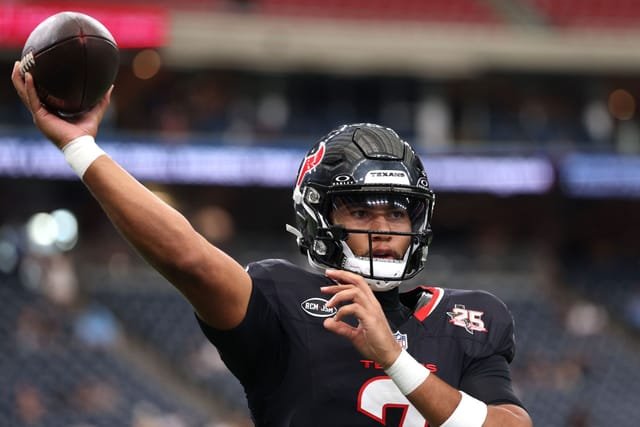
C.J. Stroud’s contract situation has quickly become one of the biggest offseason questions surrounding the Houston Texans. NFL insider Adam Schefter reported that Stroud and the Texans remain far from an agreement on a new deal, while subsequent reports suggested Houston could be prepared to offer its quarterback between $50 million and $55 million per year.
The reported numbers have created an obvious question: how much should the Texans be willing to pay a quarterback who has already established himself as the franchise’s long-term starter but has also faced criticism for inconsistent performances?
One NFL analyst offered an extremely negative assessment, arguing that Stroud would not even justify a $30 million annual salary in the current salary-cap environment. The analyst went as far as describing the quarterback as a “liability” rather than an asset.
That assessment is considerably harsher than the contract figures reportedly being discussed. It also highlights the central debate surrounding Stroud: should Houston pay for what he has already accomplished, what he is expected to become, or both?
Why C.J. Stroud’s Contract Has Become a Major Story
Stroud entered the NFL as the No. 2 overall pick in the 2023 NFL Draft and quickly changed the expectations surrounding the Texans.
Houston had spent years searching for stability at quarterback. Stroud immediately provided a different level of optimism, winning the NFL Offensive Rookie of the Year award and helping the franchise return to postseason football.
Since then, he has remained the team’s starting quarterback and has taken Houston to the playoffs in each of his first three seasons with the franchise.
That track record is the foundation of the argument for a massive extension.
Quarterback contracts are rarely based purely on the previous season. Teams generally pay for projected value over several years. If Houston believes Stroud can become one of the league’s elite quarterbacks, delaying a long-term extension could eventually become more expensive.
The Reported $50 Million-$55 Million Offer vs. $70 Million Ask
The reported difference between Houston’s potential offer and Stroud’s rumored demand is substantial.
| Contract Figure | Reported Position | What It Represents |
|---|---|---|
| $50 million-$55 million | Reported Texans range | Potential annual value of Houston’s extension offer |
| $70 million | Reported Stroud demand | Rumored annual value being sought by the quarterback |
| $30 million | Analyst’s valuation | Figure the critic argued would already be too high |
The gap between those numbers demonstrates how differently Stroud’s value is being viewed.
Houston’s reported range would place Stroud among the NFL’s highly compensated quarterbacks. A $70 million annual figure, however, would represent an enormous commitment and potentially reset expectations for quarterback contracts.
The analyst’s position sits at the opposite end of the spectrum, suggesting that Stroud has not performed at a level that justifies even a much smaller premium contract.
The Strongest Argument in Stroud’s Favor
There is a straightforward argument supporting Stroud’s position: results.
The Texans selected him second overall in 2023, and he immediately produced enough to win Offensive Rookie of the Year. More importantly for Houston, his arrival coincided with a dramatic improvement in the team’s competitive outlook.
Stroud has also helped the Texans reach the playoffs in each of his first three seasons with the organization.
That consistency of postseason qualification matters when evaluating a franchise quarterback.
A quarterback does not need to win the Super Bowl in his first few seasons to justify a major contract. Teams also consider whether the player has established a reliable foundation around which the roster can be built.
Stroud has given Houston that foundation.
Why Critics Are Questioning His Value
The criticism surrounding Stroud is centered on his performance level rather than his draft status or early success.
The analyst who criticized him argued that Stroud has produced some extremely poor performances when viewed through his own evaluation system. The analyst therefore concluded that Stroud should not be considered an asset worthy of a premium quarterback contract.
That is an opinion, rather than an established league-wide assessment.
It is also important to recognize that quarterback evaluation is complicated. Traditional statistics, film study, advanced metrics and team results can sometimes tell different stories.
A quarterback can play poorly in certain games without necessarily being a poor long-term investment. Likewise, a strong win-loss record does not automatically prove that a quarterback is elite.
The Texans therefore have to evaluate Stroud across a much larger sample than one analyst’s charting or a handful of difficult performances.
Stroud’s Rookie Contract Gives Houston an Important Decision
Stroud signed a four-year rookie contract worth $36.28 million after being selected second overall.
That initial deal gave Houston several seasons of cost-controlled quarterback play while the organization evaluated whether Stroud could become its long-term answer.
Now the Texans face the decision that eventually confronts every team with a successful first-round quarterback: commit early or wait.
Waiting can reduce the risk of paying a player who eventually declines. But it can also increase the financial cost if the quarterback continues improving.
This is why contract negotiations can become difficult even when both sides want the same long-term outcome.
The Salary Cap Changes the Meaning of a $50 Million Contract
One important factor missing from many quarterback salary debates is the growth of the NFL salary cap.
A contract that looks enormous in today’s headlines may represent a smaller percentage of a team’s future cap space as league revenues and the salary cap continue to rise.
That does not make $50 million or $70 million inexpensive. It simply changes how front offices evaluate the relative cost of a quarterback over the life of a contract.
The Texans therefore have to think beyond the headline annual number.
The structure of the contract, guarantees, signing bonus, cap hits and timing of those cap hits can be just as important as the average annual value.
What the Texans Need to Determine Before Paying Stroud
The most important question for Houston is not whether Stroud is perfect. No NFL quarterback is.
The real question is whether the organization believes he can consistently perform at a level that justifies building the roster around his contract.
There are several factors Houston should weigh:
- Consistency: Can Stroud reduce the number of poor performances as he gains experience?
- Development: Is his overall trajectory still moving toward elite quarterback territory?
- Playoff performance: Can he eventually turn regular-season success into deep postseason runs?
- Supporting cast: How much of his production depends on the offensive line, receivers and coaching?
- Contract structure: Can Houston build an extension that protects the franchise while rewarding Stroud?
These questions are more useful than simply asking whether Stroud is “worth” a particular round number.
Why $70 Million Could Be a Risky Number
A $70 million annual salary would create significant pressure on both Stroud and the Texans.
The larger the contract, the higher the expectations become. A quarterback earning that level of money would be expected to consistently perform like one of the best players in the league.
That can affect roster construction as well.
If too much of Houston’s future salary-cap space is committed to one player, the front office has fewer resources available to retain defensive stars, offensive linemen and skill-position players.
The ideal quarterback contract is therefore not necessarily the smallest possible deal. It is a contract that allows the team to keep enough talent around the quarterback to compete.
Stroud’s Preseason Performance Adds Another Talking Point
The Texans have already begun their 2026 preseason campaign, although Stroud did not play in the team’s opening contest against the Los Angeles Chargers, which Houston lost 27-7.
Houston then lost 22-20 to the Las Vegas Raiders in its second preseason game.
Stroud participated against Las Vegas, completing four of seven passes for 27 yards while sharing quarterback repetitions with Davis Mills and Brett Rypien.
Those numbers should not be treated as a major indicator of his regular-season value. Preseason games are often used for limited evaluation, and teams may simplify offensive schemes while managing playing time.
Still, the performance will naturally receive attention because it arrives during a major contract discussion.
Should Stroud Play in the Preseason Finale?
Houston is scheduled to face the Carolina Panthers in its final preseason game on Friday at Bank of America Stadium in Charlotte.
Whether Stroud receives playing time remains uncertain because he is expected to enter the regular season as the Texans’ QB1.
From a football perspective, the decision is relatively straightforward. Houston has to balance preparation against injury risk.
Giving Stroud additional snaps could help him establish rhythm with the offense before the regular season. Keeping him out could reduce unnecessary exposure in a game that has little competitive significance.
Either decision would have little direct connection to his long-term contract value.
The Bigger Question: Is Stroud Being Judged Too Early?
One of the most important points in this debate is timing.
Stroud is still relatively early in his NFL career. Quarterbacks often develop differently, and the transition from promising young passer to consistently elite veteran can take several seasons.
That creates a difficult valuation problem.
If Houston waits until Stroud proves everything skeptics want to see, the quarterback may have even greater leverage and demand an even larger contract.
If Houston commits immediately based on his early success, the franchise assumes the risk that his development may plateau.
There is no completely risk-free answer.
What Happens if the Texans and Stroud Cannot Agree?
If negotiations remain far apart, Houston could eventually face a difficult strategic choice.
The team could continue negotiating and attempt to find a middle ground. It could also delay the long-term commitment while continuing to evaluate Stroud.
From Stroud’s perspective, waiting could make sense if he believes his market value will continue to rise.
From Houston’s perspective, waiting could provide more information but also create the possibility of a more expensive contract later.
That is why the reported difference between $50 million-$55 million and $70 million is more than a simple disagreement over salary. It represents two different assessments of Stroud’s future value.
Prediction: The Final Contract Could Depend on Structure
The most likely path is that the eventual agreement, if one is reached, will depend heavily on contract structure rather than simply the headline annual salary.
Houston could potentially seek mechanisms that protect its future cap flexibility, while Stroud’s side could prioritize guarantees and overall security.
That would allow both sides to claim a meaningful victory without necessarily meeting at the exact number currently being reported.
The biggest obstacle remains the valuation gap. Houston has to decide how much it trusts Stroud’s long-term trajectory, while Stroud has to determine how much leverage his early career success gives him in negotiations.
Conclusion: C.J. Stroud’s Contract Is About More Than $70 Million
C.J. Stroud’s contract situation has become a fascinating test of how the Texans value their young quarterback. Reports indicate that Houston could be considering an extension worth $50 million to $55 million annually, while Stroud’s camp is reportedly seeking a much larger $70 million figure.
One analyst has gone in the opposite direction, arguing that Stroud is not even worth $30 million and labeling him a liability. That criticism represents one extreme of the current debate, while Stroud’s Offensive Rookie of the Year award and three straight playoff appearances provide the strongest evidence for those who believe he deserves a major extension.
The Texans ultimately have to look beyond one analyst’s opinion, one preseason performance or one impressive season. They must decide whether Stroud is capable of becoming the quarterback around whom they can build a championship roster.
If Houston believes the answer is yes, eventually paying a premium could prove easier than replacing him. If the organization has genuine doubts, committing tens of millions of dollars annually could become one of the franchise’s biggest long-term risks.
For breaking news and live news updates, like us on Facebook or follow us on Twitter and Instagram. Read more on Latest NFL on thefoxdaily.com.






COMMENTS 0