The Friendly That Revealed Something Useful
Pre-World Cup friendlies exist in a strange space in football. They are not meaningless, because nothing involving the national team is ever quite without consequence. They are not fully competitive, because the real tournament is the only thing that matters. They serve their most useful purpose when they do exactly what this game against Chile at the Estadio Nacional did: force a team into unexpected situations, test players who would not ordinarily get extended opportunities, and produce evidence about the squad’s depth that a straightforward 90-minute run-out would never generate.
Portugal’s 2-1 win over Chile on Saturday was not a clinical, controlled exhibition of one of the world’s most talented international squads at its fluid best. A red card in first-half stoppage time, a half-time tactical overhaul involving six substitutions, and a second half played ten against ten produced the kind of managed chaos that tournament football occasionally resembles more than any scripted rehearsal. And in the middle of all of it, Goncalo Guedes came off the bench, received a perfect through ball from Ruben Neves, and calmly tapped Portugal into the lead.
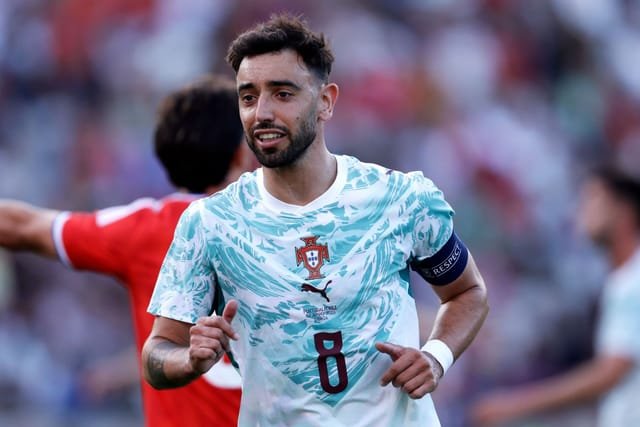
After the game, captain Bruno Fernandes was asked about what Guedes brings to the squad. His answer, specific and considered, frames one of the more interesting selection conversations in Portugal’s World Cup preparation.
Who is at the center of this? Goncalo Guedes, Real Sociedad attacker and Portugal squad member whose impact off the bench made an immediate case for his inclusion. What happened? He scored the opening goal after replacing Cristiano Ronaldo at half-time, with Portugal reduced to ten men and the shape of the game transformed. When? In the first of Portugal’s two pre-World Cup friendlies, against Chile at the Estadio Nacional. Where does the World Cup take place? The United States, beginning June 12. Why does Guedes’ contribution matter beyond a single goal? Because Fernandes’ endorsement frames him as a specific tactical option that Portugal may need at tournament level.
The Chile Game: From Controlled to Complicated to Victorious
The context of Guedes’ contribution matters. This was not a comfortable 11 vs 11 friendly in which Portugal rotated freely and Guedes jogged through against a team with no World Cup pressure to manage. This was a game that turned sharply and unexpectedly in first-half stoppage time.
Portugal had dominated possession in the first 45 minutes, with Cristiano Ronaldo leading the attack alongside his national team colleagues against a Chilean side that will not be present at the World Cup this summer. The chances were created; the goals were not. Then, near the corner flag, a tussle between Rafael Leao and Chile’s Ivan Roman escalated sufficiently for both players to receive red cards. Ten against ten for the entire second half, with Portugal having already used a substitution opportunity on one of their best attacking options before the restart even arrived.
Roberto Martinez’s response at half-time was comprehensive. Six substitutions reshaped the entire team, giving game time to the players who needed it while adjusting the tactical structure to the ten-man reality both sides now faced. Cristiano Ronaldo was among those removed, a decision that the manager explained succinctly in the post-match press conference: “The plan was to make the six substitutions we made. That was part of the plan. And he will only play 45 minutes today.”
Goncalo Guedes came on as Ronaldo’s replacement. The expectation attached to that substitution, in terms of replicating what Portugal’s all-time record scorer provides as a focal point and goal threat, was managed carefully by Fernandes himself in his post-match comments. But the reality of what Guedes delivered, within the specific context of what the second half required, was exactly what Portugal needed.
The Goal That Made the Argument
The move that produced Portugal’s opening goal was a model of the kind of quick, intelligent combination play that Guedes’ profile enables. Ruben Neves, another half-time substitute, played a perfect through ball into the feet of the Sociedad attacker. Guedes, reading the pass correctly and arriving at the right moment, calmly tapped the ball into the net. No drama, no difficulty, no hesitation. The kind of finish that looks easy because the player executing it has already done the hard work of getting to the right position at the right time.
Bruno Fernandes then added a second to give Portugal a two-goal cushion, before Lucas Cepeda pulled one back for Chile in stoppage time for a final score of 2-1. The win was what it needed to be, and the performance provided the kind of information that tournament managers actively look for in the weeks before competition begins.
Fernandes’ Endorsement: What Guedes Brings to Portugal
Speaking after the match, Fernandes was candid about the challenges the game presented and specific about what Guedes contributed within those challenges:
“I think the first half was different, with eleven players against eleven. In the second half, with ten players against ten, we had to be more patient. We needed to increase the tempo at the right moments and avoid rushing things too much. We didn’t have a traditional focal point up front, but we had Goncalo Guedes, who brings different qualities to the team. That’s why I think calling him up could be very interesting, whether to play through the middle or out on the wing.”
— Bruno Fernandes
The most significant phrase in this assessment is “different qualities.” Fernandes is not saying Guedes is better or worse than Portugal’s other attacking options. He is identifying a specific characteristic that differentiates Guedes from the more conventional center-forward profile that Ronaldo provides. Where Ronaldo’s game is built around physicality in the box, aerial threat, and the penalty area presence that has made him one of the sport’s most prolific scorers, Guedes offers something more movement-oriented, more positionally fluid, and more suited to a system in which the center-forward function is distributed rather than concentrated in a single player.
The positional flexibility Fernandes references, noting Guedes can operate “through the middle or out on the wing,” is a specific tournament asset. World Cup football regularly produces situations where a team needs to adjust its attacking shape during a match, either chasing a game, protecting a lead, or managing against a specific defensive setup. A player who can credibly fill multiple attacking positions without requiring a structural overhaul of the team’s shape gives the manager options that a purely position-specific attacker does not.
| Player | Role in Game | Contribution |
|---|---|---|
| Cristiano Ronaldo | Started; subbed off at half-time (planned) | 45 minutes; no goals in first half |
| Goncalo Guedes | Came on at half-time; replaced Ronaldo | Scored Portugal’s opener; assisted by Neves through ball |
| Ruben Neves | Half-time substitute | Provided the decisive through ball for Guedes’ goal |
| Bruno Fernandes | Captained second-half lineup | Scored Portugal’s second goal |
| Rafael Leao | Started; red card in first-half stoppage time | Dismissed after tussle with Chile’s Ivan Roman |
| Lucas Cepeda | Chile (consolation) | Scored Chile’s goal in stoppage time |
Goncalo Guedes: The Profile That Fernandes Is Describing
Goncalo Guedes’ career has been defined by exactly the kind of versatility and technical quality that Fernandes identified. The Real Sociedad attacker has, across his club career, been deployed as a left winger, a second striker, an inverted forward from the right, and as a central forward in pressing-heavy systems. His ability to receive in tight spaces, turn quickly, and find combinations with players around him makes him a natural fit for a possession-based, technically demanding system of the type Martinez has built with Portugal.
At club level with Sociedad, Guedes has been operating in one of European football’s more technically sophisticated environments. The Spanish football culture, with its emphasis on positional play and technical precision, has sharpened the qualities that Fernandes is now identifying as tournament assets. A player who has spent years being coached in the details of positioning, movement, and combination play at a high level brings those patterns to the national team context in ways that are immediately visible in matches like Saturday’s against Chile.
The fact that he scored with his first meaningful involvement in the second half, in a game Portugal were playing with ten men, against an opposition that was also reduced to ten, speaks to his composure and his understanding of when and how to arrive in goal-scoring positions. Tournament football at the World Cup level regularly produces tight games in which those moments of composure are the difference between advancing and going home. Fernandes’ endorsement is partly about what he saw on Saturday and partly about the projection of those qualities onto the highest-stakes stage available.
Martinez’s Squad Management: Ronaldo’s Presence and Portugal’s Depth
Roberto Martinez’s handling of Cristiano Ronaldo’s involvement in the Chile friendly tells its own story about how Portugal intends to approach the World Cup. The confirmation that Ronaldo was always planned to play only 45 minutes reflects the management of a 41-year-old player whose physical preparation for a major tournament requires careful calibration. Ronaldo is not being protected out of doubt about his value. He is being managed out of clarity about what he needs to be at his best when the games that matter arrive.
The fact that Portugal’s second-half lineup, without their all-time great in the team, was able to score twice and manage a ten-man game competently is exactly the kind of evidence a manager wants from a pre-tournament friendly. It demonstrates squad depth and tactical adaptability, and it identifies specific players whose contributions under pressure are reliable enough to count on when the tournament begins in earnest.
Fernandes captaining the second-half lineup and scoring Portugal’s second goal reinforces his central importance to how the team functions when Ronaldo is not leading it. The partnership between Ronaldo’s presence and Fernandes’ intelligence has been one of Portugal’s defining features in recent international tournaments. The Chile game added a new data point: when Ronaldo leaves the field, the team adjusts rather than diminishes, and players like Guedes step into the resulting space with exactly the “different qualities” that Fernandes identified.
One More Friendly, Then America
Portugal’s preparation continues with a final pre-World Cup friendly against Nigeria before the squad flies to the United States for the tournament itself. The Nigeria game provides another 90 minutes of pre-tournament evidence, another opportunity for players on the edges of the squad to make their cases, and another data point in the picture Martinez is building about which combinations work best and in which circumstances.
For Guedes, the challenge now is to carry the form and the confidence of Saturday’s substitute appearance into the Nigeria match and, ultimately, into the tournament itself. One goal and a captain’s endorsement is a strong starting position. The World Cup, however, will require much more than starting positions. It will require the consistency, the game-reading, and the composure under the very highest pressure that the sport can generate.
Fernandes believes Guedes has those qualities. Saturday gave everyone watching reason to think the endorsement is well-founded.
Conclusion: Guedes, a Friendly, and a Captain’s Verdict
The 2-1 win over Chile will not be remembered as one of Portugal’s great performances. It was messy, disrupted by red cards, managed carefully by a coaching staff using the friendly as a fitness and preparation exercise rather than a statement of intent. But from within the chaos, a useful and specific piece of information emerged.
Goncalo Guedes, given 45 minutes as Cristiano Ronaldo’s replacement in a ten-man game against ten-man opposition, scored a composed goal and earned the specific endorsement of the player who captained the team around him. “Different qualities” is not a vague compliment. It is a tactical description of an asset that Portugal’s manager may find genuinely useful across a World Cup campaign in which no game will unfold exactly as planned.
Portugal face Nigeria next. The World Cup begins June 12. And one attacker from Real Sociedad has given the manager one more interesting option to consider, with the captain’s backing attached.
When Bruno Fernandes says calling him up “could be very interesting,” the squad takes notice. The Chile game gave everyone watching a reason to agree.
For breaking news and live news updates, like us on Facebook or follow us on Twitter and Instagram. Read more on Latest Sports on thefoxdaily.com.




COMMENTS 0