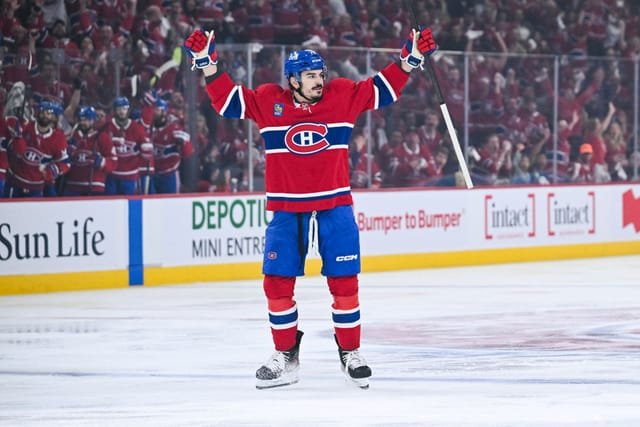
Arber Xhekaj trade rumors are becoming increasingly interesting as the Montreal Canadiens continue negotiating with the restricted free-agent defenseman without reaching a contract agreement. With training camp approaching, the uncertainty surrounding Xhekaj has created a situation where Montreal could eventually consider a sign-and-trade arrangement.
The Canadiens also have forward Zachary Bolduc in the same position. Neither player has signed a new contract, and that unusual situation has prompted Montreal Gazette columnist Stu Cowan to suggest that both RFAs could potentially become part of sign-and-trade transactions before September 16, 2026.
The idea is not without precedent for Montreal. The Canadiens used a similar mechanism last summer when they acquired Noah Dobson from the New York Islanders after Dobson had agreed to an eight-year, US$76 million contract as a restricted free agent.
That previous transaction gives the current speculation an important layer of context. Montreal does not necessarily have to choose between signing Xhekaj and keeping him. If negotiations reach an impasse, a sign-and-trade could become another way to extract value from the situation.
Why Arber Xhekaj remains unsigned
Xhekaj enters the offseason as a restricted free agent, meaning Montreal retains significant control over his NHL rights. However, his contract situation has become more complicated because he remains eligible for an offer sheet and has not yet finalized a new deal with the Canadiens.
Both sides have continued negotiations, and Xhekaj’s agent Brian Bartlett previously expressed optimism that an agreement could eventually be reached.
That optimism is important because it suggests the lack of a contract should not automatically be interpreted as a breakdown in the relationship.
Bartlett has emphasized Xhekaj’s affection for Montreal, its fans and the city, while also acknowledging that both the player and the organization must make decisions that work for their respective interests.
That leaves the door open for an eventual agreement.
What is a sign-and-trade deal?
A sign-and-trade arrangement generally allows a restricted free agent to agree to a contract before being traded to another team. For the player’s current club, the mechanism can help preserve leverage and potentially generate a return instead of losing a player through another route.
In Xhekaj’s case, a sign-and-trade could theoretically allow Montreal to negotiate a contract that reflects his value and then move him to another organization in exchange for assets.
The concept becomes especially relevant because the Canadiens have already used this type of transaction.
Montreal’s Noah Dobson precedent matters
The clearest reason the current Xhekaj speculation deserves attention is Montreal’s previous transaction involving Noah Dobson.
The Canadiens acquired Dobson from the New York Islanders after he agreed to an eight-year, US$76 million contract as a restricted free agent.
That move demonstrated that Montreal is willing to use a sign-and-trade structure when the circumstances make sense.
However, Xhekaj’s situation is not identical to Dobson’s.
Dobson entered the transaction as an established defenseman commanding a massive long-term commitment. Xhekaj remains a younger player whose value is influenced by his physical style, defensive potential and room for development.
That difference could make his eventual contract considerably less complicated.
Stu Cowan raises the sign-and-trade possibility
Montreal Gazette columnist Stu Cowan has suggested that the fact both Xhekaj and Bolduc remain unsigned could point toward a potential sign-and-trade strategy.
The important part of the theory is timing.
The NHL’s collective bargaining agreement is scheduled to undergo changes on September 16, 2026. That creates a potential deadline around which teams could become more aggressive in resolving outstanding contract situations.
If Montreal believes either player is unlikely to agree to terms that fit the club’s plans, exploring a trade before that date could become a logical option.
That does not mean a trade is imminent. It simply gives Montreal another route if negotiations fail to produce an agreement.
Arber Xhekaj’s contract situation in numbers
| Player | Position | Status | Previous salary-cap hit |
|---|---|---|---|
| Arber Xhekaj | Defenseman | Restricted free agent | US$1.3 million |
| Zachary Bolduc | Forward | Restricted free agent | US$863,334 |
The figures highlight why both negotiations matter to Montreal’s roster construction.
While neither player carried an enormous cap hit last season, their next contracts could influence how the Canadiens allocate money across the roster.
Why Xhekaj’s physical style makes him an interesting trade candidate
Xhekaj is not a conventional defenseman whose value can be judged solely by offensive production.
His physicality has made him a distinctive player, and that type of profile can generate significant interest around the NHL.
Teams looking to add size and toughness to their blue line could view Xhekaj as a player with developmental upside as well as an ability to change the physical tone of games.
That combination can make him an attractive trade target, particularly for clubs that believe they can provide him with a larger or more consistent role.
For Montreal, however, the challenge is determining whether Xhekaj’s long-term value is greater than the return another team might offer.
Philadelphia Flyers emerge as a possible destination
The Philadelphia Flyers have been mentioned as one of the teams linked to Xhekaj.
Jeff Marek recently discussed the speculation and suggested that if Montreal were to trade Xhekaj, sending him to the Eastern Conference could make sense.
The logic is straightforward from a competitive standpoint. Teams are often reluctant to move young players to direct rivals within their own conference, particularly when those players could eventually become important contributors.
A move to Philadelphia would therefore potentially allow Montreal to receive value while limiting the possibility of Xhekaj immediately becoming a recurring obstacle in the Canadiens’ playoff path.
That remains a possibility rather than a confirmed destination.
Calgary Flames interest appears to have cooled
The Calgary Flames have also been linked to Xhekaj, but their interest reportedly declined after the team acquired defenseman Jake Middleton from the Minnesota Wild.
That acquisition changes the Flames’ immediate needs on defense.
If Calgary already believes it has addressed part of its defensive requirements, the urgency to pursue another defenseman decreases.
This is an important reminder that trade rumors can change rapidly during the NHL offseason. A team can appear to be a strong fit one week and become an unlikely destination after making a single transaction.
Why Philadelphia may be a more logical trade partner
If the Canadiens ultimately decide to move Xhekaj, Philadelphia could make sense for several reasons.
The Flyers are building around a younger roster and have shown interest in adding players who can develop alongside their emerging core.
Xhekaj’s age and physical profile could therefore fit a long-term roster-building strategy.
From Montreal’s perspective, a trade to Philadelphia could also reduce the immediate competitive risk associated with sending a young defenseman to another Eastern Conference contender.
Still, the Canadiens would need to receive a return significant enough to justify giving up a player they have invested in developing.
Could Zachary Bolduc also be traded?
The Xhekaj situation has received most of the attention, but Bolduc’s contract status could be equally important.
Bolduc remains an unsigned restricted free agent after carrying a salary-cap hit of US$863,334 last season.
The fact that both players remain unsigned creates an interesting roster-management question for Montreal.
The Canadiens could eventually decide that one or both players are better suited to another organization, particularly if the front office believes their value can be converted into assets that address other roster needs.
However, there is no confirmation that Montreal is actively preparing to trade either player.
What Xhekaj’s agent has said
Perhaps the most encouraging development for Canadiens fans is the tone coming from Xhekaj’s representation.
Agent Brian Bartlett has previously expressed optimism about reaching an agreement with Montreal.
He also emphasized Xhekaj’s positive relationship with the city and its supporters.
That matters because a player who genuinely wants to remain with the organization can make negotiations easier, provided both sides can agree on the financial and contractual details.
At the same time, Bartlett’s comments also recognize that the player must protect his own interests.
That balance is typical of restricted free-agent negotiations: both sides may want the relationship to continue while disagreeing over the value of the next contract.
The biggest question is Xhekaj’s long-term role
Beyond salary, Montreal must decide exactly what role it sees Xhekaj playing in the future.
If the organization views him as a long-term NHL defenseman, committing to a new contract becomes easier to justify.
If management is less certain about his place in the top four or believes other young defensemen can eventually overtake him, trading him could become more attractive.
This is why contract negotiations often function as roster evaluations.
The number attached to a contract is not simply a financial decision. It reflects how a franchise projects a player’s role over the next several seasons.
Why the September 16 deadline could matter
The September 16, 2026, CBA change is an important piece of the current speculation.
Whenever a league-wide contractual framework is about to change, teams can become more motivated to settle outstanding business before the new rules take effect.
For Montreal, that could create a window to complete a deal with Xhekaj or Bolduc—or potentially explore a trade involving either player.
The closer the deadline gets, the greater the pressure can become for both sides to make a decision.
That does not guarantee movement, but it could accelerate negotiations.
Montreal has three realistic options
The Canadiens essentially have three broad paths available with Xhekaj.
- Sign him long term: Montreal could make Xhekaj part of its defensive core and invest in his development.
- Sign him short term: A bridge deal could allow both sides to reassess his value later.
- Sign and trade him: Montreal could agree to terms before moving him for another asset.
Each option carries a different level of risk.
A long-term contract offers stability but could become problematic if the player’s development stalls. A short-term deal preserves flexibility but can increase future negotiation pressure. A sign-and-trade produces an immediate return but eliminates the possibility of Xhekaj becoming a long-term Montreal success story.
Which option makes the most sense?
At this stage, a bridge contract may arguably be the most straightforward solution if both sides remain committed to staying together.
It would give Xhekaj an opportunity to establish his value while giving Montreal more time to evaluate his development.
However, if the player’s camp seeks a contract that the Canadiens consider too expensive or too long, the trade route becomes more realistic.
The key issue is not simply whether Xhekaj deserves a new contract. It is whether his expected future contribution matches Montreal’s valuation of him.
How a trade could affect the Canadiens
Trading Xhekaj would create both opportunities and risks.
The obvious benefit would be acquiring an asset that addresses another organizational need. Montreal could potentially add a draft pick, prospect or established player depending on the structure of the deal.
The risk is equally clear: Xhekaj could develop into the type of defenseman Montreal eventually wishes it had kept.
Young players can be difficult to evaluate because their eventual ceiling is not always obvious when contract decisions must be made.
That makes the decision particularly important for a Canadiens organization attempting to build a competitive roster for the long term.
What could happen next?
| Scenario | Potential outcome for Montreal |
|---|---|
| Xhekaj signs with Montreal | Canadiens retain a young defenseman and remove trade uncertainty |
| Short-term bridge deal | Both sides gain flexibility while Xhekaj continues developing |
| Sign-and-trade | Montreal receives assets while avoiding a prolonged contract standoff |
| Offer sheet | Another team could force Montreal to decide whether to match or accept compensation |
| Negotiations continue into camp | Pressure increases as the preseason approaches |
The hidden angle: Montreal’s decision could be about roster timing
The most interesting part of this situation may not be Xhekaj’s current value at all. It could be about when Montreal believes its roster will be ready to compete.
If the Canadiens expect to become serious contenders over the next few seasons, retaining a young defenseman with Xhekaj’s physical profile could be valuable.
If management believes the team’s competitive window is still further away, the organization may have more incentive to convert current players into future assets.
That makes the contract decision part of a larger roster-building strategy.
In other words, the Canadiens are not only deciding what Xhekaj is worth today. They are deciding whether he fits the team they want to become tomorrow.
Prediction: patience may win before the deadline
The most logical expectation is that Montreal will continue negotiating rather than immediately force a trade.
Xhekaj’s agent has expressed optimism, and the player’s reported affection for Montreal gives both sides a reason to keep talking.
However, if no agreement is reached as the September 16 CBA change approaches, the sign-and-trade possibility could become much more relevant.
Philadelphia currently appears to be a more logical potential destination than Calgary based on the latest speculation, particularly after the Flames added Middleton.
But the NHL offseason is unpredictable, and another team could quickly enter the picture.
Conclusion: Xhekaj’s future could become one of Montreal’s biggest offseason decisions
Arber Xhekaj remains unsigned with the Montreal Canadiens, and the uncertainty surrounding his contract has created a potentially important decision for the franchise.
Stu Cowan’s suggestion that Xhekaj and Zachary Bolduc could become candidates for sign-and-trade deals adds another layer to the situation, particularly because Montreal has already used such a mechanism in the Noah Dobson acquisition.
Philadelphia and Calgary have emerged as teams linked to Xhekaj, although Calgary’s interest has reportedly cooled after the acquisition of Jake Middleton.
For now, Xhekaj’s camp remains hopeful that a deal can be reached with Montreal. That makes a trade far from inevitable.
But with training camp approaching and the September 16 CBA change creating a potential deadline, the Canadiens cannot leave the situation unresolved forever.
The biggest question is ultimately simple: does Montreal believe Arber Xhekaj is part of its long-term defensive future?
If the answer is yes, a contract should eventually follow. If the answer becomes uncertain, a sign-and-trade could turn an awkward contract situation into a significant roster opportunity.
For breaking news and live news updates, like us on Facebook or follow us on Twitter and Instagram. Read more on Latest NHL on thefoxdaily.com.



COMMENTS 0