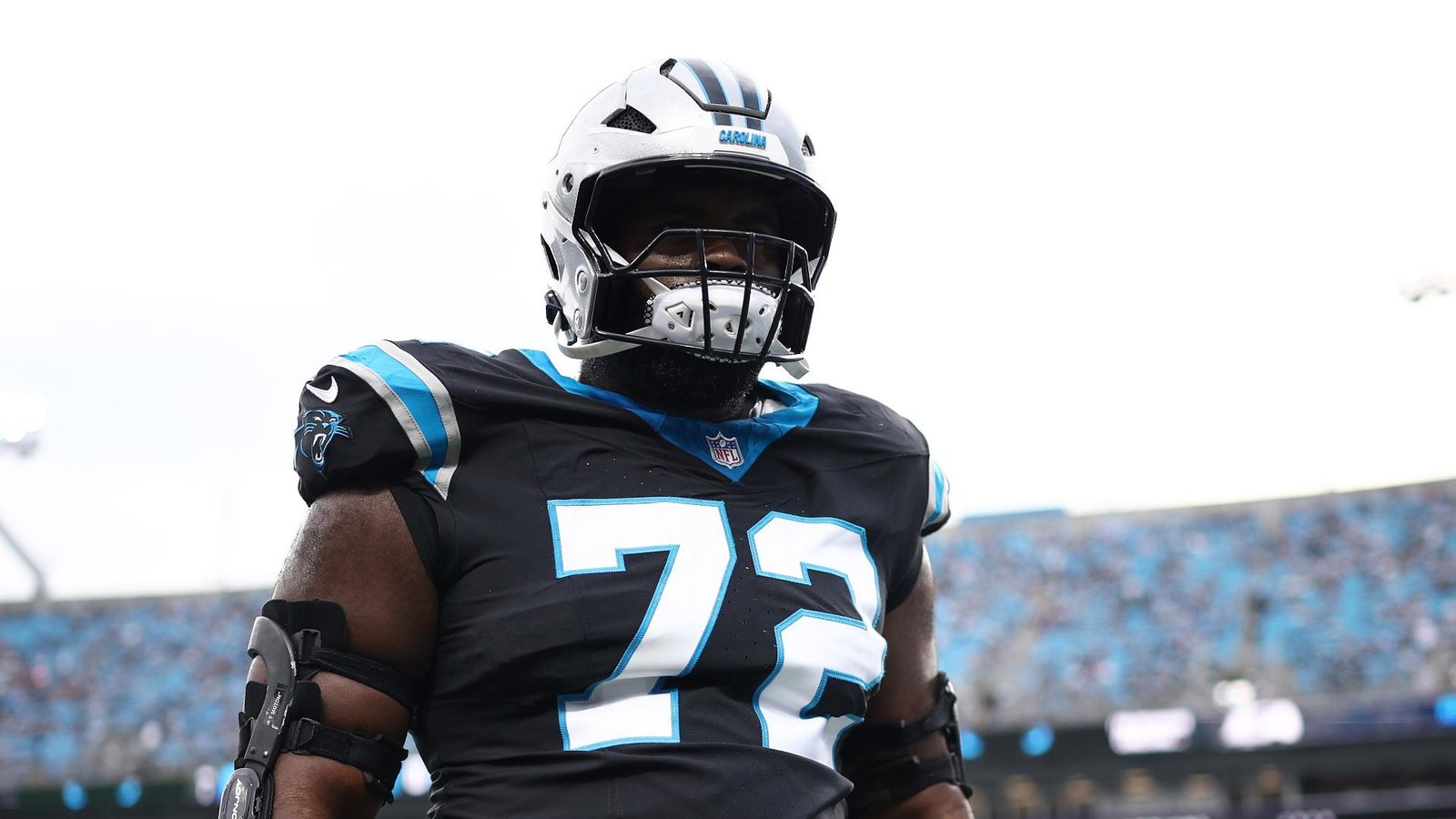
The Carolina Panthers have shown two very different sides of their identity during the opening weeks of the 2026 NFL season. They have demonstrated the ability to defeat quality opponents, produce explosive offensive performances and compete for control of the NFC South. However, defensive breakdowns and injuries along the offensive line have repeatedly prevented the team from establishing a reliable level of performance.
At 3-3 entering Week 8, Carolina remains in contention in its division, but the margin for error is shrinking. A 34-3 victory over the Atlanta Falcons in Week 2 and a win against the Detroit Lions in Week 4 offered evidence of the team’s potential. Those performances now contrast sharply with a difficult opening-week loss to the Chicago Bears and a 30-point defeat against the Tampa Bay Buccaneers.
The most pressing concern is Carolina’s inability to consistently stop the run under defensive coordinator Ejiro Evero. The problem has persisted across multiple seasons, raising questions about the defensive scheme, player execution and the effectiveness of the team’s personnel investments.
At the same time, injuries have weakened an offensive line that is struggling to protect quarterback Bryce Young. Carolina still possesses a productive passing attack, but maintaining that strength becomes considerably harder when defenders can reach the quarterback before routes develop.
The Panthers’ upcoming Thursday night matchup against the Green Bay Packers at Lambeau Field presents an important test. Green Bay’s passing game could challenge Carolina’s coverage and pass rush, while the Packers’ struggling rushing attack offers a different problem from the ground-heavy approach that overwhelmed the Panthers against Tampa Bay.
Why the Panthers’ Run Defense Remains Their Biggest Concern
Carolina’s run defense appeared to be improving before its performance against Tampa Bay exposed familiar weaknesses. After allowing the Chicago Bears to score 59 points and accumulate 291 rushing yards in Week 1, the Panthers gradually reduced the damage opponents inflicted on the ground.
The defense then produced encouraging performances against Atlanta and Detroit. Carolina held Falcons running back Bijan Robinson to 72 rushing yards and limited Lions running back Jahmyr Gibbs to 46. Those results suggested that the defense could make meaningful progress against talented offensive opponents.
However, the improvement did not hold against Tampa Bay. The Buccaneers rushed for 258 yards and scored three rushing touchdowns, overwhelming a Carolina defense that struggled to contain the ground game.
The defeat was particularly damaging because it revived questions that have followed Evero’s defense for several seasons. Appointed Carolina’s defensive coordinator in 2023, Evero has overseen repeated occasions in which opposing offenses have rushed for at least 200 yards.
According to the figures in the original report, Tampa Bay’s performance represented the 12th such occurrence against an Evero-coordinated Panthers defense, including his third against the Buccaneers. Since coach Dave Canales began his tenure in 2024, Carolina has allowed opponents to rush for 200 or more yards six times more than any other NFL defense over the same period.
Those numbers point to a recurring problem rather than a single bad afternoon.
The historical numbers raise questions about the defensive system
The 2024 season provides important context. Carolina surrendered a league-worst 3,057 rushing yards that year, an average of 179.8 per game. The team became the first NFL defense since 1980 to allow at least 3,000 rushing yards in a season, according to the original report.
The Panthers’ struggles continued into 2026 despite periods of improvement. Through the opening seven weeks, Carolina ranked last in the league in rushing yards allowed per game, conceding an average of 153.2 yards. That was 7.5 yards more per game than the Dallas Cowboys, who ranked 31st at 145.7.
Repeated failures against the run create problems beyond the rushing statistics themselves. When an offense can consistently gain yards on the ground, it can stay ahead of the chains, maintain possession and create more manageable passing situations.
That flexibility makes the defense’s job more difficult. Instead of forcing opponents into obvious passing situations, Carolina must account for runs, play-action passes and other options that become more dangerous when the ground game is working.
A defense that cannot reliably stop the run may eventually become easier to attack, even if its coverage remains competitive.
What Is Going Wrong Under Ejiro Evero?
The available results do not establish one definitive cause for Carolina’s recurring run-defense problems. The evidence instead points toward a combination of personnel availability, execution and questions about whether the defensive approach is consistently producing the intended results.
Evero’s defense has shown strengths in coverage, but those strengths have not eliminated its vulnerability on the ground. Carolina’s recent injury problems also complicate any assessment of the coaching staff’s performance.
Against Tampa Bay, outside linebacker Jaelan Phillips was unavailable with a hamstring injury. Cornerbacks Jaycee Horn and Mike Jackson were also sidelined, with both on injured reserve. The Panthers have dealt with other significant absences, including outside linebacker Nic Scourton.
Phillips and replacement starting cornerback Akayleb Evans were subsequently ruled out for the Packers matchup, further limiting the defensive options available to the coaching staff.
These absences matter because defensive football depends on coordinated assignments. A player who can set the edge against a run may have a different role from a defender responsible for rushing the quarterback. If the defense loses key contributors, replacements must perform unfamiliar assignments or take on responsibilities that differ from their usual roles.
However, injuries cannot fully explain a pattern that extends across multiple seasons. The historical numbers make it reasonable to question whether the Panthers need changes to their approach, personnel deployment or execution standards.
Canales expects better preparation and execution
Head coach Dave Canales has acknowledged that the team needs to address its recurring problems. Following the Tampa Bay defeat, he indicated that the coaching staff was reviewing adjustments and working on how the players execute the defensive plan.
The distinction between having a plan and executing it is central to Carolina’s challenge. A defensive scheme can identify the correct gaps and responsibilities, but the players must recognize their assignments, maintain their positions and react quickly enough to stop the ball carrier.
Coaches must also determine whether repeated problems require technical corrections or more substantial changes. If opponents continue finding success with similar rushing concepts, simply asking players to execute better may not be sufficient without identifying why the existing approach is vulnerable.
For Evero, the priority is to produce a defense that can perform consistently rather than alternating between impressive outings and damaging breakdowns.
Ejiro Evero’s Future Depends on More Than One Bad Performance
Evero remains an experienced defensive coordinator who has been regarded as a potential head coaching candidate. His reputation and standing around the league are relevant when assessing his position in Carolina, but the team’s repeated defensive struggles have created a difficult situation.
According to the original report, Evero signed a contract extension in 2025 that runs through the 2027 season. The deal provides contractual continuity, although it does not eliminate the pressure to improve results.
The Panthers have invested draft capital and financial resources in upgrading their defense over the previous two offseasons. Those investments naturally increase expectations that the unit should improve, particularly in an area where problems have persisted for several years.
There are two separate questions for the organization. The first is whether the current players can execute Evero’s system more effectively when healthy. The second is whether the system itself needs adjustments to produce more reliable results against the run.
Those questions should not be treated as interchangeable. A defense can struggle because its players are unavailable or make repeated mistakes, while a sound defensive concept can also become less effective if opponents identify and exploit its weaknesses.
The upcoming games should provide additional evidence about which problems are most significant. A sustained improvement in run defense would strengthen the case that Carolina can address the issue without making major structural changes. Continued failures, particularly against opponents with limited rushing production, would make the need for a deeper evaluation harder to dismiss.
Offensive Line Injuries Are Creating a Second Major Problem
Carolina’s defensive problems have attracted considerable attention, but the offensive line is another area of concern. The Panthers have struggled to maintain consistent pass protection, and injuries have forced the coaching staff to rely on replacements across multiple positions.
The most significant setback came against Tampa Bay, when veteran right tackle Taylor Moton suffered a fractured fibula. Canales said Moton would undergo season-ending ankle surgery, ending his return after just seven quarters following offseason treatment for a blood clot.
Moton’s absence leaves Carolina without one of its established offensive line options at a time when the unit is already under pressure.
Monroe Freeling faces an important adjustment
Rookie Monroe Freeling, selected in the first round of the 2026 NFL draft as a developmental left tackle, has again been pushed into fill-in duty at right tackle.
The position change comes with a steep learning curve. Offensive tackles must handle different alignments and pass-rushing angles, while the speed and strength of NFL defenders leave little time to correct mistakes.
NFL Next Gen Stats figures cited in the original report showed that Freeling allowed three pressures in 22 pass sets against Tampa Bay. Moton, by comparison, surrendered no pressures in his 16 pass snaps before leaving with his injury.
Across his first five games, Freeling had allowed 18 pressures, including four sacks, according to the same tracking data.
Those numbers do not determine Freeling’s long-term potential, particularly given his developmental role and the circumstances surrounding his appearances. They do, however, illustrate the immediate challenge facing Carolina as it attempts to protect Young with an inexperienced replacement at right tackle.
Left tackle and interior protection also need attention
The problems extend beyond Freeling. Rasheed Walker, brought in to cover for injured left tackle Ikem Ekwonu, endured a difficult performance against Tampa Bay.
According to NFL Next Gen Stats, Walker allowed three sacks and seven total pressures in Week 7. He had surrendered 34 pressures across the season, the highest total on the Panthers at the time of the report.
The interior line has also struggled. Center Luke Fortner and left guard Damien Lewis had each been credited with four sacks allowed, while right guard Robert Hunt was beaten on a play that led to a strip-sack touchdown for Tampa Bay.
Lewis was ruled out for the Packers game with a knee injury. Ekwonu’s return also remained uncertain, with his recovery from a patellar tendon injury and time on the physically unable to perform list complicating the outlook.
The Panthers had drafted center Sam Hecht in the fifth round as a potential long-term starter, but he was a healthy scratch against Tampa Bay. Carolina instead used Corey Bullock and practice-squad promotion Torricelli Simpkins III among its available options. Simpkins was subsequently listed as out for the Green Bay matchup with a left ankle injury.
With Moton sidelined, the Panthers must find a workable combination across the offensive line while managing injuries and the development of younger players.
Why Offensive Line Stability Matters for Bryce Young
Carolina’s offensive production makes the protection issues especially important. The Panthers entered Week 8 ranked second in passing yards per game at 276.0 and fifth in total offensive yards at 381.3.
Those figures show that the team has been capable of moving the ball despite its inconsistent results. However, maintaining that production becomes harder when opposing defenses can generate pressure before Young has time to deliver the ball.
Pass protection affects the entire offense. receivers need time to complete their routes, quarterbacks need opportunities to identify the best target, and play-callers need confidence that longer-developing plays can be executed.
When protection breaks down, the offense may need to rely more heavily on quick throws, shorter routes and adjustments designed to reduce the time defenders have to reach the quarterback.
Canales has indicated that Carolina can still attack downfield when the protection allows it, while also providing Young with earlier passing options.
That approach could help the Panthers adapt to their current personnel limitations. Shorter passes can give the quarterback an alternative when pressure arrives quickly, although they do not eliminate the need for receivers to create separation or for the offensive line to handle its assignments.
Carolina’s challenge is to preserve the strengths of its passing game without allowing protection problems to dictate every offensive decision.
Bryce Young and the Passing Game Offer a Reason for Optimism
Despite the difficult loss to Tampa Bay, Carolina has reasons to believe its offense can respond. Young entered that game after a productive opening stretch in which he established a franchise record with 11 passing touchdowns through his first five games of the 2026 season.
His performance against the Buccaneers was a setback. Young committed three turnovers, including two interceptions and a sack-fumble that resulted in a defensive touchdown.
That performance exposed the risks created when protection and decision-making break down simultaneously. However, it does not erase the production that preceded it.
Young has demonstrated the ability to distribute the ball effectively to Carolina’s receiving options, including McMillan and Coker, as well as tight ends Tommy Tremble and Darren Waller. Waller produced a 52-yard touchdown against Tampa Bay, offering a reminder that the Panthers can create explosive plays through the air.
Against Green Bay, those weapons could be particularly valuable. The Packers entered the matchup ranked ninth in passing defense, allowing 208.0 passing yards per game.
That ranking suggests Carolina will face a meaningful challenge through the air. The Panthers will need to identify ways to move the ball without exposing Young to repeated pressure from the defensive front.
Young’s response will depend partly on his own decisions and partly on the protection provided by his teammates. A more balanced distribution of quick passes and downfield opportunities could help Carolina remain productive while its offensive line adjusts to injuries.
Chuba Hubbard Could Help Carolina Find Offensive Balance
Although the passing game has been a major strength, Carolina’s rushing attack has produced less impressive overall numbers. The Panthers entered Week 8 ranked 21st in rushing yards per game, averaging 105.3.
That places additional responsibility on Young and the passing offense. If Carolina cannot establish a credible ground game, opposing defenses can devote more attention to disrupting the quarterback and covering the receivers.
Running back Chuba Hubbard nevertheless provides a potential source of balance. Through six games, he had accumulated 571 total yards and six touchdowns, according to the original report.
His contribution is not limited to rushing attempts. A productive all-purpose back can help an offense create manageable down-and-distance situations and provide an additional receiving option when defenses concentrate on wide receivers.
The Packers’ rushing defense ranked 17th in the league entering the matchup, creating a possible opportunity for Carolina to improve its ground production.
However, the offensive line injuries remain relevant to that possibility. Running backs need effective blocking to find consistent lanes, and a reshuffled front can make it more difficult to establish a dependable rushing attack.
If Hubbard can generate positive gains while Young continues producing through the air, Carolina may become less predictable. That balance would also reduce the pressure on the passing game to carry the offense on every drive.
What the Packers Matchup Could Reveal About Carolina
The Green Bay game presents a different set of challenges from the loss to Tampa Bay. The Packers were described in the original report as having a top-five passing offense, a top-10 passing defense and the league’s worst rushing attack entering Week 8.
That profile could test whether Carolina can defend the pass effectively while addressing its weaknesses on the ground. Green Bay’s passing ability places pressure on Evero to ensure that his coverage schemes and pass rush work together.
Meanwhile, the Packers’ comparatively weak rushing production offers Carolina an opportunity to avoid facing another offense that can dominate through repeated ground gains.
The short turnaround after the Tampa Bay defeat adds another complication. Carolina must make adjustments, recover from injuries and prepare for a road game without the usual extended preparation period between Sunday and the following weekend.
The matchup is therefore about more than the final score. It offers a chance to assess whether the Panthers can correct their most damaging mistakes and perform with greater consistency against a different style of opponent.
Carolina’s Response After Losses Provides Encouragement
There is one additional reason for optimism: the Panthers have generally responded well after defeats during the period covered by the report.
According to ESPN Research, Carolina had covered the betting spread in 12 consecutive games following a loss. That was one short of the 13-game streaks recorded by the Indianapolis Colts from 2011 to 2013 and the Detroit Lions from 2022 to 2025.
The report also stated that Carolina had gone 8-3 following losses dating back to 2025, including playoff games. Those figures suggest that the team has often been competitive in its response to setbacks.
However, these records should be interpreted carefully. Covering the spread is a betting outcome, not the same as winning a game or correcting a recurring football problem. A team can perform competitively without resolving its weaknesses, just as a victory does not necessarily demonstrate that every issue has been fixed.
The Packers also entered the matchup with four consecutive covers, the longest active streak in the NFL according to the report. That provides additional context for a game in which Carolina must improve its execution against a capable opponent.
What Needs to Change for the Panthers to Become Consistent?
Carolina’s path forward depends on addressing problems on both sides of the ball. The defense must find a more reliable way to contain the run, while the offense needs to protect Young with a line that has been weakened by significant injuries.
Three priorities stand out.
- Improve run-defense execution: Evero and the defensive staff need to identify why opponents continue finding success on the ground and ensure that players can execute their assignments consistently.
- Adapt the offensive line: Carolina must establish workable protection combinations while Moton is unavailable and Lewis is sidelined, with Freeling and Walker facing demanding responsibilities.
- Preserve offensive production: Young, Hubbard and the receiving group need to keep the offense moving while adapting to the protection limitations created by injuries.
The Panthers do not need to solve every problem in one game, but they must show that their recent setbacks can lead to meaningful corrections.
Their early victories demonstrate that the roster has the ability to compete. The challenge is turning those flashes into a more dependable standard of performance.
Final Assessment: The Panthers Must Fix the Foundations
Carolina’s inconsistent start to the 2026 season reflects problems that extend beyond one defensive coordinator or one disappointing Sunday. The recurring run-defense failures under Ejiro Evero have become a major concern, while injuries along the offensive line threaten to undermine an otherwise productive passing attack.
Evero faces pressure to demonstrate that his defense can deliver reliable results against the run, particularly after years of troubling statistics in that area. At the same time, the Panthers must account for the impact of injuries before drawing definitive conclusions about individual players or the defensive scheme.
On offense, Young’s early production and Hubbard’s all-purpose contributions offer reasons to remain optimistic. But those strengths will be difficult to sustain if the offensive line continues allowing pressure at a damaging rate.
The Green Bay matchup provides an opportunity for Carolina to respond, test its adjustments and show whether it can perform more consistently against a different type of opponent.
Ultimately, the Panthers’ season may depend on the fundamentals that often receive less attention than touchdowns and highlight plays. Defensive gap discipline, dependable blocking, sound quarterback decisions and effective communication are the building blocks of consistent football.
Carolina has shown that it can produce impressive performances. Now it must demonstrate that those performances are a reliable reflection of the team’s ability, rather than brief exceptions in an otherwise unpredictable season.
For breaking news and live news updates, like us on Facebook or follow us on Twitter and Instagram. Read more on Latest NFL on thefoxdaily.com.






COMMENTS 0