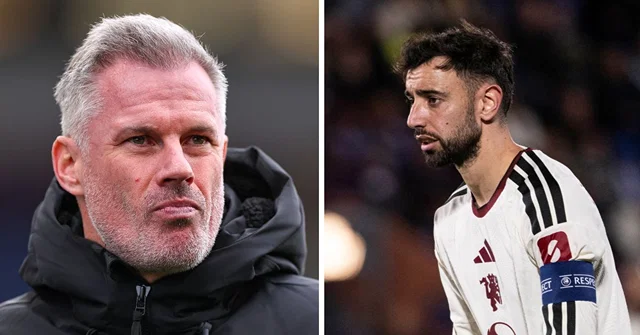
Jamie Carragher has launched a scathing attack on Manchester United captain Bruno Fernandes after the midfielder questioned Michael Carrick‘s tactics following the club’s humiliating 4-1 defeat away to Como in the UEFA Champions League. The former Liverpool defender described Fernandes’ public criticism of his manager as a disgrace and argued that the Portuguese international’s attitude is damaging the team.
Manchester United endured a difficult night against Cesc Fabregas’ Como side on Wednesday, suffering a heavy defeat that intensified scrutiny of the club’s performances. Fernandes started the match but was substituted in the 66th minute, with Joshua Zirkzee coming on and scoring United’s consolation goal in stoppage time.
Following the loss, Fernandes questioned why United had not been instructed to press higher up the pitch. His comments prompted a strong response from Carragher, who accused the midfielder of prioritising his own image over the team’s collective needs.
The controversy has raised further questions about leadership at Old Trafford, the relationship between players and the manager, and the tactical problems that have contributed to United’s disappointing start to the season. With the club having won just two of their 11 matches across all competitions, the criticism comes at a particularly difficult moment.
Jamie Carragher Calls Bruno Fernandes a ‘Disgrace’ After Como Loss
Carragher did not hold back when discussing Fernandes’ comments on CBS Sports. The former Liverpool defender compared the captain’s public criticism of Carrick to the conduct of Lisandro Martinez, whom he had also criticised for speaking out against Manchester United’s hierarchy the previous week.
In Carragher’s view, Fernandes crossed a line by questioning the manager’s approach after a heavy defeat. Rather than focusing publicly on tactical disagreements, he argued, the captain should demonstrate leadership by supporting the manager and taking responsibility for the team’s performance.
“No (not a good look). We said Lisandro Martinez was bang out of order last week for calling out the hierarchy and for Bruno Fernandes to do that is a disgrace really.”
Carragher’s criticism centred on what he sees as a gap between Fernandes’ technical quality and his behaviour on the pitch. He acknowledged that the midfielder is a talented footballer but questioned whether his attitude consistently serves Manchester United’s interests.
The distinction is important because Carragher was not arguing that Fernandes lacks ability. Instead, he suggested that the captain’s approach to the game, his visible reactions during matches and his decision to question the manager publicly are undermining the team’s collective effort.
Fernandes has been a prominent figure at United, and the captaincy places additional expectations on his conduct. Carragher believes those responsibilities require a player to put the club’s interests ahead of personal frustration, particularly after a damaging result.
Why Carragher Believes Fernandes Criticised Carrick
One of Carragher’s strongest accusations was that Fernandes reacted negatively because he had been substituted. The Portugal international was withdrawn in the 66th minute against Como, with Zirkzee replacing him and later scoring United’s only goal of the evening.
Carragher suggested that being taken off embarrassed Fernandes and contributed to his subsequent criticism of Carrick’s tactics. However, this was the pundit’s interpretation of the midfielder’s motivation rather than an established explanation for Fernandes’ comments.
“But in terms of attitude, the way he goes about things, is not right at all. He’s reacted like that because he’s been brought off and he’s been embarrassed by the manager because he’s been brought off.”
The accusation touches on a familiar challenge for football managers: balancing the authority to make substitutions with the expectations of senior players. A captain may disagree with a tactical decision, but how that disagreement is expressed can influence the atmosphere around a team.
For Carragher, Fernandes’ reaction was particularly problematic because of his leadership role. A captain is expected to set an example when results go against the team, and public criticism of the manager can create the impression of division at a time when unity is needed.
Nevertheless, Fernandes’ comments also raised a legitimate footballing question about United’s approach against Como. The midfielder believed the team had been too passive and should have pressed higher. Whether that criticism was justified depends on the tactical plan, the players’ execution and the circumstances of the match.
The central issue is therefore not simply whether Fernandes was entitled to question the tactics. It is whether his public remarks help Manchester United address their problems or risk deepening tensions within the squad.
Carragher Claims Bruno Fernandes Is ‘Killing’ Manchester United’s Pressing Game
Carragher’s most striking criticism concerned Fernandes’ interpretation of pressing. While the midfielder questioned why United had not pressed Como higher up the pitch, Carragher argued that Fernandes himself has contributed to the club’s difficulties when trying to press as a coordinated unit.
High pressing requires players to move together, close passing lanes and apply pressure at the right moments. If one player rushes forward without the rest of the team maintaining its shape, opponents may find space to play through the press. Effective pressing is therefore a collective responsibility rather than a matter of individual effort alone.
Carragher believes Fernandes’ energetic style can sometimes work against that collective structure. He accused the midfielder of running around in ways that look industrious to supporters but do not necessarily benefit the team tactically.
“When he talks about pressing, man-to-man or zonal, for years, Bruno Fernandes has meant Manchester United can’t press. Because he does things for the crowd, I commentate on games and he runs all over and plays like a kid in the schoolyard, he plays for the supporters, it looks like he’s working hard, he’s not, he’s killing the team doing it.”
The comments represent a serious challenge to Fernandes’ value as a team player. Carragher is effectively arguing that visible effort should not be confused with effective pressing, especially when a team’s success depends on players understanding their individual responsibilities within a larger tactical structure.
Why Pressing Requires More Than Running
Pressing is often associated with intensity, energy and a willingness to chase opponents. However, simply running towards the ball does not automatically make a press effective. Players must recognise when to close down an opponent, when to block a passing option and when to maintain their position to prevent the opposition from exploiting gaps.
In a coordinated pressing system, one player’s movement can trigger the actions of several teammates. If the first player presses at the wrong time or leaves a passing lane open, the opposition may bypass the pressure and attack the space behind the midfield.
This helps explain the tactical concern behind Carragher’s argument. He believes Fernandes’ movement can be too individualistic, making it harder for United to operate as a compact unit. If that assessment is accurate, the problem would extend beyond effort or attitude to the organisation of the team’s defensive work.
However, the supplied comments do not establish that Fernandes alone is responsible for United’s pressing difficulties. Pressing depends on the manager’s instructions, the positioning of multiple players and the team’s ability to maintain its shape. Carragher’s remarks should therefore be understood as a forceful criticism of Fernandes rather than proof that one player explains all of United’s tactical problems.
Carragher Praises Bruno Fernandes’ Talent but Questions His Attitude
Despite the strength of his criticism, Carragher acknowledged Fernandes’ footballing ability and referred to the midfielder’s previous success under Carrick. He argued that Fernandes benefited when Carrick became manager and restored him to what Carragher considered his rightful position on the pitch.
According to Carragher, Fernandes went on to enjoy a fantastic season and received the Player of the Season award. He suggested that the manager’s tactical decisions played an important role in allowing the Portuguese international to perform at his best.
“When you think about last season he got Player of the Season, that was off the back of Michael Carrick becoming manager, he wouldn’t have got that without Michael Carrick because he got put back in his rightful position and went on to have a fantastic season because he’s a talented footballer.”
Carragher’s argument is that Fernandes has previously benefited from Carrick’s management, making his criticism after the Como defeat particularly disappointing in the pundit’s eyes. He believes the midfielder should recognise the role the manager played in helping him perform well rather than publicly challenging his decisions after a difficult result.
This also highlights the complicated relationship between individual performance and team success. A player can be technically gifted and capable of producing decisive contributions while still being criticised for how he responds to tactical instructions or setbacks.
For Manchester United, the challenge is to make the most of Fernandes’ creativity and influence without allowing disagreements or individual tendencies to disrupt the team’s organisation. His talent remains central to the debate, but Carragher believes talent alone is not enough when a captain is expected to lead a struggling side.
Carragher Uses Bryan Robson as an Example of Manchester United Leadership
To reinforce his argument, Carragher compared Fernandes’ conduct with that of former Manchester United captain Bryan Robson. Robson is widely regarded as one of the club’s great players and leaders, and Carragher used his example to explain what he believes a captain should represent during difficult periods.
Carragher noted that Robson played during an era when Manchester United were not enjoying the kind of sustained success associated with the club’s strongest periods. Despite those challenges, he argued, Robson continued to fight for the team rather than publicly blaming managers or teammates.
“He’s not playing in a successful era for Manchester United. Years ago, there was a captain called Bryan Robson, one of the greatest players to ever play for Man United because he played for the club, he didn’t throw the manager or the players under the bus.”
The comparison reflects Carragher’s broader view of captaincy. He believes a leader should protect the team during difficult moments, maintain standards and avoid making public comments that could undermine the manager or create further uncertainty.
That does not necessarily mean a captain must agree with every tactical decision. Disagreements can be part of professional football, and players may have valid concerns about how a team is performing. The question is how those concerns are communicated and whether the discussion contributes to improvement.
Carragher concluded his criticism by arguing that Fernandes’ visible frustration and comments about the manager were not appropriate for someone wearing the Manchester United armband.
“He kept fighting for Manchester United and watching him throw his arms up every week in a game is an absolute disgrace, calling the manager out considering how he’s performed this season on the pitch. Awful attitude and not what a Manchester United captain should do.”
The comparison with Robson places the debate in a broader context. For Carragher, leadership is not measured only by technical ability or individual statistics. It is also defined by a player’s response to adversity and willingness to uphold the team’s interests when results are poor.
How Did Michael Carrick Respond to Bruno Fernandes’ Comments?
Michael Carrick declined to turn the controversy into a public dispute after being asked about Fernandes’ criticism. Rather than singling out the captain or directly addressing the midfielder’s remarks, the Manchester United manager focused on the team’s performance against Como.
Carrick made clear that he was angry with what he had seen on the pitch. His comments reflected frustration with the overall display, particularly the work required from players both when attacking and defending.
“I’m angry to be honest. My whole life is wrapped around this. I didn’t like what I’ve seen tonight.”
The manager then emphasised that tactical systems cannot succeed without the necessary work rate from the players. His remarks appeared to shift attention away from a specific disagreement about pressing and towards the team’s broader responsibility to compete throughout a match.
“There’s a little bit of whatever system you play, whatever tactics you play, if you don’t run, and you don’t run forward, and you don’t run back, you aren’t going to win.”
Carrick’s response highlights a central point in the debate: tactics and effort are closely connected. A team may have a clear plan for pressing or defending, but that plan will struggle if players fail to execute their responsibilities consistently.
At the same time, Carrick did not publicly endorse Fernandes’ criticism or blame the captain for the defeat. His decision to focus on the collective performance avoided an immediate escalation of the disagreement in front of reporters.
Whether the manager and captain discuss the tactical concerns privately remains unclear from the available information. What is evident is that the heavy defeat has prompted questions about both United’s on-field organisation and the standards expected from senior players.
Manchester United’s Poor Form Adds to the Pressure
The dispute comes against the backdrop of a difficult run for Manchester United. The club have won just two of their 11 matches across all competitions this season, a record that underlines the scale of the challenge facing Carrick and his players.
A heavy defeat to Como adds further pressure because it raises questions about the team’s ability to compete effectively and respond when matches become difficult. The disagreement over pressing has also brought attention to the relationship between tactical instructions and player execution.
For a club with Manchester United’s expectations, a run of disappointing results can quickly turn individual mistakes into wider discussions about leadership, management and team identity. Fernandes’ comments have become part of that debate because he is both an influential player and the team’s captain.
There are several issues United must address. Defensively, the team needs to improve its ability to remain organised and prevent opponents from creating dangerous opportunities. In possession, players must execute the manager’s plan more consistently. Just as importantly, the squad needs to respond to setbacks without allowing frustration to overshadow its collective responsibilities.
It would be premature to attribute the club’s poor results entirely to Fernandes or to the disagreement with Carrick. The available information points to broader problems involving performance, tactical execution and the team’s ability to compete. Nevertheless, criticism from a prominent pundit has intensified scrutiny of the captain’s role in addressing those challenges.
What Comes Next for Manchester United?
Manchester United’s immediate focus will turn to their Premier League fixture against Bournemouth at Old Trafford on Sunday. The match offers an opportunity to respond on the pitch after the damaging defeat to Como and the public controversy that followed.
The result will matter, but the performance will also be closely examined. Supporters will want to see greater intensity, improved defensive organisation and a clearer understanding of how the team intends to press opponents.
Fernandes’ response to the criticism will also attract attention. As captain, he will be expected to help the team move beyond the disappointment and maintain focus on the next challenge. Whether he and Carrick have differing views about the tactical approach, their ability to work together will be important if United are to improve their results.
Carrick, meanwhile, must find a way to translate his tactical ideas into consistent performances. His comments after the Como loss made clear that he expects players to work hard in both directions, regardless of the system being used.
The defeat and the resulting criticism have exposed questions that cannot be settled through public comments alone. Manchester United need better results, more consistent execution and a united response from the players and coaching staff. Their performance against Bournemouth will provide an early opportunity to show whether they can begin addressing those concerns.
Final Verdict: Carragher’s Criticism Raises Questions About Fernandes’ Captaincy
Jamie Carragher’s attack on Bruno Fernandes has turned Manchester United’s 4-1 defeat to Como into a wider debate about leadership, tactical discipline and accountability. Carragher believes the midfielder’s public criticism of Michael Carrick was inappropriate and argued that his individual approach to pressing can damage the team’s overall structure.
He also acknowledged Fernandes’ talent and suggested that the midfielder previously benefited from Carrick’s management. By comparing him with Bryan Robson, Carragher made clear that he believes the captaincy requires more than technical quality: it demands composure, responsibility and a willingness to put the club ahead of personal frustration.
Carrick chose not to engage directly with Fernandes’ comments, instead stressing that players must run forward and backward if the team is to win. His response placed the emphasis on collective effort rather than an individual dispute.
With Manchester United having won only two of their 11 matches across all competitions this season, the priority remains improving performances and results. The controversy may dominate discussion in the short term, but the team’s response against Bournemouth will be a more meaningful indication of whether the club can begin to move forward.
For breaking news and live news updates, like us on Facebook or follow us on Twitter and Instagram. Read more on Latest Football on thefoxdaily.com.






COMMENTS 0