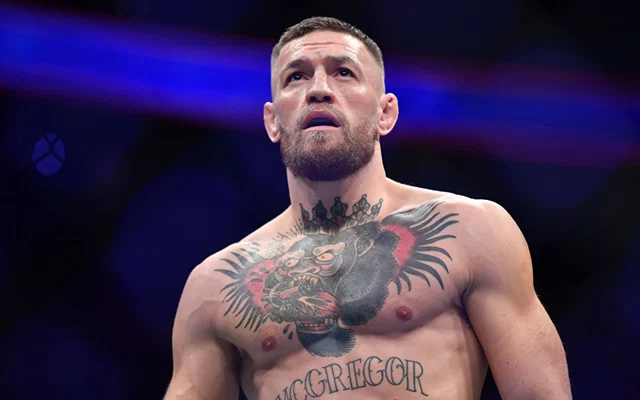
Conor McGregor’s hopes of returning to the UFC remain alive, according to his longtime coach, John Kavanagh. The Irish fighter is currently recovering from a serious knee injury suffered during his comeback fight against Max Holloway at UFC 329 in July, but Kavanagh believes McGregor could compete again if his rehabilitation progresses well.
Speaking on The Ariel Helwani Show, Kavanagh said McGregor was taking his recovery seriously and appeared to be moving well. The coach also explained that he would not dismiss the possibility of another comeback, pointing to the many times McGregor had overcome difficult challenges throughout their long professional relationship.
However, Kavanagh stopped short of promising a return date. According to the coach, McGregor may not be ready to resume mixed martial arts-specific training until 2027. His recovery, physical condition and ability to regain the demands of competitive fighting will ultimately determine what happens next.
John Kavanagh Believes Conor McGregor Could Fight Again
Kavanagh has worked with McGregor for approximately 22 years, giving him a long view of the former two-division UFC champion’s career. During that time, he has witnessed the Irishman progress from a rising prospect to one of the biggest names in mixed martial arts.
That history is one reason Kavanagh remains open to the possibility of another comeback. Rather than guaranteeing that McGregor will return, he said he trusts the fighter’s determination and is unwilling to rule him out simply because his latest attempt ended in injury.
“I think we’re now 22 years around each other, and I’ve just seen him do too many things that seem to be impossible, and he does them repeatedly. So, if he says he does, I’m not going to doubt him. We’ll see. I guess it’ll be next year before he can start returning to MMA-type training. He’s going through his rehab now, and he’s back. He looks pretty good to me.”
Kavanagh’s comments offer an encouraging update for fans who have questioned whether McGregor will fight again. Nevertheless, his assessment is based on the fighter’s current progress rather than confirmation that he has recovered sufficiently to compete.
There is also a significant difference between moving comfortably during rehabilitation and being ready for the physical demands of a UFC contest. A professional mixed martial arts fight requires explosive movement, balance, changes of direction, kicking, wrestling and the ability to respond to an opponent under pressure.
McGregor will need to work through those demands gradually as his rehabilitation allows. Kavanagh’s optimism suggests the team has not abandoned the idea of a return, but the next stage will depend on how the recovery develops.
McGregor Is Reportedly Taking His Rehabilitation Seriously
In his interview, Kavanagh highlighted McGregor’s approach to therapy and recovery. He said the Irishman appeared to be moving around well and was putting considerable effort into the rehabilitation process.
“He looks to be moving around quite well. He’s being very aggressive with his therapy and his recovery, and then I guess we wait to see what happens next year… Can he make another comeback and get back into that fight shape? If anybody can, he can.”
The comments indicate that McGregor is focused on rebuilding his physical condition rather than treating his injury as the end of his fighting career. Even so, the coach made it clear that the eventual outcome remains uncertain.
Rehabilitation after a major knee injury is not simply about being able to walk or perform controlled exercises. Returning to high-level competition requires an athlete to rebuild strength, stability, mobility and confidence while gradually increasing the intensity of physical activity.
Those demands are especially relevant for a fighter whose style has relied heavily on precise movement, distance management and explosive striking. McGregor must be able to plant his feet, shift his weight and generate power without compromising the injured knee.
The progression from rehabilitation to MMA training will therefore be an important stage in determining whether another UFC appearance is realistic. Kavanagh’s expectation that McGregor could resume MMA-specific training next year provides a possible timeframe, but it should not be interpreted as a confirmed fight date.
What Happened During Conor McGregor’s UFC 329 Fight Against Max Holloway?
McGregor’s latest injury occurred during his highly anticipated rematch against Max Holloway at UFC 329 on July 11, 2026. The bout marked his return to the Octagon after an extended absence from competition, making the matchup a major moment in his career.
The fight, scheduled for five rounds at welterweight, ended after just 69 seconds of the opening round. McGregor attempted a flying kick early in the contest but landed awkwardly, injuring his right knee. He tried to continue, but the injury affected his ability to move and remain stable.
After McGregor struggled to continue, referee Mike Beltran stopped the contest. Holloway was awarded a first-round technical knockout victory, although the finish resulted from McGregor’s injury rather than a conventional sequence of unanswered strikes.
The abrupt ending was a major setback for McGregor. After spending years away from the Octagon, he had finally returned to competition, only for the fight to be halted before either fighter could establish a sustained rhythm.
McGregor subsequently confirmed that he had suffered damage to the anterior cruciate ligament, commonly known as the ACL, and the meniscus in his right knee. He also revealed that he had undergone surgery and began discussing his plans for recovery.
The injury was particularly striking because McGregor had previously experienced similar damage to his left knee during his first fight against Holloway in 2013. The fact that the latest injury affected the opposite knee added another difficult chapter to the Irishman’s history of setbacks.
Why the Knee Injury Matters for a Potential UFC Return
A return to professional fighting after an ACL injury involves more than allowing the knee to heal. The ACL helps stabilise the joint, particularly during movements that involve pivoting, sudden changes of direction and rotation. These actions are common in mixed martial arts, where fighters must react quickly to striking exchanges and grappling situations.
Meniscus damage can also complicate recovery because the meniscus helps distribute loads across the knee joint. The exact rehabilitation process and timeline depend on the nature of the injury, the procedure performed and the individual athlete’s progress.
For McGregor, the challenge will be to regain the physical qualities needed to compete safely and effectively. His training team will need to assess his progress as he moves from rehabilitation exercises towards more demanding athletic work.
Even if he reaches the point where he can resume MMA training, a return to sparring and full fight preparation would represent further stages rather than immediate confirmation of a bout. Training camp requires an athlete to tolerate repeated high-intensity sessions, recover between workouts and handle unpredictable physical contact.
That is why Kavanagh’s comments remain cautiously optimistic rather than definitive. He sees encouraging signs in McGregor’s current movement and commitment to therapy, but the coach has not claimed that the former champion is already ready for full training.
Conor McGregor Shared an Update After ACL Surgery
McGregor also addressed his condition publicly after undergoing knee surgery in July 2026. In an August social media update, he presented the operation as a successful step in his recovery and emphasised his determination to return to the sport.
“What’s up, folks? ‘The Mac’ is back, baby. My knee is repaired. Surgery was a success, and I am on the road to recovery. That should tell you what you need to know about my mindset.”
The message reflected McGregor’s desire to remain involved in competition despite the setback. Rather than announcing his retirement, he focused on the operation and the rehabilitation process ahead.
McGregor also referred to other fighters who had returned to competition after suffering serious knee injuries. He mentioned former UFC bantamweight champion Dominick Cruz and former UFC champion Georges St-Pierre as examples of athletes who had dealt with ACL problems during their careers.
“I want to give a shoutout to Dominick Cruz, who tore multiple ACLs to recapture his bantamweight crown. Georges St-Pierre, multiple ACLs. Don’t know whether he returned after his second ACL, however, he is doing backflips and movement is still stellar.”
By highlighting those fighters, McGregor pointed to examples of athletes who managed to return after significant setbacks. Their experiences, however, do not establish how quickly or successfully McGregor will recover. Every injury and rehabilitation process is different, and the outcome will depend on his own medical and physical progress.
His public comments and Kavanagh’s assessment nevertheless indicate that a comeback remains a possibility being considered by the fighter and his team.
Could Conor McGregor Return to the UFC in 2027?
Based on Kavanagh’s comments, 2027 is the earliest broad timeframe currently discussed for McGregor to begin returning to MMA-specific training. That does not mean he has a confirmed fight scheduled for that year, nor does it establish when he could be ready to compete.
The distinction matters because returning to training and returning to the Octagon are separate milestones. An athlete may be able to complete technical drills before being ready for intense sparring, a full training camp or the demands of a five-round contest.
McGregor has also indicated that he wants to complete his remaining contractual fight with the UFC. That stated intention gives a potential comeback a clear objective, but it does not guarantee that a fight will take place. His physical recovery and the practical arrangements surrounding any future bout remain important considerations.
For now, the most useful indicator will be his progress through rehabilitation and his eventual ability to resume the sport’s specific training demands. Kavanagh has not announced an opponent, a venue or an official return date.
What Another Comeback Would Mean for McGregor
McGregor’s career has been defined by major achievements as well as long interruptions caused by injuries and time away from competition. He became the UFC’s first simultaneous two-division champion in 2016, winning titles in the featherweight and lightweight divisions. His success helped establish him as one of the sport’s most recognisable figures.
However, his recent years have been interrupted by setbacks, including the leg injury he suffered against Dustin Poirier in July 2021 and the knee injury that ended his UFC 329 rematch against Holloway. The latest setback means that any future return would require him to rebuild his competitive condition after another extended period away from fighting.
A successful return would depend on more than McGregor’s motivation or public confidence. He would need to regain the physical capacity to train consistently and compete at the highest level. The level of opposition, the pace of his recovery and the timing of any potential fight would also shape the challenge ahead.
Kavanagh’s long working relationship with McGregor gives his comments particular relevance, but even a coach who knows a fighter well cannot guarantee the outcome of a medical recovery. His message is that McGregor remains committed and that the possibility of another fight should not be dismissed prematurely.
John Kavanagh Remains Optimistic, but No Return Is Confirmed
John Kavanagh’s latest assessment offers a hopeful update on Conor McGregor’s recovery following the knee injury that cut short his UFC 329 fight against Max Holloway. The coach says McGregor is moving well, taking rehabilitation seriously and still has the desire to compete again.
His expectation is that McGregor may be able to return to MMA-specific training next year, but the timing of a competitive comeback remains uncertain. The Irishman must first continue recovering from the ACL and meniscus injuries sustained in July and demonstrate that he can handle the demands of full training.
McGregor has publicly expressed his determination to return, while Kavanagh has made clear that he is not prepared to rule out another comeback. For now, those statements establish intent and optimism rather than a confirmed plan.
Whether McGregor fights again will ultimately depend on how his rehabilitation progresses and whether he can regain the condition required for elite-level mixed martial arts. Kavanagh believes the possibility remains open, but the next chapter of McGregor’s UFC career will have to wait until his recovery provides clearer answers.
For breaking news and live news updates, like us on Facebook or follow us on Twitter and Instagram. Read more on Latest MMA on thefoxdaily.com.






COMMENTS 0