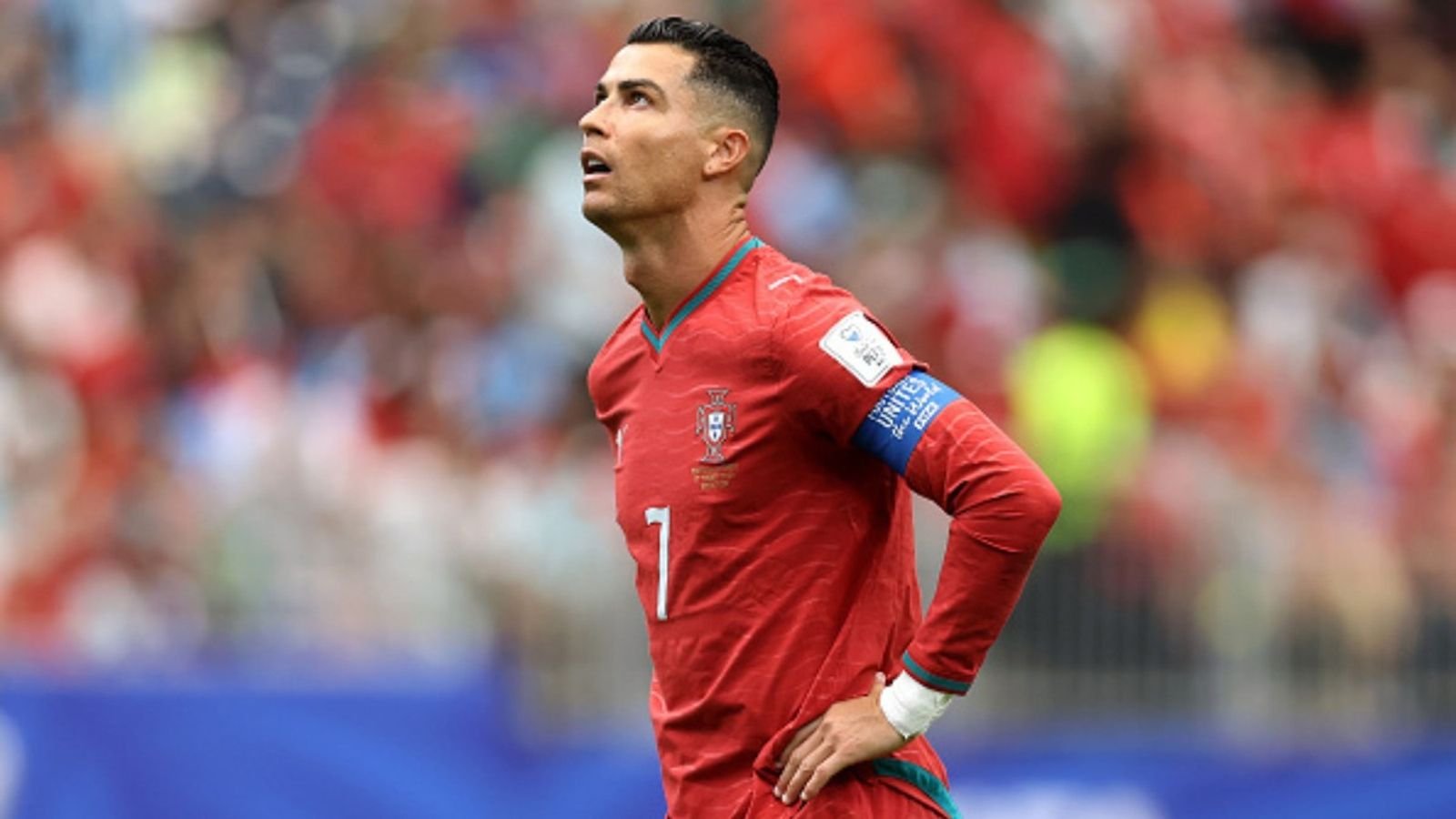
Cristiano Ronaldo has once again rewritten football history by becoming the first player ever to score in six different FIFA World Cup tournaments. The Portuguese superstar achieved the landmark during Portugal’s 2026 World Cup clash against Uzbekistan, adding another extraordinary milestone to a career already defined by record-breaking consistency and longevity.
The achievement places Ronaldo in a category that may remain untouched for decades, as he continues to perform at the highest level nearly two decades after his World Cup debut in 2006.
Cristiano Ronaldo, captain of Portugal and global football icon
What: Became the first player in history to score in six FIFA World Cups
When: June 2026, during the FIFA World Cup group stage
Where: NRG Stadium, United States (Portugal vs Uzbekistan)
Why it matters: It highlights unmatched longevity and elite performance across 20 years of international football
How: Ronaldo scored during Portugal’s dominant group-stage match, continuing his scoring streak across six editions of the tournament
Historic Milestone: Six World Cups, One Consistent Goal Machine
Ronaldo’s record is not just about one goal—it is about sustained excellence across generations of football. He has now scored in the following World Cup editions:
- 2006 – Germany
- 2010 – South Africa
- 2014 – Brazil
- 2018 – Russia
- 2022 – Qatar
- 2026 – United States/Mexico/Canada
This 20-year scoring span reflects a level of athletic longevity rarely seen in elite sport, especially at the World Cup level where competition is at its peak.
Context: Why This Record Is So Difficult to Break
Scoring in even one World Cup requires peak form, fitness, and selection. Scoring across six editions requires something far more rare: survival at the top level for two decades.
To understand the scale of Ronaldo’s achievement, consider the challenges:
- Most players retire internationally after 10–12 years
- World Cup squads change drastically every cycle
- Maintaining elite physical conditioning into late 30s and 40s is extremely rare
- Competition for attacking places increases every generation
Ronaldo’s ability to remain relevant across tactical eras—from early 2000s counterattacking football to modern high-press systems—sets him apart in football history.
Match Impact: Portugal vs Uzbekistan Overview
In the Group K encounter, Portugal displayed dominant attacking rhythm, with Ronaldo at the center of attention. His goals came at key moments, helping Portugal establish control early in the match.
Portugal’s attacking structure allowed Ronaldo to operate with efficiency rather than constant build-up involvement, a tactical adjustment that has extended his career effectiveness.
Alongside Ronaldo’s brace, Portugal benefited from strong contributions across the pitch, reinforcing their status as one of the tournament favorites.
Evolution of Ronaldo: From 2006 Debut to 2026 Record Breaker
Ronaldo’s World Cup journey reflects not just consistency but evolution. In 2006, he was a young winger learning the international stage. By 2026, he is a veteran forward leading a highly structured attacking unit.
Key phases of his World Cup evolution:
- 2006–2010: Emerging talent with growing influence
- 2014–2018: Peak performance years and leadership role
- 2022–2026: Tactical finisher and experienced goal scorer
This transformation shows how elite athletes adapt their playing style to extend careers without losing effectiveness.
Why This Record Matters in Modern Football Analysis
Ronaldo’s achievement goes beyond individual glory. It raises broader questions about athlete longevity, sports science, and generational comparison in football.
Modern football has become more physically demanding, yet players like Ronaldo continue to defy expected career limits. His six-World-Cup scoring record is likely to become a benchmark for future generations.
Key insights:
- Longevity is becoming as important as peak performance
- Elite conditioning programs are extending player careers
- Top forwards are adapting roles to reduce physical strain
- International football rewards experience in high-pressure games
Comparison: Ronaldo vs Other World Cup Legends
While many football legends have made their mark in World Cups, none have matched Ronaldo’s six-edition scoring record.
| Player | World Cups Scored In | Career Span |
|---|---|---|
| Cristiano Ronaldo | 6 (2006–2026) | 20 years |
| Lionel Messi | 5 (2006–2022) | 16+ years |
| Miroslav Klose | 4 (2002–2014) | 12 years |
| Pele | 4 (1958–1970) | 12 years |
This comparison highlights how Ronaldo’s record is less about single-tournament brilliance and more about sustained elite output across generations.
Tactical Angle: How Portugal Uses Ronaldo in 2026
At this stage of his career, Ronaldo is no longer expected to cover large attacking spaces. Instead, Portugal’s system is built to maximize his strengths:
- Positioning inside the penalty box
- Late runs into scoring zones
- Aerial dominance in set-piece situations
- Minimal defensive workload
This role specialization is a key reason he continues to score at the highest level despite age-related physical decline.
Global Reaction and Legacy Impact
Ronaldo’s six-World-Cup scoring achievement has sparked global debate about football greatness and longevity. While comparisons with Lionel Messi and other modern legends continue, this record strengthens Ronaldo’s case as one of the most enduring goal scorers in sports history.
More importantly, it reshapes expectations for future athletes. The idea of a 20-year World Cup scoring career may now become the ultimate benchmark for football longevity.
Future Outlook: Can the Record Be Broken?
Breaking this record would require a player to:
- Debut in a World Cup at a very young age
- Maintain elite form for 20+ years
- Remain injury-free across multiple cycles
- Consistently be selected for national teams over decades
Given modern football demands, it is difficult to imagine this feat being repeated anytime soon.
Conclusion: A Record That Redefines Greatness
Cristiano Ronaldo’s achievement of scoring in six different FIFA World Cups is more than a statistical milestone—it is a symbol of unmatched discipline, adaptability, and longevity.
From a teenage debutant in 2006 to a record-setting veteran in 2026, Ronaldo’s journey reflects the evolution of modern football itself.
Whether or not Portugal go on to win the tournament, this record ensures that Ronaldo’s legacy in World Cup history is permanently etched at the highest level of the sport.
For breaking news and live news updates, like us on Facebook or follow us on Twitter and Instagram. Read more on Latest Sports on thefoxdaily.com.






COMMENTS 0