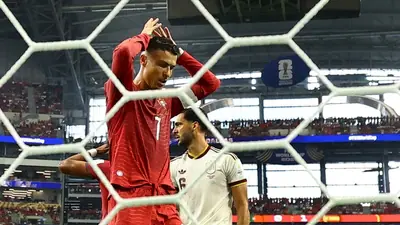
Every sporting generation eventually reaches a moment it desperately hopes will never arrive. For football fans, that moment came at the 2026 FIFA World Cup as Cristiano Ronaldo‘s final appearance on the sport’s biggest stage ended in heartbreak.
Portugal’s Round of 16 defeat against Spain brought the curtain down on Ronaldo’s World Cup journey after six tournaments, two decades, and countless unforgettable moments. The result itself was painful enough, but the broader conversation surrounding Ronaldo’s final campaign has become one of the defining stories of the tournament.
At the center of the debate lies a difficult question: Did Portugal benefit from keeping Ronaldo as a starter, or did loyalty to one of football’s greatest players ultimately become a tactical disadvantage?
The answer is not simple. It involves much more than goals, statistics, or age. It touches on leadership, legacy, squad management, and the challenge every great team faces when transitioning away from an iconic figure.
For Ronaldo, the tournament delivered one final record, one final disappointment, and perhaps the most complicated chapter of his extraordinary international career.
The End of Cristiano Ronaldo’s World Cup Journey
When Ronaldo made his World Cup debut in 2006, he was a young superstar bursting with potential. Twenty years later, he arrived in North America as one of the most accomplished footballers in history.
Between those two moments, football changed dramatically. Tactical systems evolved, athletic standards increased, and entire generations of players came and went. Through it all, Ronaldo remained relevant.
His appearance at the 2026 FIFA World Cup was itself a remarkable achievement. Very few outfield players in football history have competed at such a high level into their forties.
Yet longevity creates its own challenges.
While experience can compensate for declining athleticism, there comes a point when even the greatest players must adapt their game. The 2026 World Cup revealed both the strengths and limitations of Ronaldo’s late-career evolution.
A Historic Record Overshadowed by Bigger Questions
One of the tournament’s most memorable milestones came when Ronaldo became the first player ever to score in six different FIFA World Cups.
It was a record that perfectly captured the consistency and longevity that have defined his career.
However, that achievement was quickly overshadowed by debates surrounding his performances and role within the Portuguese team.
Football history often remembers trophies more than records. While Ronaldo added another remarkable accomplishment to his résumé, Portugal’s early exit inevitably shifted attention toward what went wrong rather than what was achieved.
| Achievement | Significance |
|---|---|
| Scored in Six World Cups | First player in football history to achieve the feat |
| Six World Cup Appearances | Spanned two decades of international football |
| Portugal Captain | Led multiple generations of national team players |
| Final World Cup at Age 41 | Rare longevity at elite international level |
These achievements highlight why Ronaldo remains one of football’s defining figures regardless of how the tournament ended.
The Debate That Followed Ronaldo Throughout the Tournament
Before the World Cup even began, discussion surrounding Ronaldo centered on one issue: should he still be Portugal’s first-choice striker?
Supporters argued that his experience, leadership, and finishing ability justified his inclusion. Critics questioned whether Portugal possessed younger and more dynamic options capable of offering greater tactical flexibility.
The debate intensified as the tournament progressed.
Against weaker opposition, Ronaldo demonstrated flashes of the quality that made him a global icon. However, against stronger teams, his influence became increasingly limited.
This created a difficult dilemma for Portugal’s coaching staff.
Should they trust one of football’s greatest-ever players to deliver in decisive moments, or should they prioritize tactical efficiency regardless of reputation?
That question became one of the defining themes of Portugal’s campaign.
How Modern Football Has Changed the Role of Strikers
One important factor often overlooked in discussions about Ronaldo is how dramatically the striker position has evolved.
Modern forwards are expected to do far more than score goals.
- Press defenders aggressively.
- Track back defensively.
- Create chances for teammates.
- Contribute to possession build-up.
- Cover significant distances throughout matches.
Many of today’s most successful attackers combine goalscoring with relentless off-ball work.
Ronaldo’s game naturally evolved in a different direction as he aged. Rather than functioning as an all-action forward, he became a specialist finisher focused on positioning inside dangerous areas.
That approach can still be highly effective, but it requires a team structure specifically designed to maximize those strengths.
When service becomes inconsistent, the limitations become more visible.
Did Portugal Create Enough Opportunities?
One argument frequently raised in Ronaldo’s defense is that Portugal failed to provide him with sufficient service.
On paper, Portugal possessed one of the strongest midfields in the tournament. Creative players such as Bruno Fernandes and Bernardo Silva are capable of producing moments of brilliance against any opponent.
However, elite international tournaments often reduce available space and time.
Opponents focused heavily on disrupting Portugal’s attacking rhythm, preventing the team from consistently delivering quality chances into dangerous areas.
As a result, Ronaldo frequently found himself isolated from the game.
This raises an important analytical question: was the issue Ronaldo’s performance, or was it Portugal’s inability to create conditions where he could succeed?
The reality likely lies somewhere in the middle.
The Gonçalo Ramos Factor
One of the most fascinating subplots of Portugal’s campaign involved the emergence of Gonçalo Ramos as a potential alternative.
Ramos represented a different profile of striker.
He offered greater mobility, pressing intensity, and movement across the front line. His ability to stretch defenses created tactical possibilities that differed from Ronaldo’s more central role.
When given opportunities, Ramos demonstrated why many observers viewed him as Portugal’s long-term solution at striker.
The contrast between the two players highlighted a broader strategic dilemma facing modern football teams: balancing experience and legacy against tactical evolution.
Portugal’s handling of that challenge will likely be studied for years.
Spain’s Victory Was About More Than One Player
Although Ronaldo became the focus of much post-match discussion, Portugal’s defeat cannot be reduced to one individual.
Spain won because they executed their game plan effectively.
The Spanish side controlled key phases of possession, defended intelligently, and remained patient under pressure. Their winning goal reflected the qualities that have made them one of the tournament’s strongest teams.
Elite knockout matches are often decided by small margins.
Portugal competed well for long stretches but ultimately failed to capitalize on crucial moments.
Spain, by contrast, demonstrated the efficiency and composure associated with championship contenders.
The Emotional Reality Behind Ronaldo’s Final Appearance
Statistics and tactical debates tell only part of the story.
The emotional dimension of Ronaldo’s final World Cup may ultimately be what fans remember most.
At the final whistle, the Portuguese captain stood as a symbol of a dream that had finally reached its conclusion.
For twenty years, the World Cup represented the one major objective that remained unfinished.
He won league titles.
He conquered the Champions League.
He lifted major international trophies.
He shattered scoring records.
Yet the FIFA World Cup remained elusive.
The visible disappointment after Portugal’s elimination reflected not failure, but the emotional weight of pursuing an ambition for two decades.
What Ronaldo’s Career Teaches About Greatness
One of the most valuable lessons from Ronaldo’s journey is that greatness is not defined solely by perfection.
Modern sports culture often focuses exclusively on championships and trophies. While success matters, it is not the only measure of achievement.
Ronaldo’s career demonstrates the importance of:
- Consistency over time.
- Relentless self-improvement.
- Adaptation to changing circumstances.
- Resilience after setbacks.
- Leadership under pressure.
Very few athletes have maintained elite standards for as long as Ronaldo.
That achievement alone places him among the most influential figures in sporting history.
The Future of Portugal After Ronaldo
Portugal now enters a new era.
For nearly two decades, the national team’s identity was closely connected to Ronaldo. His presence influenced tactics, leadership structures, and public expectations.
Moving forward, Portugal must build around a new generation of talent.
The encouraging news for Portuguese supporters is that the foundation already exists.
The squad contains experienced leaders, emerging stars, and a strong football infrastructure capable of producing future talent.
The challenge will be maintaining competitiveness while establishing a new identity independent of the player who defined an era.
A Unique Perspective: Why This World Cup May Improve Ronaldo’s Legacy
At first glance, that idea may seem contradictory.
How could a disappointing World Cup improve someone’s legacy?
The answer lies in authenticity.
Fans witnessed Ronaldo confronting limitations that every athlete eventually faces. Rather than diminishing his reputation, that reality humanized him.
His willingness to continue competing, accepting criticism, and pursuing one final dream revealed qualities that statistics cannot measure.
In many ways, the tournament reinforced why he became such an influential figure in the first place.
Greatness is not merely about winning. It is also about continuing to strive when success is no longer guaranteed.
Conclusion: A Tournament Too Far, But a Legacy Beyond Question
Cristiano Ronaldo’s final FIFA World Cup may not have unfolded as he hoped. Portugal exited earlier than expected, debates about his starting role intensified, and the dream of lifting football’s greatest trophy remained unfulfilled.
Yet focusing solely on those disappointments would miss the broader significance of his journey.
Across six World Cups and twenty years of international football, Ronaldo inspired a generation, transformed Portugal into a consistent contender, and established standards of professionalism that continue to influence the sport.
The 2026 tournament may have been one challenge too far for a player entering his fifth decade of life, but it did not diminish what came before it.
Instead, it served as the final chapter of one of football’s greatest stories—a story defined not by a single tournament result, but by extraordinary ambition, relentless dedication, and a legacy that will endure long after the final whistle of his last World Cup appearance.
For breaking news and live news updates, like us on Facebook or follow us on Twitter and Instagram. Read more on Latest Sports on thefoxdaily.com.





COMMENTS 0