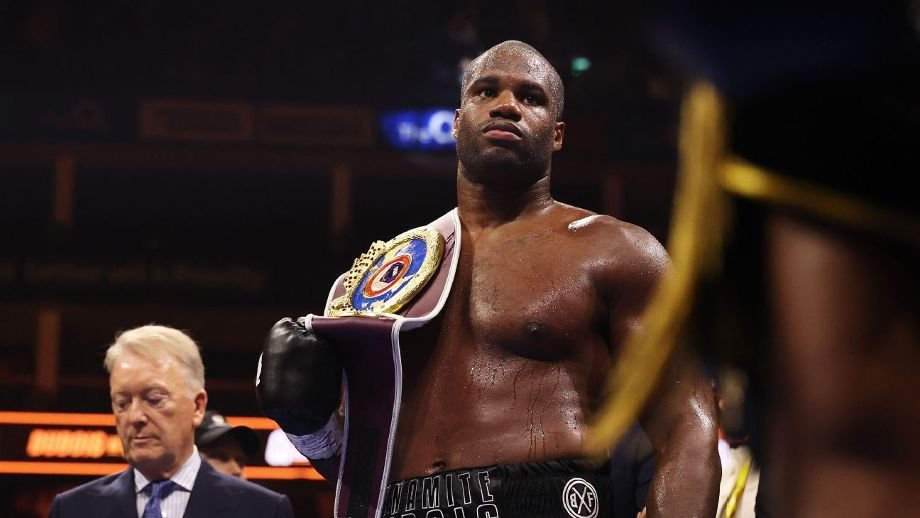
Daniel Dubois and Sebastian Fundora strengthened their positions in professional boxing with title defenses on October 17, 2026, producing contrasting victories that highlighted the different ways championship fights can unfold. Dubois needed just two rounds to defeat Fabio Wardley in London, while Fundora had to wait until the final round to stop Ermal Hadribeaj in Las Vegas.
The results left both champions in their existing positions in ESPN’s divisional rankings. Dubois remained No. 3 among heavyweights, while Fundora held the No. 2 spot in the junior middleweight division, also known as super welterweight at 154 pounds.
The biggest ranking change came in the heavyweight division, where Wardley fell from No. 4 to No. 6 after suffering his first professional knockdown. Meanwhile, Jose Armando Resendiz secured a unanimous decision victory over short-notice opponent Koen Mazoudier, maintaining his No. 8 position among super middleweights.
Together, the results demonstrate why a title defense can have consequences beyond a championship belt. The manner of victory, the quality of the opponent and the surrounding competitive landscape all influence how a fighter’s standing is assessed.
Daniel Dubois Makes a Statement With Dominant Heavyweight Title Defense
Dubois delivered the most emphatic performance of the night in London, retaining his WBO heavyweight championship with a second-round technical knockout against Wardley. The champion established control almost immediately, putting his opponent on the canvas just 17 seconds into the opening round.
The knockdown was particularly significant because Wardley had never previously been knocked down during his professional career. Dubois’ early success disrupted the challenger’s plans and forced him to respond under pressure from the opening exchanges.
Wardley managed to survive the remainder of the first round, but the respite did little to change the direction of the contest. Dubois continued attacking in the second, landing damaging punches and leaving Wardley’s corner with an increasingly difficult decision.
At 2 minutes, 21 seconds of the second round, Wardley’s corner threw in the towel, bringing the contest to an end. The stoppage allowed Dubois to retain his title without leaving the outcome to the judges.
A Different Fight From Their Previous Encounter
The rematch carried additional significance because the two British heavyweights had already produced a dramatically different contest earlier in the year. In their first meeting in May 2026, Dubois recovered after being knocked down twice before stopping Wardley in the 11th round.
That earlier fight demonstrated Wardley’s ability to trouble the champion and make a contest competitive even when the momentum shifted against him. The rematch, however, was defined by Dubois’ immediate aggression and his ability to establish an advantage before Wardley could settle into the fight.
The contrast matters when evaluating Dubois’ performance. Winning a rematch is one achievement; changing the way a familiar opponent is able to compete is another. Dubois did not allow the second meeting to develop into another prolonged exchange of momentum.
His performance also reinforced the importance of opening-round effectiveness in heavyweight boxing. Heavyweights possess the punching power to change a contest with a single clean shot, making early knockdowns particularly consequential. Once Wardley was forced to recover from the opening blow, Dubois maintained enough pressure to prevent him from regaining control.
What the Result Means for the Heavyweight Rankings
Dubois remains No. 3 in ESPN’s heavyweight rankings, while Wardley falls two places from No. 4 to No. 6. The result gives Dubois a clearer statistical advantage over a direct rival who had previously demonstrated the ability to challenge him.
According to the supplied rankings, Oleksandr Usyk remains No. 1, followed by Tyson Fury at No. 2. Filip Hrgovic occupies fourth place after moving up one position, while Anthony Joshua rises to No. 5.
The changes illustrate how rankings can respond to a single result without completely reshaping a division. Dubois did not move up despite retaining his title impressively, but Wardley’s fall reflects the significance of losing a rematch against a closely ranked opponent.
These positions should not be confused with the official championship order maintained by individual sanctioning bodies. A divisional ranking is an assessment of a fighter’s standing relative to other leading competitors, while a championship belt represents recognition under a particular boxing organization.
For Dubois, the next challenge is converting his title defense into a stronger position among the division’s leading names. A future fight against another highly ranked heavyweight could provide a more direct measure of how close he is to the top of the rankings.
Sebastian Fundora Survives a Tough Challenge Before Stopping Ermal Hadribeaj
Fundora’s victory in Las Vegas followed a very different pattern. The WBC junior middleweight champion needed almost the entire scheduled 12 rounds to retain his belt against Hadribeaj, finally producing a decisive left hook at the end of the contest.
The fight appeared increasingly likely to reach the scorecards as the final round approached. Instead, Fundora found the decisive opening at 2 minutes, 59 seconds of the 12th round, sending Hadribeaj to the canvas with a left hand.
Hadribeaj managed to return to his feet, but referee Thomas Taylor stopped the fight. The late stoppage secured Fundora’s title defense and handed the challenger his first professional defeat, according to the supplied fight report.
Why Fundora’s Late Stoppage Matters
Fundora’s result is a reminder that championship boxing can remain uncertain until the final moments. A fight that reaches the closing stages without a stoppage can still end decisively if one competitor finds an opening and capitalizes on it.
Unlike Dubois, who established an immediate advantage, Fundora had to work through a much longer contest. His victory required him to remain effective across the scheduled distance and find the decisive punch when the opportunity appeared.
The difference between the two performances is useful when assessing champions. An early stoppage can demonstrate the ability to impose a fight plan quickly, while a late stoppage can reflect the importance of maintaining pressure and remaining alert as fatigue accumulates.
Neither result automatically establishes that one champion is better than another. Heavyweight and junior middleweight boxing involve different physical demands, opponents and tactical considerations. The more meaningful comparison is how each fighter handled the challenge presented in his own division.
For Hadribeaj, the loss ends an unbeaten professional run, but it does not erase the experience of competing for a world championship. His position in the rankings remains a useful indicator of how the supplied list evaluates his overall standing, even after a setback.
Fundora Remains Near the Top at 154 Pounds
Fundora retains the No. 2 position in ESPN’s junior middleweight rankings. Jaron Ennis remains No. 1, with Fundora immediately behind him. Hadribeaj stays at No. 9 despite losing the title fight.
The rankings place Fundora among the leading competitors in a division where championship status and divisional standing do not always align perfectly. Ennis holds the top position in the supplied list, while Fundora’s WBC title establishes his status as a reigning champion within the division.
That distinction is important for readers following boxing rankings. A champion can retain a belt without moving up the rankings, particularly when the list already places another fighter ahead of him. Rankings reflect a broader evaluation of the division rather than a simple count of successful title defenses.
Fundora’s immediate achievement is clear: he successfully defended his WBC championship against a challenger who took the fight into the final round. The next stage of his campaign will depend on the opponents available and the direction of the division’s championship picture.
Jose Armando Resendiz Wins a Competitive Co-Main Event
The Las Vegas card also featured a closely contested encounter between Jose Armando Resendiz and Koen Mazoudier. Resendiz secured a unanimous decision, with the judges scoring the 10-round contest 98-92, 97-93 and 97-93 in his favor.
Although all three judges awarded Resendiz the victory, the fight was described as more competitive than the scorecards suggested. That distinction is relevant because a unanimous decision establishes the official result but does not necessarily communicate every detail of how evenly the action unfolded.
Resendiz entered the bout on short notice after Jermall Charlo withdrew because of an injury suffered during training camp. Accepting a replacement assignment under those circumstances can present practical challenges, including limited preparation time and the need to adjust to a different opponent.
Resendiz nevertheless completed the fight with a victory, improving his record to 17 wins and three losses, according to the supplied rankings. He remains No. 8 in the super middleweight division, which covers fighters weighing up to 168 pounds.
Why the Resendiz Result Deserves Attention
Resendiz’s performance highlights a different aspect of professional boxing from the headline title defenses. While Dubois and Fundora were protecting world championships, Resendiz was competing to maintain his position among the division’s ranked contenders.
For a fighter in that position, a victory can help preserve opportunities for future high-level contests. It does not guarantee a title shot, but remaining active and defeating an opponent can strengthen a fighter’s case for continued inclusion among the division’s leading names.
The short-notice circumstances also provide context for the result. Replacing an opponent late in a training camp changes the preparation available to both fighters and can alter the tactical expectations surrounding a bout. However, the available information does not establish how much those circumstances affected the final performance.
The most defensible conclusion is that Resendiz secured the official win, retained his ranking and kept his campaign moving. His next opponent and the timing of his return will help determine whether he can improve on his current position.
How ESPN’s Boxing Rankings Work
The latest results provide an opportunity to understand how divisional boxing rankings differ from championship records. ESPN’s rankings are designed to identify leading fighters in each weight class, with recent performances and results influencing their positions.
The supplied ranking guidelines also establish rules for fighters changing divisions, inactive competitors and athletes who test positive for performance-enhancing substances.
Recent Results Can Change a Fighter’s Position
A major victory or defeat can affect a fighter’s ranking, particularly when it involves another highly placed opponent. Wardley’s fall from fourth to sixth illustrates this principle, while Dubois’ unchanged position shows that a successful title defense does not necessarily result in an immediate rise.
Rankings also reflect more than the possession of a belt. Different organizations maintain separate championship systems, and a fighter may hold a title while occupying a lower position on an independent divisional list.
Moving Between Weight Classes
According to the supplied guidelines, fighters who announce a move to another weight class will be ranked in their new division, when warranted, only after competing there. This approach distinguishes a planned move from an established record of competing at a particular weight.
The guidelines also allow a boxer who currently holds titles in two divisions to appear in both rankings. That flexibility recognizes that some fighters compete successfully across weight classes rather than remaining tied to a single division throughout their careers.
Inactivity and Anti-Doping Rules
The ranking policy states that fighters who have not competed during the previous 12 months and do not have a fight scheduled will be removed from the list until they return to the ring. This rule makes recent activity an explicit consideration in maintaining a ranking.
The supplied guidelines also state that a fighter who tests positive for a performance-enhancing substance will be removed from the rankings. Eligibility to reenter follows the fighter’s next bout, under the described policy.
These provisions matter because rankings are intended to reflect the active competitive landscape rather than simply preserve a fighter’s reputation indefinitely. A highly regarded boxer who is inactive may eventually lose his place to an opponent who is competing regularly and producing relevant results.
What the Results Mean for Boxing Fans
The October 17 results offer three different lessons for followers of professional boxing. Dubois demonstrated the value of a fast, decisive start in heavyweight competition. Fundora showed that a championship fight can be settled in its final seconds. Resendiz, meanwhile, secured a unanimous decision in a competitive contest after entering on short notice.
The ranking changes are more selective than the results themselves. Wardley experienced the clearest immediate decline, while Dubois and Fundora retained their respective positions. Hadribeaj also remained ranked despite losing his first professional contest, and Resendiz held on to eighth place at super middleweight.
For fans tracking future matchups, these positions provide a useful starting point rather than a complete forecast. A ranking can identify potential opponents and establish relative standing, but it cannot determine how a future fight will unfold. Styles, preparation, experience and the quality of opposition will continue to shape individual contests.
What Happens Next for Dubois, Fundora and Their Divisions?
The next meaningful developments will depend on the opponents each champion faces and how the wider divisional picture evolves. Dubois remains third among heavyweights, with Usyk and Fury ahead of him in the supplied rankings. A future contest against another leading contender could help clarify his position in the championship landscape.
Wardley’s next appearance will also be important. His ranking has fallen following the rematch, but a return to winning form could help rebuild his standing. The immediate priority is likely to be a competitive return to the ring, although the supplied information does not identify his next opponent.
Fundora remains second at 154 pounds, behind Ennis. A future meeting with another leading contender could create a clearer path toward a stronger divisional position, but no specific next fight is confirmed in the supplied material.
Hadribeaj’s response to his first professional loss will be another development worth following. His ranking remains unchanged, leaving open the possibility of rebuilding momentum through subsequent performances.
For Resendiz, the priority will be maintaining activity and turning his latest victory into further progress in the super middleweight division. His short-notice win provides a positive result, but future opponents will offer a better indication of whether he can move closer to a championship opportunity.
Final Assessment: Three Wins, Different Consequences
Dubois, Fundora and Resendiz all emerged from October 17 with victories, but their results carried different implications. Dubois retained his WBO heavyweight title in emphatic fashion and reinforced his position near the top of the division. Fundora preserved his WBC championship with a dramatic final-round stoppage. Resendiz maintained his place among the super middleweight contenders with a unanimous decision.
The clearest ranking adjustment was Wardley’s two-place drop after his defeat. The other positions remained unchanged, demonstrating that rankings respond selectively to results rather than automatically rewarding every champion with a higher place.
For boxing fans, the broader significance lies in the relationship between championship success and divisional standing. Belts establish titleholders, rankings provide a wider assessment of competition, and future performances determine whether a fighter can convert one strong result into sustained progress. The latest results have kept all three divisions moving, even if the rankings changed only modestly.
For breaking news and live news updates, like us on Facebook or follow us on Twitter and Instagram. Read more on Latest Sports on thefoxdaily.com.


COMMENTS 0