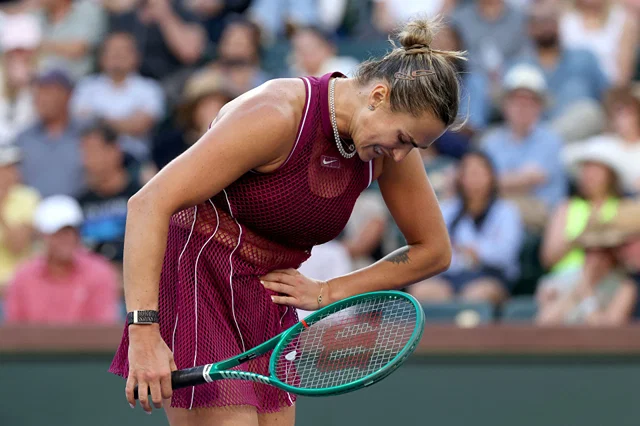
Eight-time Grand Slam champion Jimmy Connors has issued a blunt warning to Aryna Sabalenka after a disappointing end to her 2026 season, suggesting that the demands of remaining world No. 1 require complete commitment. Using teenage star Mirra Andreeva as an example, the former tennis great questioned whether Sabalenka’s off-court interests could be affecting her performances and warned that success in professional tennis can quickly shift towards the next winning star.
Speaking on the latest episode of his Advantage Connors podcast, Connors stressed that tennis is a year-round profession. He argued that players competing at the highest level must understand how to balance personal interests with the demands of maintaining their position at the top of the sport.
His comments came after Sabalenka finished the season with several major achievements but struggled to maintain her early-year momentum. She ended 2026 at No. 3 in the rankings after losing the top position in September and suffered an early exit at the WTA Finals.
Jimmy Connors delivers blunt warning to Aryna Sabalenka
Connors believes that being one of the best players in the world requires consistent dedication throughout the year. While recognising that athletes have interests outside their sport, he questioned how effectively they manage those commitments while competing for major titles.
“Tennis is a 365-day-a-year job. If you are going to be the best or one of the best, and if you have got outside interests that are taking your mind away from that, and I know everybody does, but it’s how you handle that,” Connors said.
Sabalenka’s off-court commitments have previously attracted attention from fans, journalists and tennis experts. Questions have been raised about whether her activities away from competition could affect her concentration and performance on court.
One such discussion emerged before the US Open, when a journalist asked Sabalenka about going to a party ahead of the tournament. The Belarusian responded bluntly, pushing back against the suggestion that her social activities were interfering with her tennis.
Connors’ latest remarks have brought the subject back into the conversation. Rather than focusing on one particular incident, he questioned whether outside interests could become more important than winning if a player does not maintain the necessary competitive focus.
He also highlighted the commercial reality of professional tennis, arguing that players who stop winning can quickly lose the attention that comes with being at the top.
“Because once you’re not winning anymore, and you’re not selling out 25,000-seat stadiums, you know what the one word you have to get used to is? Bye. And I hate to say it like that, but it’s true.”
The comment reflected Connors’ view that tennis audiences and the sport’s wider attention can move towards players who are winning consistently. His warning was directed at Sabalenka as she looks to regain her strongest form heading into the next season.
Mirra Andreeva becomes Connors’ example
Connors used Mirra Andreeva’s rise as an example of how quickly a new star can attract attention through results. The 19-year-old enjoyed a remarkable 2026 campaign, winning the French Open before capturing the WTA Finals without dropping a set.
Andreeva’s achievements have strengthened her position among the leading players in women’s tennis. Her WTA Finals victory was particularly significant because she defeated established competitors while maintaining an unbeaten record throughout the tournament.
Connors suggested that if Sabalenka could not maintain her winning level, attention from fans and the tennis business could increasingly move towards Andreeva, who is already producing major results.
“If Sabalenka can’t do it, they are going to hook on to her (Andreeva) because she’ll sell out the stadiums, and she’s winning,” Connors said.
His point was that a player’s position in tennis is closely connected to results. Sabalenka has enjoyed considerable success in recent seasons, but Andreeva’s breakthrough campaign has demonstrated how quickly a younger player can become a major attraction by winning important tournaments.
Connors also believes that the pressure created by rivals should motivate Sabalenka rather than distract her. He argued that knowing other players want to defeat her should provide an additional reason to raise her level.
“Everybody wants to beat you, but that should lift your game,” he added.
Sabalenka’s 2026 season began strongly before losing momentum
Sabalenka’s final ranking does not tell the full story of her 2026 campaign. She finished the year at No. 3 with 6,685 ranking points and recorded 48 wins against 13 losses across 15 tournaments.
Her season included three titles, with victories at Brisbane, Indian Wells and Miami. The early months were particularly successful, as she established herself as one of the dominant players on the WTA Tour.
Sabalenka entered the Miami tournament with a strong run of results and stood at 23-1 through that event. However, her momentum slowed considerably afterwards. She recorded a 25-12 record following Miami and did not win another title during the remainder of the season.
The contrast between the two parts of her campaign became one of the defining features of her year. After winning three tournaments early in the season, she struggled to convert later opportunities into additional trophies.
Her performances in the two hard-court Grand Slam finals were also disappointing. Elena Rybakina defeated Sabalenka in both Melbourne and New York, preventing the Belarusian from adding another major title to her record.
At the Australian Open, Rybakina won 6-4, 4-6, 6-4. The pair then met again in the US Open final, where Rybakina secured a 6-4, 5-7, 6-2 victory.
Those defeats meant that Sabalenka finished the season without another Grand Slam title, despite reaching both hard-court major finals. Her inability to maintain her early-year success also contributed to her losing the No. 1 ranking in September.
Sabalenka loses world No. 1 position after 99 weeks
Sabalenka’s time at the top of the rankings came to an end in September after 99 consecutive weeks as world No. 1. The change marked a significant moment in a season that had started with her firmly established as the leading player in women’s tennis.
Although she remained among the top three players by the end of the year, the loss of the No. 1 position added to the disappointment of her later results. Her campaign showed how quickly the rankings can change when other players produce stronger results during the final stages of a season.
Rybakina’s victories in the two hard-court major finals and Andreeva’s impressive run at the WTA Finals further highlighted the competition facing Sabalenka. Both players produced results that strengthened their positions among the leading names on the tour.
Connors’ comments were made against this background. His concern was not simply that Sabalenka had lost some matches, but whether she could maintain the level of commitment required to remain a consistent title contender while dealing with the demands of life outside tennis.
WTA Finals defeat to Andreeva adds to Sabalenka’s disappointment
Sabalenka’s final tournament of the season provided another difficult moment. At the WTA Finals, she finished the group stage with one win and two defeats, resulting in an early exit from the competition.
It was her first group-stage elimination at the tournament since 2021. The result was particularly notable because Sabalenka entered the event as one of the leading contenders but was unable to secure enough victories to advance.
Her defeat to Andreeva became one of the most striking results of the group stage. Sabalenka initially appeared to be in control, building a 4-1 lead, but Andreeva recovered and went on to win 6-4, 6-0.
The second-set scoreline underlined the teenager’s strong performance and added another important victory to her impressive season. For Sabalenka, the defeat was a difficult conclusion to a campaign in which her results had declined after a dominant opening stretch.
Andreeva’s victory also gave further relevance to Connors’ comparison. The teenager was not merely a rising prospect; she had already defeated one of the biggest names in the sport and finished the tournament without dropping a set.
Kim Clijsters offers a different theory about Sabalenka’s form
While Connors focused on the balance between tennis and outside interests, former world No. 1 Kim Clijsters offered a different perspective on Sabalenka’s season. Speaking on Andy Roddick’s Served podcast, the four-time Grand Slam champion speculated about whether changes in the Belarusian’s personal life could influence her priorities.
Clijsters made clear that she was guessing rather than claiming to know what Sabalenka was thinking. Drawing on her own experience of balancing professional tennis with family life, she wondered whether the Belarusian might be entering a stage where her personal ambitions were beginning to change.
“It just made me think, like she’s getting to a stage in her life and in her career like, maybe there’s a strong maternal kind of feeling that’s starting to play up, right? I went through that, so maybe I’m kind of focusing on my situation, but who knows? You know, she’s going to get married soon. Is she starting to think about starting a family? Is she not as happy on tour anymore? Is it not feeling like, you know, this is the all or nothing kind of mindset that you at times need to have to push yourself through the struggles. I’m curious to see what’s going to happen,” Clijsters said.
Her comments were based partly on her own career experience. Clijsters retired in 2007 to start a family and returned to professional tennis two years later. She then won the 2009 US Open, demonstrating that it was possible to return to the highest level after taking time away from the sport.
Clijsters’ experience informed her questions about whether Sabalenka’s personal circumstances could eventually influence her relationship with professional tennis. However, she did not present her theory as a confirmed explanation for the Belarusian’s results.
Sabalenka’s engagement and plans for marriage in 2027
Sabalenka announced her engagement in March and plans to marry her fiancé, Georgios Frangulis, in 2027. The announcement has added another personal milestone to a period in which she is also considering her future beyond the tennis court.
She has also spoken about wanting to start a family with Frangulis when she is 32. Those comments were among the personal developments that prompted Clijsters to reflect on whether Sabalenka’s priorities might change as she moves through the next stage of her life.
However, Sabalenka has not confirmed that her engagement or future family plans have affected her performances. Clijsters’ remarks remain speculation based on her own experiences, while Connors’ comments focus on the professional demands of competing at the highest level.
The two former champions have therefore approached Sabalenka’s difficult finish to 2026 from different perspectives. Connors believes outside interests must be managed carefully, while Clijsters has raised questions about the possible influence of major personal milestones.
Sabalenka’s plans for the 2027 season remain unclear
Sabalenka has not confirmed where she will begin her 2027 campaign. Brisbane is considered a likely option, particularly because she won the tournament in both 2025 and 2026.
A return to Brisbane would give her an opportunity to begin the new season at an event where she has enjoyed considerable success. However, until her schedule is officially confirmed, her opening tournament remains uncertain.
The next season will provide an opportunity for Sabalenka to respond to the challenges of 2026. She will be looking to recover the consistency that helped her win three titles early in the year and compete for the biggest trophies again.
Andreeva’s rise, Rybakina’s victories and the changing rankings have added to the competitive pressure around the top of women’s tennis. Connors believes that pressure should motivate Sabalenka to improve rather than allow her attention to drift away from the sport.
For now, the reasons behind Sabalenka’s second-half struggles remain open to interpretation. Her results are clear, but neither Connors nor Clijsters has established that her personal interests or future family plans caused the decline. Sabalenka’s response on court in 2027 will offer a clearer indication of how she intends to approach the next stage of her career.
For breaking news and live news updates, like us on Facebook or follow us on Twitter and Instagram. Read more on Latest Sports on thefoxdaily.com.






COMMENTS 0