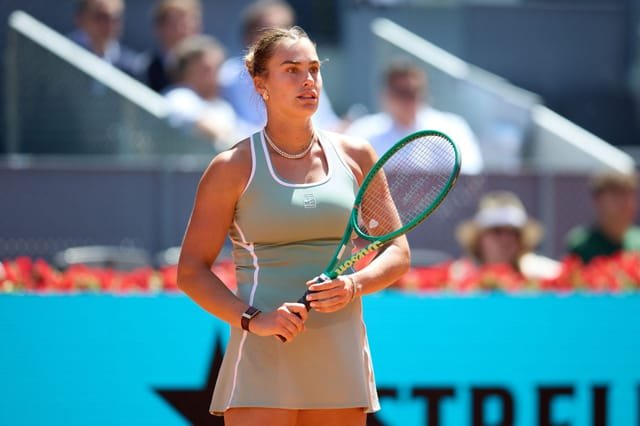
Aryna Sabalenka‘s political stance has once again become a major talking point away from the tennis court, after former Belarus minister Pavel Latushka criticised the world No. 1 for remaining silent about political repression in Belarus and the country’s role in the wider regional conflict.
The controversy comes at a particularly important moment in Sabalenka’s career. The Belarusian remains one of the most successful players on the women’s tour and is the defending US Open champion, but her recent results have raised questions about her form heading into the final Grand Slam of the season.
The latest criticism is therefore happening on two separate fronts. Away from tennis, Sabalenka continues to face pressure over her public position on Belarus and the war in Ukraine. On the court, a series of painful defeats has exposed a different concern: her difficulty closing matches after establishing commanding positions.
Why Aryna Sabalenka Is Facing Political Criticism
Pavel Latushka, who previously served as a Belarusian cabinet minister and ambassador under President Alexander Lukashenko, has criticised Sabalenka over what he describes as her unwillingness to publicly confront the political situation in Belarus.
Sabalenka has previously expressed opposition to the war in Ukraine. However, when asked by TIME about Lukashenko, she declined to discuss him directly.
“No one does. It’s so obvious.”
When the discussion turned specifically to Lukashenko, Sabalenka responded:
“I don’t want to talk about it.”
Those comments have become the focus of renewed criticism from Latushka, who argues that Sabalenka’s global profile gives her a platform that could be used to speak about political prisoners and repression in Belarus.
Who Is Pavel Latushka?
Latushka is a former Belarusian government official who served as both a minister and ambassador during Lukashenko’s rule. His political position later changed dramatically following the political crisis that began in 2020.
Since then, he has been associated with the opposition movement led by Sviatlana Tsikhanouskaya and has become one of the prominent Belarusian voices criticising the country’s government.
His criticism of Sabalenka therefore comes from someone who has direct experience inside the Belarusian political system as well as later involvement with the opposition.
Belarus’ Political Crisis Remains Highly Sensitive
The background to the dispute dates back to Belarus’ contested 2020 presidential election and the protests that followed.
Large demonstrations took place across the country, with protesters challenging Lukashenko’s rule. The government responded with a severe crackdown, leading to widespread international criticism and the detention of opposition supporters.
The political situation also became connected to the wider conflict in Eastern Europe after Russia launched its full-scale invasion of Ukraine in 2022. Belarus has supported Russia, making the country’s position particularly controversial internationally.
For athletes from Belarus, this has created an unusual situation in which sporting achievements are frequently discussed alongside geopolitical issues.
Why Sabalenka’s Position Is Difficult to Separate From Tennis
Sabalenka competes internationally as one of the most recognisable athletes from Belarus. Her position at the top of women’s tennis naturally gives her a substantial global audience.
At the same time, athletes from Russia and Belarus have faced additional scrutiny since the invasion of Ukraine. Tennis authorities introduced measures concerning the participation of players from the two countries, while Ukrainian players have also expressed strong personal opposition to their Russian and Belarusian counterparts.
This has created an uncomfortable balance for players such as Sabalenka. They are expected to compete professionally while also being asked questions about political events over which they may have limited direct control.
Sabalenka’s approach has generally been to express opposition to war while avoiding direct political confrontation with Lukashenko.
Latushka Says Sabalenka Could Use Her Global Platform
Latushka’s criticism centres on the idea that Sabalenka’s international profile creates an opportunity to draw attention to political prisoners and the situation inside Belarus.
In a post on X, he argued that Sabalenka should use her status to speak more directly about the country’s political situation and called for the release of female political prisoners.
The criticism reflects a broader debate involving internationally successful athletes from politically sensitive countries: how much responsibility should a global sports star have to speak about events in their homeland?
There is no simple answer.
Some believe athletes with enormous platforms have a moral responsibility to speak. Others argue that sporting figures should not be forced into political activism, particularly when speaking openly could create personal or professional risks.
Sabalenka Has Chosen a Cautious Approach
Sabalenka’s public statements suggest that she has deliberately avoided directly naming Lukashenko while making clear that she does not support the war.
This distinction is important. Saying that she opposes war is not the same as publicly condemning the Belarusian government, and Latushka’s criticism is specifically focused on that gap.
For Sabalenka, maintaining that boundary may be a conscious decision. For critics, however, silence on specific political figures can be interpreted as insufficient given her international influence.
The disagreement is therefore unlikely to disappear simply because Sabalenka has previously stated her opposition to war.
The Political Controversy Comes During a Difficult Tennis Run
While the political discussion continues, Sabalenka has also experienced a significant dip in momentum on the tennis court.
Her Cincinnati Open campaign ended in the fourth round when Sara Bejlek defeated her 7-6 (7), 6-4 on August 19.
The result was particularly painful because Sabalenka had held substantial advantages during the match.
She led 5-1 in the first-set tiebreak and later established a 4-1 advantage in the second set. Despite those positions, she could not close the match.
Sabalenka’s Recent Problem: Losing From Winning Positions
The Cincinnati defeat was not an isolated incident.
According to the provided match record, Sabalenka has suffered five losses from winning positions across her last seven defeats. That pattern is far more concerning than a normal loss because it suggests that the issue is not simply a lack of quality against stronger opponents.
When a player repeatedly loses after building significant leads, the problem can involve decision-making, shot selection, momentum management or the ability to stay composed during crucial points.
For a player with Sabalenka’s power, the challenge is particularly interesting. Her aggressive game can overwhelm opponents, but the same attacking style can become risky when she is trying to protect a lead.
From a Strong Start to a Difficult Summer
Sabalenka began the 2026 season impressively, winning three titles from her first four tournaments.
That start established her as one of the dominant players on the women’s tour and strengthened her position at the top of the rankings.
However, the momentum began to change at the Madrid Open.
She lost to Hailey Baptiste in the quarterfinals despite having multiple match points. Another opportunity slipped away at the Italian Open, where she surrendered a significant advantage against Sorana Cirstea.
The French Open brought another difficult defeat, this time against Diana Shnaider after Sabalenka suffered a major collapse during the match.
These results have created a clear contrast between the Sabalenka of the early season and the player approaching the US Open.
Sabalenka’s US Open Challenge Is Bigger Than Expected
The timing of her Cincinnati exit could hardly be more significant.
Sabalenka is the defending champion at the US Open, meaning she enters the tournament with a substantial ranking responsibility. She must defend the points and momentum associated with last year’s title run while also attempting to rediscover the consistency that made her one of the most feared players in women’s tennis.
Her recent results make that challenge more complicated.
A player does not suddenly lose elite ability after a handful of defeats, but repeated collapses from winning positions can create psychological pressure. Every future lead can potentially become a reminder of what happened in previous matches.
World No. 1 Ranking Also Faces Pressure
Sabalenka’s position at the top of the rankings is not completely secure.
Elena Rybakina could overtake her in the rankings if she reaches the semifinals at the US Open, meaning Sabalenka cannot afford another early exit if she wants to maintain her position at No. 1.
This creates an additional layer of pressure before the final Grand Slam of the year.
| Sabalenka’s 2026 Situation | Key Detail |
|---|---|
| Current ranking | World No. 1 |
| US Open status | Defending champion |
| Early-season titles | Three in first four tournaments |
| Cincinnati result | Fourth-round defeat |
| Cincinnati opponent | Sara Bejlek |
| Recent losses from winning positions | Five across her last seven defeats |
| Ranking threat | Elena Rybakina |
The Bigger Question: Can Sabalenka Reset Before the US Open?
The most important question surrounding Sabalenka now is not whether she can hit enough winners. Her ability to produce powerful tennis has never been seriously questioned.
The issue is whether she can manage matches more effectively when the pressure increases.
Her Cincinnati defeat provides a useful example. Leading 5-1 in a tiebreak gives a player a major opportunity to take control of a set. Similarly, a 4-1 advantage in the second set should normally provide a strong platform for victory.
Yet neither advantage translated into a win.
That suggests that Sabalenka’s preparation for the US Open may need to focus as much on match management as on technical improvements.
Why Her Mental Approach Could Be Crucial
Tennis is unique because players are largely responsible for solving problems alone during matches. There is no teammate who can take over for five minutes when momentum shifts.
For an aggressive player such as Sabalenka, staying patient after gaining a lead can be difficult. The instinct to finish points quickly can sometimes give an opponent an opening to return to the contest.
A more controlled approach could be valuable when she finds herself ahead.
Instead of attempting to force every point, Sabalenka may benefit from making opponents work through longer sequences and reducing unnecessary risks at crucial moments.
A Unique Pressure Before New York
Sabalenka will arrive at the US Open carrying several different forms of pressure.
- She is defending the Grand Slam title she won previously.
- She enters as the world No. 1.
- Her recent results have been inconsistent.
- She has repeatedly surrendered strong positions.
- Elena Rybakina is capable of challenging her ranking position.
- Political questions continue to follow her away from the court.
That combination makes the tournament one of the most important periods of Sabalenka’s season.
Will the Political Debate Affect Her Tennis?
It would be impossible to state with certainty that the political criticism is affecting Sabalenka’s performances.
However, the constant attention surrounding non-tennis issues can add another layer of media pressure to an athlete already competing under intense expectations.
Sabalenka has spent much of her career developing into one of the leading figures in women’s tennis. With that status comes greater scrutiny, including questions that extend far beyond results and rankings.
Her ability to separate those external issues from competition could become important during the US Open.
What Happens Next for Aryna Sabalenka?
Sabalenka now has limited time to recover from her Cincinnati disappointment before the US Open begins.
The priority will be rebuilding confidence and finding a way to turn strong positions into completed victories. Her early-season success proves that her level remains extremely high, but the recent defeats demonstrate that maintaining that level under pressure is the immediate challenge.
Off the court, questions about her political position are likely to continue as long as the situation in Belarus remains unresolved.
Conclusion
Aryna Sabalenka is facing pressure from two very different directions as she prepares for the US Open. Former Belarus official Pavel Latushka has criticised her for refusing to directly address President Alexander Lukashenko and political repression in Belarus, while her recent tennis results have created concerns about her ability to close matches.
Sabalenka has consistently expressed opposition to war but has avoided directly discussing Lukashenko. That cautious position continues to attract criticism from sections of the Belarusian opposition.
Meanwhile, her defeat to Sara Bejlek in Cincinnati highlighted a worrying sporting trend. Sabalenka surrendered significant leads and suffered another loss from a winning position, continuing a pattern seen several times during her recent run.
With the US Open approaching, Sabalenka’s biggest challenge may be mental rather than technical. She still possesses the power, experience and ranking required to go deep at a Grand Slam. The question is whether she can regain the composure and consistency that turned her into a major champion.
If she solves that problem, the US Open could provide the perfect response to her recent setbacks. If the collapses continue, however, her world No. 1 ranking and title defence could both come under serious pressure.
For breaking news and live news updates, like us on Facebook or follow us on Twitter and Instagram. Read more on Latest Sports on thefoxdaily.com.





COMMENTS 0