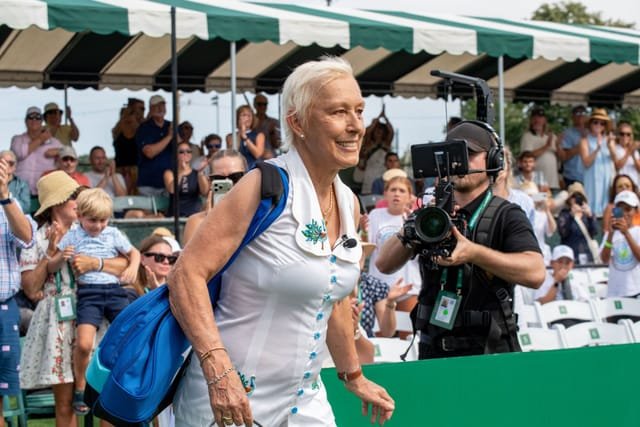
Martina Navratilova has sounded the alarm over the increasingly late finishes at the 2026 US Open, arguing that the schedule is becoming difficult to sustain for professional tennis players.
The former world No. 1 reacted after a series of matches at Flushing Meadows stretched deep into the night. With night sessions beginning at 7 p.m. and matches having no fixed duration, the second contest of the evening can sometimes start much later than expected and finish in the early hours of the morning.
Navratilova summed up her concern in four words: “This is not sustainable.”
Her comments have added to a long-running discussion surrounding tennis scheduling. Players have repeatedly pointed out that their working day does not end when the final point is played. Post-match media commitments, treatment, food, travel and preparation for the following day can push their bedtime even further into the morning.
The issue is particularly important at a Grand Slam, where players may have to compete again after only a limited recovery period. The conversation is therefore not simply about whether fans enjoy watching late-night tennis. It is also about how tournament schedules can influence player welfare and competitive fairness.
Why US Open matches are finishing so late
The US Open’s night sessions are built around a 7 p.m. start, with two matches commonly scheduled on Arthur Ashe Stadium.
On paper, the format provides spectators with an attractive double-header and gives the tournament a valuable evening television window. The problem is that tennis does not operate with a fixed game clock.
A match can finish quickly if one player dominates, but it can also stretch for several hours when the competitors are closely matched. Five-set men’s matches can be particularly unpredictable, while long women’s contests can also push the second scheduled match deep into the night.
If the opening match lasts longer than expected, the second match starts late automatically. A player scheduled to compete in the second night-session match therefore has limited control over when their contest will actually begin.
This creates a scheduling chain reaction. A delayed start can produce a delayed finish, which then affects recovery and potentially the next day’s preparation.
How late did matches finish at the 2026 US Open?
The concern highlighted by Navratilova comes after several notably late finishes during the tournament.
On the opening night, the final US Open match ended at 2:01 a.m. The following schedule also produced several unusually late conclusions, including finishes at 12:26 a.m., 1:55 a.m. and 2:15 a.m.
These times illustrate why the issue has become more than an occasional scheduling curiosity. When matches repeatedly finish around or after midnight, late-night tennis becomes a regular feature of the tournament rather than an exceptional occurrence.
The most important point is not necessarily one match finishing late. It is the accumulation of these delays across a Grand Slam fortnight.
For players, every late finish can affect what happens after the match. A competitor who walks off court at 2 a.m. still has responsibilities before they can properly rest.
Why a 2 a.m. finish can affect player recovery
Professional tennis requires athletes to recover between matches. Physical treatment, nutrition, hydration, sleep and preparation can all influence how effectively a player returns to competition.
A late finish compresses the available recovery window when the next match is scheduled relatively soon afterward.
Players may also have mandatory or expected media commitments after their matches. Instead of immediately leaving the venue after the final point, they can spend additional time speaking to reporters and fulfilling tournament-related obligations.
Afterward, treatment and meals can further extend the working day. By the time a player returns to their accommodation and begins preparing for sleep, the clock can be approaching dawn.
The problem becomes more significant when the player has another match or demanding training session scheduled soon after.
In other words, the impact of a late finish is not measured only by the time shown on the scoreboard. The player’s entire post-match routine matters.
Martina Navratilova calls the situation unsustainable
Navratilova’s brief reaction carried weight because she is speaking from extensive experience at the highest level of professional tennis.
Her four-word assessment focused on sustainability rather than criticizing individual players or a specific match. The underlying argument is that scheduling should account for the physical demands placed on competitors throughout a long tournament.
Her comments also reflect a wider concern in tennis about the relationship between entertainment and athlete welfare.
Late-night matches can create memorable moments for television audiences and fans inside the stadium. However, the same scheduling pattern can be considerably less attractive from a player’s perspective when it repeatedly interferes with rest and preparation.
Late-night tennis has been a recurring US Open issue
The problem is not entirely new. The US Open has previously attracted criticism when matches have started or finished extremely late.
A notable example involved Venus Williams and Sofia Kenin, whose match in 2026 did not begin until 12:13 a.m. The contest subsequently extended beyond 2 a.m., generating renewed discussion about the tournament’s scheduling practices.
Such examples show why the current debate is broader than one tournament night. The challenge comes from trying to fit unpredictable matches into a fixed entertainment schedule.
Tennis tournaments must balance broadcast commitments, ticket sales, fan experience, player needs and competitive integrity. Those priorities do not always point in the same direction.
Why tennis scheduling is harder than scheduling timed sports
One reason the problem is difficult to solve is the unique structure of tennis.
In sports with a fixed game duration, organizers can estimate when an event will finish with reasonable accuracy. Tennis is different because the length of a match depends on the score, rallies, momentum, medical timeouts, changeovers and the competitiveness of the players.
A scheduled 7 p.m. match could finish relatively quickly, or it could continue for several hours. The next match cannot begin until the court becomes available.
This unpredictability means tournament organizers must build schedules around estimates that can change dramatically during the day.
However, the unpredictability of tennis does not eliminate the need to consider player welfare. Instead, it makes scheduling solutions more complicated.
Coco Gauff also draws Navratilova’s attention
Navratilova’s comments about scheduling came around the same time she assessed Coco Gauff’s performance at the 2026 US Open.
Gauff reached the fourth round after defeating Cristina Bucsa 6-3, 6-4 in the third round. Navratilova discussed the match during Sky Sports’ coverage and credited Bucsa for making the contest difficult for the American.
She highlighted Bucsa’s attacking approach and ability to take time away from Gauff. That style can make life uncomfortable for a player who prefers additional time to construct points.
Navratilova also noted that Gauff appeared more stressed during the contest and described her performance as somewhat inconsistent, while acknowledging that she still won in straight sets.
Her assessment was balanced: Bucsa received credit for her tennis, while Gauff’s performance was judged in the context of getting through a potentially challenging third-round encounter.
Gauff advances despite an uneven performance
Gauff’s 6-3, 6-4 victory over Bucsa ensured that she continued her US Open campaign without dropping a set in the tournament.
Although Navratilova identified areas where Gauff could have performed better, the result remained the most important outcome.
Grand Slam tournaments are often less about producing perfect tennis in every round and more about finding ways to win while dealing with different opponents and circumstances.
Gauff’s ability to advance despite an uneven performance provides another example of the difference between playing at one’s best and finding a way through a difficult match.
Coco Gauff’s next US Open opponent
After defeating Bucsa, Gauff advanced to the round of 16, where she is scheduled to face Iva Jovic.
Jovic is the 14th seed, meaning Gauff faces another seeded opponent as the tournament reaches its later stages.
The matchup also provides another test of Gauff’s ability to adapt. At Grand Slam level, opponents can challenge a player in very different ways, making tactical flexibility increasingly important as the draw becomes more difficult.
For Gauff, the objective is straightforward: continue winning and reach another deep run in New York.
What late-night finishes mean for competitive fairness
The scheduling debate is not limited to physical recovery. It can also raise questions about competitive fairness.
If one player finishes a match extremely late while another receives a much earlier finish before their next assignment, the two competitors may enter their subsequent matches with different amounts of recovery time.
The issue becomes particularly sensitive during the later rounds, when small differences in preparation can potentially become more important.
Players cannot control how long their opponents’ matches last, and they cannot always control when their own match begins. That makes scheduling decisions an important part of tournament management.
A fair system does not necessarily require every player to have identical schedules. But it should aim to avoid creating unnecessary disadvantages through repeated extreme delays.
Could the US Open reduce late-night finishes?
There is no single solution to the scheduling problem, but several approaches can be considered by tournament organizers.
One option is to reconsider the number of matches placed in certain night sessions. Fewer matches could provide greater flexibility when the opening contest runs long.
Another possibility is adjusting start times or introducing stronger limits around how late certain matches can begin. Such measures would have to be balanced against broadcasting and spectator considerations.
Better scheduling also involves protecting players who repeatedly find themselves in late-night matches. Tournament planners can examine previous match times when determining subsequent assignments and recovery windows.
The challenge is finding a system that preserves the atmosphere and commercial appeal of night-session tennis without routinely pushing athletes toward dawn.
The fan experience versus player welfare
Late-night tennis has obvious entertainment value. Fans at home may enjoy dramatic matches that continue well past midnight, while spectators inside the stadium can experience an atmosphere that is difficult to reproduce during daytime sessions.
Some of the most memorable matches in tennis history have also taken place late at night.
But memorable does not necessarily mean sustainable.
A tournament can benefit from occasional dramatic late finishes while still questioning whether repeated 1 a.m. and 2 a.m. conclusions should become normal.
That distinction sits at the heart of Navratilova’s criticism. The argument is not necessarily that night tennis should disappear. Instead, the sport may need to consider how frequently athletes are required to perform on schedules that extend deep into the night.
Why player voices matter in the scheduling debate
Players are the people directly experiencing the consequences of tournament scheduling, which makes their feedback particularly important.
The post-match period is not simply free time. Professional players have physical and professional responsibilities after competition, and those responsibilities can continue long after the final point.
When athletes repeatedly explain that late finishes affect recovery, those concerns should form part of the conversation about how future tournaments are organized.
Navratilova’s intervention adds another influential voice to that discussion because she understands the demands of elite tennis from personal experience.
Key facts about the 2026 US Open late-night controversy
| Issue | Details |
|---|---|
| Central concern | Repeated late-night match finishes |
| Navratilova’s reaction | “This is not sustainable.” |
| Typical night-session start | 7 p.m. |
| Venue highlighted | Arthur Ashe Stadium |
| Latest cited opening-night finish | 2:01 a.m. |
| Other cited late finishes | 12:26 a.m., 1:55 a.m., 11:15 p.m. and 2:15 a.m. |
| Previous example | Venus Williams vs Sofia Kenin began at 12:13 a.m. |
| Gauff’s third-round result | Defeated Cristina Bucsa 6-3, 6-4 |
| Gauff’s next opponent | Iva Jovic |
What Navratilova’s warning means for the US Open
Navratilova’s warning puts attention on a problem that can easily be overlooked when the focus is on spectacular tennis.
Fans see the competition, the packed stadium and the final score. Players experience the entire process, including preparation, competition, media duties, treatment and recovery.
When matches regularly extend into the early morning, the difference between those two perspectives becomes particularly clear.
The US Open remains one of tennis’s biggest events, and night sessions are an important part of its identity. But maintaining that identity may require organizers to reconsider how many matches can realistically be placed into a single evening without creating repeated scheduling problems.
The goal should not be to eliminate late-night drama. Instead, the challenge is to ensure that extraordinary finishes remain extraordinary rather than becoming routine.
Conclusion: Martina Navratilova raises a wider tennis concern
Martina Navratilova’s US Open scheduling reaction has reignited debate over the growing number of late-night finishes at Grand Slam tournaments.
Her four-word warning, “This is not sustainable,” reflects concerns about the effect of extremely late matches on player recovery, preparation and competitive balance.
The 2026 US Open has already produced several finishes after midnight, including matches concluding around 2 a.m. For players, the final point is only the beginning of the post-match routine, with media commitments, treatment, meals and preparation potentially extending the day even further.
At the same tournament, Navratilova also assessed Coco Gauff’s straight-set win over Cristina Bucsa, while Gauff moved into the round of 16 against Iva Jovic.
The scheduling issue will likely remain part of the wider conversation around modern tennis. As Grand Slam tournaments continue balancing television demands, fan experience and player welfare, the question is becoming increasingly difficult to ignore: how late is too late for elite athletes to compete?
For breaking news and live news updates, like us on Facebook or follow us on Twitter and Instagram. Read more on Latest Sports on thefoxdaily.com.






COMMENTS 0