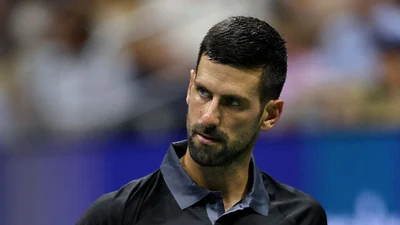
Novak Djokovic US Open hopes ended in a way few would have expected from a player who has built one of the most remarkable records in tennis history. The Serbian suffered a first-round defeat to Argentina’s Mariano Navone, ending his campaign in New York almost immediately and creating fresh speculation about whether the final chapter of his career is approaching.
The result was significant for several reasons. Djokovic had never previously lost his opening match at the US Open and had not suffered a first-round Grand Slam defeat in 20 years. At 39, he is also entering a stage of his career where every physical setback naturally carries greater importance.
But there is another detail that deserves just as much attention as the defeat itself. Djokovic is already expected to return to competition in China later this month, with the ATP 500 tournament in Beijing on his schedule.
That planned appearance does not guarantee that Djokovic will continue playing for years, nor does it erase the physical concerns visible in New York. However, it does offer an important indication of his immediate intentions. The US Open shock appears to have raised questions about his physical future without providing evidence that he has decided to walk away.
Why Djokovic’s US Open defeat was so unusual
A first-round loss is not automatically evidence that a tennis great is finished. Even the best players occasionally have poor matches, face inspired opponents or arrive at a tournament below their best level.
Djokovic’s defeat was different because of the historical context surrounding it.
New York has been one of the most important venues of his career. He has won the US Open four times and has repeatedly handled the pressure of playing on one of tennis’s biggest stages.
His defeat to Navone therefore represented more than an unexpected result on a scoreboard. It ended a remarkably long streak and occurred during a period when questions about Djokovic’s physical condition had already become more frequent.
During the match, Djokovic was visibly uncomfortable. He was seen vomiting multiple times and struggled with movement while dealing with shoulder and back pain. His serve also dropped into the mid-90s.
For a player whose success has historically depended heavily on movement, flexibility, defensive coverage and physical endurance, those symptoms are particularly relevant.
The physical question may matter more than the ranking question
Djokovic’s position in tennis cannot be measured only through titles or rankings. His biggest challenge at this stage is arguably whether his body can continue supporting the style of tennis that made him so successful.
His game has traditionally required extraordinary court coverage. Djokovic can turn defensive positions into attacking opportunities because of his ability to reach balls that appear almost impossible to retrieve.
That ability becomes harder to maintain when shoulder, back or other physical problems interfere with movement and serving.
This is why the Beijing tournament could become particularly interesting. It may provide Djokovic with an opportunity to compete in a different environment and determine how his body responds after the demanding North American hard-court swing.
The result in Beijing may therefore be less important than the physical signals he sends during the tournament.
Djokovic has already shown that age alone does not tell the whole story
There is a temptation to view Djokovic’s age as the simplest explanation for his recent struggles. But his performances over the previous seasons demonstrate why such a conclusion would be too simplistic.
In 2025, Djokovic reached the semi-finals at all four Grand Slam tournaments. That level of consistency would be extraordinary for any player and becomes even more remarkable considering the stage of his career.
He also reached the Australian Open final in 2026, demonstrating that he remained capable of going deep at the sport’s biggest events.
At the same time, physical difficulties affected his campaigns at Roland Garros and Wimbledon before resurfacing in New York.
This creates a more complicated picture than simply saying Djokovic is no longer good enough.
The evidence suggests that his competitive ability remains significant, while the bigger uncertainty concerns how often his body can allow him to display it.
The rise of Alcaraz and Sinner has changed Djokovic’s competitive landscape
Another major factor in understanding Djokovic’s current situation is the emergence of Carlos Alcaraz and Jannik Sinner.
For much of Djokovic’s career, he was one of the players setting the standard that everyone else had to reach. The younger generation is now reversing that dynamic.
Alcaraz and Sinner have increasingly become central figures in the Grand Slam conversation, forcing Djokovic to compete against players who combine youth, athleticism and elite-level consistency.
That does not make Djokovic irrelevant. In fact, his experience remains one of his greatest weapons. But the margins are different.
A younger player may recover from a physically demanding match more quickly. Djokovic, by contrast, has to manage his schedule and physical workload more carefully.
This is perhaps the most important difference between Djokovic’s current career and his peak years: the question is no longer whether he can beat the best players on his best day. The question is whether he can repeatedly reach that level across an entire tournament.
Why Beijing could be more than just another tournament
Djokovic is listed for the ATP 500 event in Beijing, a tournament where he has enjoyed extraordinary success.
He has won the Beijing title six times, with victories coming in 2009, 2010, 2012, 2013, 2014 and 2015. His record at the tournament is even more striking: 29 wins without a defeat.
His last appearance there came in 2015, when he defeated Rafael Nadal in the final.
Returning after such a long absence creates an intriguing storyline, but the bigger value of the tournament could be competitive rather than historical.
Beijing can give Djokovic another opportunity to evaluate where his game stands after the disappointment in New York. A strong physical performance would provide reassurance that the US Open problems were not necessarily a permanent sign of decline.
Conversely, if physical limitations again dominate his matches, the retirement discussion would likely become even louder.
Djokovic’s Beijing return could also create a Sinner storyline
One of the most interesting elements of the Beijing field is the presence of Jannik Sinner, who is also expected to return after missing the US Open because of injury.
That creates a fascinating contrast.
Djokovic is a 39-year-old champion trying to manage the physical demands of the final stage of a historic career. Sinner represents the younger generation that has increasingly occupied the spotlight at the top of men’s tennis.
If both players compete in Beijing, the tournament could offer a useful snapshot of two very different stages of professional tennis.
For Djokovic, the priority will be proving that his body can handle competition. For Sinner, the challenge will be returning from injury and rebuilding momentum.
Their presence also underlines how dramatically the men’s game has changed since Djokovic last played in Beijing.
What Djokovic’s next move says about retirement speculation
Retirement decisions in professional sport rarely depend on one result.
For Djokovic, the most important factors are likely to include physical condition, motivation, competitive level and his ability to prepare properly for major tournaments.
The US Open defeat undoubtedly provides material for retirement discussions. But the existence of a planned Beijing appearance suggests that the immediate focus remains competition rather than farewell.
It would therefore be premature to interpret one early exit as proof that Djokovic is about to retire.
At the same time, it would also be unrealistic to ignore what happened in New York. The physical issues seen during the match represent a legitimate concern, particularly because similar problems have affected Djokovic during other recent tournaments.
Djokovic’s situation compared with Federer and Nadal
| Player | Career stage | Major storyline | Current relevance |
|---|---|---|---|
| Roger Federer | Retired in 2022 | Ended an era after a historic career | Former member of the Big Three |
| Rafael Nadal | Retired in 2024 | Physical problems increasingly shaped his final seasons | Former member of the Big Three |
| Novak Djokovic | Still competing | Balancing historic ambitions with physical demands | Last active member of the Big Three |
The comparison with Federer and Nadal is unavoidable, but Djokovic’s situation remains unique.
Federer’s final years were heavily affected by knee problems, while Nadal repeatedly battled injuries that limited his availability. Djokovic has also experienced physical difficulties, but he has continued to return to major tournaments and compete at an elite level.
That difference makes predicting his retirement particularly difficult.
There is no obvious single result that can determine when Djokovic will stop. His career has repeatedly demonstrated that conventional expectations about longevity do not necessarily apply to him.
The 24 Grand Slam titles change the calculation
Djokovic has already achieved what many players would consider an unreachable career. His 24 Grand Slam titles place him among the most successful players in tennis history and give him a legacy that is already secure.
That creates an unusual motivation question.
He is no longer playing simply to prove that he belongs among the greatest. That argument has effectively been settled by his achievements.
Any decision to continue is therefore more likely to be connected to personal competitive ambition, the desire for another major title and the satisfaction of competing at the highest level.
His continued participation suggests that those motivations remain strong.
The real test is consistency, not one comeback
One strong tournament in Beijing would not suddenly eliminate every concern surrounding Djokovic. Likewise, another difficult physical performance would not automatically mean retirement is imminent.
The more meaningful indicator will be consistency.
Can Djokovic compete week after week without his body breaking down? Can he prepare properly for the Grand Slams? Can he survive several long matches against younger opponents? Can his serve, movement and defensive game remain effective deep into tournaments?
Those questions matter much more than whether he wins or loses his next individual match.
This is where the next stage of Djokovic’s career could look very different from his prime. Instead of playing a packed schedule, he may need to become increasingly selective and prioritize tournaments where his preparation can be maximized.
What could happen next?
There are several possible paths for Djokovic.
Scenario 1: A strong Beijing return
If Djokovic performs well physically in Beijing, it could provide an immediate boost in confidence. A deep run would show that the US Open defeat did not completely derail his season.
Scenario 2: Competitive tennis but physical limitations
Djokovic could also produce good tennis while continuing to experience physical problems. That would suggest that his skill level remains high but that maintaining it over multiple matches is becoming increasingly difficult.
Scenario 3: Continued physical struggles
If similar issues repeatedly prevent Djokovic from competing effectively, the retirement conversation would become harder to avoid. At that point, the issue would be less about one surprising defeat and more about a sustained pattern.
The unique angle: Djokovic may be entering a new type of tennis career
The most interesting possibility is that Djokovic does not necessarily have to choose between competing at full capacity and retiring immediately.
He could instead enter a highly selective phase of his career.
Rather than chasing every tournament, Djokovic could focus on events where the rewards are greatest and preparation time is sufficient. That approach would allow him to preserve energy while continuing to pursue the tournaments that matter most to his legacy.
For a player with 24 Grand Slam titles, this could be a logical evolution rather than a decline in ambition.
The modern tennis calendar is demanding even for younger athletes. For a 39-year-old with decades of elite competition behind him, intelligent scheduling could become just as important as technical ability.
Why fans should watch Beijing closely
Djokovic’s return to Beijing will not answer every question about his future, but it could provide valuable clues.
Fans should watch his movement, serving level, recovery between matches and ability to maintain intensity rather than focusing exclusively on the final result.
If he looks physically comfortable and competes deep into the tournament, the retirement speculation may temporarily quieten.
If physical problems again dominate the story, the discussion will become more serious.
Either way, Beijing represents a meaningful next checkpoint in a career that has already exceeded almost every historical expectation.
Conclusion: The US Open may be a warning, but it is not a farewell
The Novak Djokovic US Open defeat was historic, painful and understandably concerning. Losing in the first round after two decades without a Grand Slam opening-round defeat marked a dramatic change from the standards Djokovic established throughout his career.
The physical problems visible during the match make the situation more complicated. Djokovic is no longer competing in an era where experience alone guarantees an advantage, and younger stars such as Carlos Alcaraz and Jannik Sinner have changed the competitive landscape.
Yet retirement should not be declared simply because the 39-year-old suffered one shocking defeat.
His planned return to Beijing is the clearest immediate indication that he still wants to compete. With six Beijing titles and a perfect 29-0 record there, the tournament also provides an unusually appropriate setting for his next chapter.
The bigger question is no longer whether Djokovic can still produce extraordinary tennis. He has already shown that he can.
The question is whether his body will allow him to produce it often enough to keep challenging the very best.
For now, Djokovic appears to have chosen competition over conclusion. Beijing will offer the next important evidence of whether that decision can still work.
For breaking news and live news updates, like us on Facebook or follow us on Twitter and Instagram. Read more on Latest Sports on thefoxdaily.com.





COMMENTS 0