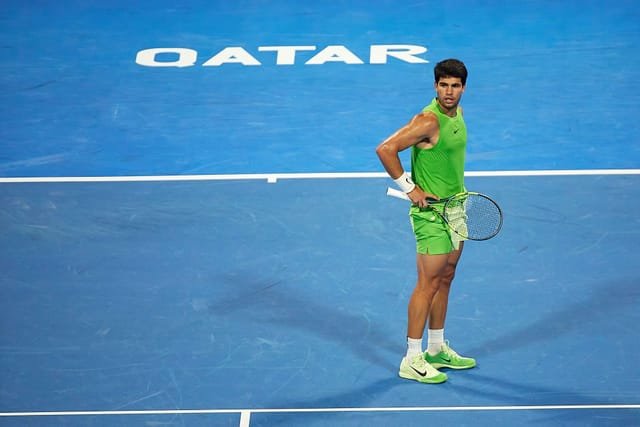
Carlos Alcaraz‘s US Open participation has become a major talking point as the seven-time Grand Slam champion prepares to return following an extended injury layoff. While the Spaniard remains scheduled to make his comeback at the US Open, former ATP player Batata Clerc has issued a strong warning about the risks of entering a Grand Slam without sufficient competitive preparation.
Alcaraz has spent much of the 2026 season away from tournament competition after an injury suffered at the Barcelona Open in April. His prolonged absence has raised questions about match fitness, endurance and whether he can immediately handle the unique physical and mental demands of best-of-five tennis.
The 23-year-old was also expected to return at the Cincinnati Open but withdrew from the Masters 1000 event. That decision has intensified the debate surrounding his US Open plans, particularly because the New York Major is approaching quickly.
Clerc believes Alcaraz should consider delaying his Grand Slam comeback. The former World No. 4 has argued that the Spaniard needs competitive matches before attempting to navigate a demanding five-set tournament and suggested beginning his comeback in Asia instead.
However, not everyone views Alcaraz’s withdrawal from Cincinnati as a warning sign. American coach Rick Macci offered a contrasting perspective, backing the Spaniard’s team and suggesting that additional practice, recovery and rest could be precisely what he needs.
Why Carlos Alcaraz’s US Open Return Is Under Scrutiny
The central question is not whether Alcaraz possesses the level required to compete at a Grand Slam. His achievements have already established that. The uncertainty is whether he can reproduce that level immediately after spending months away from competitive tennis.
Grand Slam tennis places unique demands on players. A best-of-five match can last considerably longer than a typical ATP match, while a player may have to compete repeatedly over two weeks against increasingly difficult opponents.
That makes match preparation particularly important after a lengthy injury absence.
A player can train extensively away from competition and still discover that tournament tennis creates different demands. Match intensity, pressure points, changes of momentum and the physical stress of repeated competition are difficult to completely replicate during practice.
That is the foundation of Clerc’s warning.
Batata Clerc Tells Alcaraz Not to Play the US Open
Clerc delivered a direct message regarding Alcaraz’s comeback plans, arguing that the Spaniard lacks sufficient match experience after his long absence.
His concern centers specifically on the five-set format of Grand Slam tennis. According to Clerc, Alcaraz would benefit from returning through tournaments in Asia before attempting to peak at a Major.
The former Argentine professional believes the objective should not simply be getting back onto a competition court. Instead, Alcaraz needs to build toward the physical and competitive level required to win a major tournament.
That distinction is crucial.
Returning from injury and competing in a tournament are two different objectives. If Alcaraz’s ultimate target is another Grand Slam title, his preparation needs to be designed around reaching peak form rather than merely participating.
Who Is Batata Clerc?
Clerc is not speaking as an outsider unfamiliar with elite tennis. The Argentine competed on the ATP Tour between 1977 and 1986 and built an accomplished career.
He won 25 career titles and reached the French Open semifinals twice. His highest singles ranking was World No. 4 in 1981.
After retiring from professional tennis, Clerc remained involved in the sport as an analyst. His experience gives his comments additional context, particularly when discussing the challenges of returning to elite competition after an extended absence.
His advice is therefore less about questioning Alcaraz’s talent and more about questioning the timing of his comeback.
Why Five-Set Tennis Changes the Equation
One of Clerc’s strongest arguments is that the US Open is not simply another ATP event.
Best-of-five tennis demands a different level of endurance and recovery. Players have to manage their energy over potentially long matches while also maintaining concentration during critical points.
For an athlete returning from injury, that creates several variables.
- Match endurance must be tested against real competition.
- Recovery between matches becomes increasingly important.
- Repeated high-intensity movements can expose physical weaknesses.
- Mental resilience must be rebuilt under tournament pressure.
- Confidence can fluctuate after a long competitive absence.
Alcaraz has experienced the intensity of Grand Slam tennis many times before, but previous experience cannot completely substitute for current match rhythm.
That is why Clerc believes a gradual return could be more beneficial.
Alcaraz’s Injury Layoff Has Already Changed His 2026 Season
Alcaraz’s injury problems began at the Barcelona Open in April. He successfully progressed through his opening-round match but subsequently withdrew before his scheduled round-of-16 contest.
What initially appeared to be a setback that might result in a relatively short absence eventually became a much longer interruption to his season.
The consequences extend beyond missed tournaments.
Players build competitive rhythm through regular matches, and Alcaraz has missed a significant portion of the season in which he would normally have accumulated that experience.
His return therefore involves two separate challenges: becoming physically healthy and rebuilding competitive sharpness.
Why Cincinnati Withdrawal Created More Questions
The Cincinnati Open appeared to offer Alcaraz an ideal opportunity to return before the US Open. The Masters 1000 event would have provided high-level competition while also allowing him to test his physical condition against elite opposition.
His withdrawal removed that potential preparation event from the calendar.
That naturally led to questions about whether the US Open could now arrive too soon.
However, a withdrawal does not automatically indicate a setback. A player’s team may decide that additional training and recovery are more valuable than entering a tournament before the athlete is completely prepared.
This is precisely where the opinions of Clerc and Macci diverge.
Rick Macci Offers a Completely Different Perspective
While Clerc urged Alcaraz to avoid the US Open, renowned American coach Rick Macci offered reassurance.
Macci has worked with several major names in tennis, including Serena Williams, Andy Roddick and Maria Sharapova. His perspective therefore comes from extensive experience working with elite players.
Following Alcaraz’s Cincinnati withdrawal, Macci argued that there were no obvious red flags and suggested that the Spaniard’s team understood what was best for his recovery.
His message emphasized patience, practice and rest.
Macci’s position is essentially that an athlete’s training team has access to information that outside observers do not. A withdrawal may therefore reflect a cautious and intelligent recovery strategy rather than a medical crisis.
Clerc vs Macci: Two Different Ways of Looking at Alcaraz’s Comeback
| Factor | Batata Clerc’s View | Rick Macci’s View |
|---|---|---|
| Cincinnati withdrawal | Raises concerns about match preparation | Not necessarily a warning sign |
| US Open | Should potentially be avoided | Alcaraz should play when fully ready |
| Main concern | Lack of competitive matches | Premature assumptions about his condition |
| Preparation | Build match rhythm through tournaments | Practice, recovery and rest can be valuable |
| Return philosophy | Gradual competitive comeback | Wait until Alcaraz feels completely ready |
The Most Important Issue Is Match Rhythm, Not Talent
There is little question about Alcaraz’s ability to compete at the highest level when healthy. The more interesting issue is how quickly that ability can translate into tournament performance following months away.
Match rhythm influences many small aspects of tennis. Players become accustomed to reading opponents’ patterns, managing pressure points and making decisions instinctively.
Those elements are difficult to measure through practice sessions.
For a player as explosive as Alcaraz, movement is another important consideration. His style relies heavily on speed, aggressive court positioning and rapid changes of direction.
A successful comeback therefore requires more than simply being pain-free. He needs confidence in his movement and the willingness to play naturally rather than protecting the previously injured area.
Could the Winston-Salem Open Be the Missing Piece?
One potential solution is the Winston-Salem Open, an ATP 250 event scheduled for the week before the US Open.
Alcaraz could potentially request a wild card for the tournament, giving him an opportunity to play competitive matches shortly before the Major.
Such a route could address part of Clerc’s concern without necessarily forcing Alcaraz to abandon his US Open plans.
The event would potentially provide a controlled environment in which he could test his body, rebuild match confidence and assess his physical response to competition.
However, the effectiveness of that strategy would depend on how much tennis Alcaraz can realistically play without compromising his recovery.
Why a Tune-Up Tournament Could Be Valuable
A tournament immediately before a Grand Slam can provide information that training cannot.
Alcaraz could learn how his body responds to consecutive match days, how quickly he recovers and whether his intensity remains consistent under competitive conditions.
It could also help his team determine whether the US Open schedule is realistic.
At the same time, playing another tournament carries its own risk. A player returning from injury cannot simply maximize match volume without considering recovery.
That creates the central balancing act: Alcaraz needs enough competition to regain rhythm but not so much that he jeopardizes his physical recovery.
Why Starting in Asia Could Make Sense
Clerc’s suggestion of returning in Asia is based on the idea of building toward peak form rather than rushing directly into a Grand Slam.
A later return would provide Alcaraz with more time to train and potentially enter a sequence of tournaments where his workload could be managed more carefully.
The Asian swing could also offer an extended runway for rebuilding match fitness. Instead of needing to be Grand Slam-ready immediately, Alcaraz could gradually increase his competitive intensity.
The downside is obvious: he would potentially sacrifice the opportunity to compete at the US Open, one of the biggest events of the season.
For a seven-time Grand Slam champion, that is not an easy decision.
What Alcaraz Should Prioritize Before Returning
Regardless of whether he plays the US Open, Cincinnati or a tournament in Asia, the most important factor should be the condition of his body.
A successful comeback should ideally involve several checkpoints:
- Full confidence in the injured area during movement.
- The ability to train at competition intensity.
- Comfort with repeated high-intensity sessions.
- Confidence in explosive court movement.
- A positive physical response after extended training.
- Mental readiness to compete without hesitation.
The final point can be particularly important. A player may be physically cleared but still subconsciously protect an injured area. For a player whose game depends on explosive movement, that hesitation can affect performance.
Could Alcaraz Still Make a Deep US Open Run?
If Alcaraz ultimately enters the US Open, his ceiling remains extremely high. His Grand Slam experience and ability to adjust during matches give him tools that many players returning from injury would not possess.
However, expecting him to immediately perform at peak championship level would be risky without seeing how his body and game respond to competitive tennis.
A deep run is possible, but the biggest uncertainty is not his technical ability. It is whether his physical preparation and match rhythm will be sufficient for the demands of multiple five-set battles.
This makes the first few matches particularly important. If he returns, his early-round performances could reveal whether the long layoff has affected his movement, endurance or confidence.
The Bigger Risk: Rushing Back for One Tournament
The temptation to return for a Grand Slam is understandable. Major tournaments carry enormous prestige, ranking implications and emotional significance.
But injury comebacks require a longer-term perspective.
If Alcaraz returns before he is genuinely ready, one tournament could potentially disrupt the remainder of his season. Conversely, a carefully managed comeback could allow him to rebuild his body and competitive confidence for the final stretch of the year.
This is why Macci’s emphasis on patience is important. The goal should not simply be to get Alcaraz onto the court. The goal should be to keep him healthy once he gets there.
What Fans Should Watch Before the US Open
The most useful indicators will come from Alcaraz’s training and any potential competitive appearance before the US Open.
Fans should pay attention to whether he is able to train consistently, whether he shows confidence in his movement and whether his team makes any additional adjustments to his schedule.
A potential appearance at Winston-Salem would be particularly interesting because it could provide a clearer picture of his match readiness.
If he skips that event as well, the decision could reinforce the idea that his team prefers a slower recovery process.
Unique Insight: The Real Question Is Not Whether Alcaraz Can Play, but Whether He Can Peak
The debate surrounding Alcaraz’s US Open participation is often framed too simply as a question of whether he is healthy enough to compete.
For a player of his caliber, the more important question is whether he can peak.
There is a huge difference between being healthy enough to play a best-of-five match and being physically prepared to play potentially seven matches against the world’s best players.
That distinction supports both sides of the debate. Clerc is right to emphasize the importance of match experience, while Macci is right that forcing competitive tennis before the body is ready can be counterproductive.
The ideal scenario would be for Alcaraz to return only when his medical recovery, physical conditioning, match confidence and mental readiness align.
Conclusion: Carlos Alcaraz Faces a Crucial Comeback Decision
Carlos Alcaraz’s US Open comeback will be one of the most closely watched stories in tennis as the seven-time Grand Slam champion attempts to return after a four-month injury layoff.
Batata Clerc has delivered a strong warning, arguing that Alcaraz should avoid the US Open because he lacks sufficient match practice for the demands of five-set Grand Slam tennis. Clerc believes starting in Asia would give the Spaniard a better chance of rebuilding his form and reaching peak condition.
Rick Macci has taken a more reassuring position, suggesting that Alcaraz’s Cincinnati withdrawal should not automatically be interpreted as a red flag. According to the experienced coach, additional practice, recovery and rest may be exactly what the Spaniard needs.
The possible Winston-Salem route could offer a middle ground, allowing Alcaraz to test himself competitively before the US Open without committing to a long tournament schedule.
Ultimately, the decision should come down to one question: is Alcaraz merely ready to compete, or is he ready to compete at the level required to win a Grand Slam?
That distinction could determine whether his US Open return becomes the beginning of another championship campaign or simply the first step in a longer comeback.
For breaking news and live news updates, like us on Facebook or follow us on Twitter and Instagram. Read more on Latest Sports on thefoxdaily.com.






COMMENTS 0