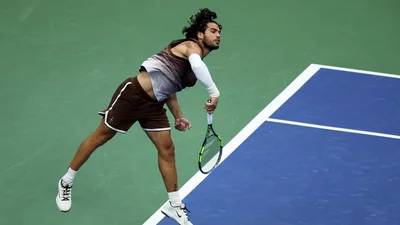
Carlos Alcaraz US Open 2026 campaign began with exactly the kind of result the Spaniard needed. Returning to Grand Slam competition after a lengthy injury absence, Alcaraz defeated Russia’s Roman Safiullin 6-4, 6-4, 6-4 at Arthur Ashe Stadium to move into the next round.
The victory was significant for more than the scoreline. Alcaraz had not played a Grand Slam match since his injury interrupted his season, and he admitted feeling extremely nervous before stepping onto the court in New York.
Those nerves, however, did not translate into uncertainty once the match began. Alcaraz moved effectively, attacked from the baseline and used his trademark forehand and unexpected drop shots to keep Safiullin under pressure throughout the contest.
Alcaraz makes a confident return after wrist injury
The biggest question surrounding Alcaraz before the match was not his ranking or his previous success at the US Open. It was whether his wrist would withstand the demands of a best-of-five Grand Slam match.
Alcaraz had withdrawn from the Barcelona tournament in April after beginning his campaign with a victory. The wrist problem subsequently forced him to miss both the French Open and Wimbledon.
His return at the US Open therefore represented an important test.
Against Safiullin, there were no obvious signs that the injury was restricting his movement or shot-making. Alcaraz later said that he felt pain-free and that his wrist and arm felt good during the match.
That is arguably the most encouraging development for the Spaniard. A convincing first-round victory matters, but being able to compete without discomfort could be even more important for his chances later in the tournament.
Why Alcaraz was nervous before facing Safiullin
Alcaraz’s admission that he was “really really nervous” before the match was understandable.
Returning to a Grand Slam after missing two major tournaments creates a different kind of pressure. Players can practise for weeks, but competition brings uncertainty that training cannot fully reproduce.
Alcaraz himself acknowledged that the match-day routine felt unfamiliar after his long absence. The warm-up, the atmosphere, the crowd and the competitive intensity all felt different.
Once the match started, however, the nerves appeared to disappear quickly.
That transition from anxiety before the match to control during it is one of the strongest signs that Alcaraz may be ready to compete deep into the tournament.
How Alcaraz controlled the match against Safiullin
Safiullin was not an opponent Alcaraz could simply overlook. The Russian is a powerful baseliner and had previously defeated the Spaniard, giving him a reason to believe he could create problems.
The first set remained competitive until the score reached 3-3.
Alcaraz then produced one of the defining shots of his game: a powerful forehand that helped him secure the crucial break. From there, he protected his advantage and took the opening set 6-4.
The second set followed a similar pattern, although Safiullin initially managed to make the Spaniard work harder.
Safiullin broke early, but Alcaraz immediately responded. He recovered the break and then found another opportunity to take control of the set.
His variety was particularly effective.
Instead of allowing long baseline exchanges to develop on Safiullin’s terms, Alcaraz occasionally changed the rhythm with drop shots and even moved forward for serve-and-volley plays.
That mixture of power and unpredictability made it difficult for Safiullin to settle into a consistent rhythm.
The third set showed Alcaraz’s composure
Alcaraz broke early in the third set and quickly established control.
At that stage, the match could have become complicated if Safiullin had managed to recover the break. Instead, Alcaraz remained composed and continued to apply pressure.
He eventually completed the 6-4, 6-4, 6-4 victory.
The straight-sets result was especially valuable because it reduced the physical demands of Alcaraz’s opening match. After a long injury layoff, spending unnecessary hours on court would have been far from ideal.
Winning in three sets allowed him to move forward while keeping the workload under control.
Alcaraz’s biggest weapon remains his forehand
One of the clearest features of Alcaraz’s performance was the influence of his forehand.
The Spaniard repeatedly used the shot to change the direction of rallies and force Safiullin away from comfortable positions. His ability to generate pace while maintaining control allows him to turn neutral exchanges into attacking opportunities very quickly.
However, the most interesting aspect of his performance was that he did not rely exclusively on power.
Alcaraz mixed heavy baseline shots with drop shots, changes of pace and occasional net approaches. This variety is a major reason why opponents find him difficult to read.
A player who only hits hard can eventually become predictable. Alcaraz’s game is more complicated because he can attack with power or suddenly shorten a point with a delicate touch.
Why the injury comeback is more important than the first-round score
The 6-4, 6-4, 6-4 scoreline will appear in the record books, but the larger story is Alcaraz’s physical condition.
Missing the French Open and Wimbledon meant that his competitive rhythm was interrupted during a major part of the season. He also decided not to return through the Cincinnati warmup event, choosing instead to make his comeback at the US Open.
That decision carried obvious risk.
A Grand Slam uses best-of-five sets in the men’s singles competition, meaning matches can become physically demanding. Returning directly at a major tournament therefore requires confidence in the body as well as confidence in the tennis.
Alcaraz’s first match provided a positive answer.
He reported no lingering wrist pain and said he was able to hit normally. That should give him greater confidence as the tournament progresses.
Alcaraz’s relationship with the US Open makes his return special
New York has already played an important role in Alcaraz’s career.
He won his first Grand Slam title at the US Open, establishing himself as one of the sport’s leading young players. His success in New York helped transform him from a promising teenager into a global tennis star.
That history explains why his return to Arthur Ashe Stadium carried additional emotional significance.
Alcaraz spoke about missing the crowd, the energy and the feeling of competition. The reaction from the New York crowd also provided a reminder of why Grand Slam tennis remains such a unique experience.
For a player returning after injury, that atmosphere can create pressure, but it can also provide energy.
Novak Djokovic’s early exit changes the draw
Alcaraz’s first-round victory also came against the backdrop of a major upset elsewhere in the tournament.
Four-time US Open champion Novak Djokovic, seeded fourth, was eliminated after a marathon five-set defeat to Argentina’s Mariano Navone.
Djokovic’s early departure immediately altered the competitive landscape in Alcaraz’s section of the draw.
The two players had been placed in the same half and could potentially have met in the semifinals. With Djokovic gone, the path to the latter stages becomes different for several contenders.
However, Alcaraz was quick to avoid looking too far ahead.
His attitude was simple: focus on the next opponent rather than thinking about a possible semifinal several rounds away.
That approach is particularly sensible at a Grand Slam. One poor match can end a title challenge regardless of what the draw looks like on paper.
What Djokovic’s exit means for Alcaraz
| Factor | Before Djokovic’s exit | After Djokovic’s exit |
|---|---|---|
| Potential semifinal opponent | Djokovic was a possible opponent | Djokovic is eliminated |
| Draw difficulty | Included one of the tournament’s most experienced champions | The path has changed considerably |
| Pressure on Alcaraz | High expectations as a leading contender | Still high, but with a different competitive landscape |
| Immediate priority | Win the first round | Continue progressing one match at a time |
Still, Djokovic’s elimination should not automatically make Alcaraz the favourite to win the tournament. Grand Slam draws can change quickly, and other elite players remain capable of producing difficult matches.
For Alcaraz, the immediate objective should remain physical recovery and maintaining the level he displayed in his opening match.
The biggest question: can Alcaraz maintain this level?
The first-round performance answered one question but created another.
Alcaraz proved that he could compete effectively after his injury layoff. The next challenge is doing it repeatedly.
A Grand Slam title requires several victories against increasingly difficult opponents. The physical demands increase with every round, and the pressure also rises.
That makes recovery particularly important for Alcaraz.
His opening match was encouraging because he won in straight sets without showing obvious physical limitations. But the tournament will become a much more demanding test as he moves deeper into the draw.
Why Alcaraz’s game is suited to Grand Slam pressure
Alcaraz possesses several qualities that make him particularly dangerous in long-format Grand Slam tournaments.
First, he can win points in different ways. He can overpower opponents from the baseline, use his forehand to dictate rallies, bring them forward with drop shots or finish points at the net.
Second, he has demonstrated the ability to adjust during matches. If an opponent finds success against one pattern, Alcaraz can change his tactics instead of continuing with the same approach.
Third, his athleticism allows him to defend difficult positions and immediately turn defence into attack.
Those qualities are valuable in best-of-five tennis because matches rarely remain tactically identical from beginning to end.
The mental side of Alcaraz’s comeback
Perhaps the most interesting part of his return was not his forehand or movement but his description of the emotions surrounding the match.
Alcaraz admitted that he had almost forgotten what match day felt like.
That statement illustrates how different competition is from practice. A player can hit thousands of balls during training, but the feeling of walking into a packed Grand Slam stadium cannot be perfectly recreated.
Alcaraz managed to turn that nervous energy into a controlled performance.
That could prove valuable later in the tournament because successful Grand Slam campaigns require players to manage emotions as effectively as their tennis.
What comes next for Carlos Alcaraz?
Alcaraz now moves into the next round with confidence, but his tournament is still in its early stages.
The priority will be straightforward: recover well, assess the wrist after another competitive match and prepare for the next opponent.
The absence of Djokovic opens up possibilities in the draw, but Alcaraz’s own words provide the better strategy. Thinking about a semifinal before reaching it only creates unnecessary pressure.
Round by round is the logical approach.
Conclusion: A promising start to Alcaraz’s US Open comeback
Carlos Alcaraz’s US Open 2026 campaign could hardly have started better. After missing the French Open and Wimbledon because of a wrist injury, he returned to Grand Slam competition with a convincing straight-sets victory over Roman Safiullin.
More importantly, Alcaraz reported that he felt pain-free and was able to play his normal style. His powerful forehand, clever drop shots and willingness to move forward allowed him to control the match despite admitting that he was extremely nervous beforehand.
Novak Djokovic’s early elimination has also changed the potential route through Alcaraz’s section of the draw, although the Spaniard is rightly refusing to look too far ahead.
The biggest test now is consistency. One successful match proves that Alcaraz can return from injury, but a Grand Slam title requires him to repeat that performance through several increasingly demanding rounds.
For now, though, the signs are encouraging. The wrist held up, the tennis looked natural and the nerves disappeared once competition began.
After a long wait away from Grand Slam tennis, Alcaraz is back in New York—and his title defence has started with a statement.
For breaking news and live news updates, like us on Facebook or follow us on Twitter and Instagram. Read more on Latest Sports on thefoxdaily.com.





COMMENTS 0