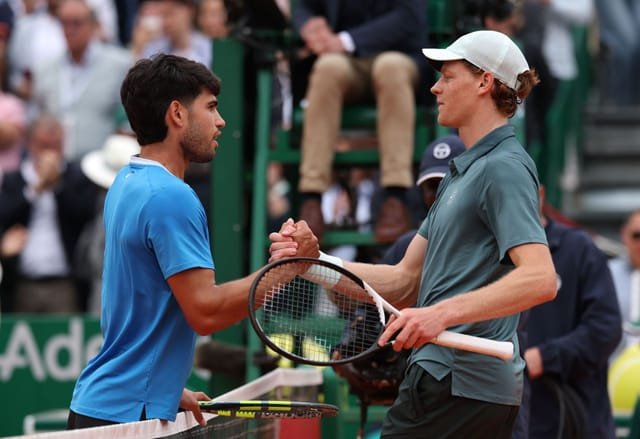
Carlos Alcaraz and Jannik Sinner US Open 2026 participation remains a major talking point as both players face uncertainty ahead of the final Grand Slam of the season. The pair contested the previous US Open final, but their preparations for this year’s tournament have been disrupted by separate physical issues and limited competitive action.
Former Serena Williams coach Patrick Mouratoglou has now explained why he is concerned about both players. According to the experienced coach, Alcaraz faces the challenge of returning to competitive tennis after a lengthy absence, while Sinner must manage a knee problem after withdrawing from two major North American hard-court events.
The situation creates an unusual scenario at the top of men’s tennis. Alcaraz and Sinner have established themselves as two of the sport’s leading Grand Slam contenders, but neither can currently approach the US Open preparation in the normal way.
Mouratoglou believes their participation should ultimately depend on three crucial factors: whether competing could worsen their injuries, whether they feel physically ready and whether their tennis level is good enough to challenge the world’s best.
Why Carlos Alcaraz’s US Open Preparation Is a Concern
Alcaraz’s biggest problem is the length of his absence.
The Spaniard has been out of competitive action since sustaining a wrist injury at the Barcelona Open in April. That means his potential return at the US Open would come after a substantial period without a competitive match.
Training can reproduce many elements of professional tennis, but it cannot completely replicate the physical and mental demands of an actual Grand Slam match.
Players have to react to unpredictable points, manage momentum changes, deal with pressure on important points and recover between competitive matches. Those elements become particularly difficult to simulate outside tournament conditions.
Mouratoglou therefore believes Alcaraz could experience significant soreness after his first competitive match.
That does not necessarily mean the Spaniard would be unable to perform at the US Open. His exceptional athleticism and Grand Slam experience give him a huge advantage. The concern is whether his body can immediately tolerate the intensity of five-set tennis after such a long competitive break.
The Biggest Challenge for Alcaraz May Be Match Sharpness
There is an important difference between being medically recovered and being competitively ready.
A player can feel healthy during training but discover that match conditions place completely different demands on the body.
Alcaraz has spent years developing the movement patterns, explosive changes of direction and high-intensity rallies required at the top of professional tennis. However, those skills must be tested repeatedly in competition before a player can know exactly how the body will respond.
The US Open therefore presents a difficult equation for him.
If he plays, he risks discovering physical limitations during the tournament. If he skips the event, he avoids that risk but loses the opportunity to defend his position on one of tennis’s biggest stages.
Why Jannik Sinner’s Situation Is Different
Sinner’s situation is almost the opposite of Alcaraz’s.
The Italian has been competing regularly but has recently reduced his schedule because of physical concerns.
After successfully defending his Wimbledon title, Sinner withdrew from the Canadian Open. He subsequently pulled out of the Cincinnati Open because of a knee injury.
That decision suggests that his team is prioritising recovery over accumulating additional matches before New York.
For Sinner, the problem is therefore not primarily a lack of match practice. It is whether his knee will withstand the demands of a Grand Slam tournament.
Why a Knee Injury Creates a Special Challenge
Tennis places enormous demands on the lower body.
Players repeatedly accelerate, stop, change direction, slide and push off the court. Even rallies that appear controlled can require hundreds of explosive movements across a match.
A knee issue can therefore become particularly important because it affects a body part involved in almost every aspect of movement.
Mouratoglou believes Sinner would need to be extremely efficient if he competes at the US Open. In practical terms, that means avoiding unnecessary physical expenditure and attempting to finish points and matches as efficiently as possible.
That is easier said than done at a Grand Slam.
Even elite players can be dragged into long matches by opponents capable of defending aggressively and extending rallies. A five-set tournament also demands recovery from one round to the next, meaning a small physical problem can become increasingly important as the competition progresses.
Three Conditions Could Decide Alcaraz and Sinner’s Participation
Mouratoglou identified three conditions that could ultimately determine whether Alcaraz and Sinner compete in New York.
| Condition | Why It Matters |
|---|---|
| Risk of worsening the injury | Neither player would want a Grand Slam appearance to create a more serious physical problem. |
| Physical readiness | They need to know that their bodies can handle the intensity and workload of Grand Slam tennis. |
| Current tennis level | Being available is not enough; they must feel capable of competing at a championship level. |
This three-part test is important because it shows why simply receiving medical clearance does not automatically mean a player should compete.
A player can be healthy enough to play but still not be physically ready for seven potential rounds of Grand Slam tennis. Likewise, a player can be physically fit but lack the match sharpness required to challenge the strongest opponents.
Why the US Open Is a Unique Test
The US Open presents one of the toughest environments in tennis.
The tournament combines best-of-five-set matches with potentially extreme physical demands and the pressure of playing on one of the sport’s biggest stages.
For a fully fit player with a normal preparation schedule, that is already a significant challenge.
For someone returning from a long injury absence or managing an active physical concern, the difficulty increases considerably.
That is why Alcaraz and Sinner’s decisions cannot simply be based on rankings or expectations. The priority has to be whether their bodies are genuinely capable of handling the tournament.
Alcaraz Still Has a Major Advantage
Despite the concerns, writing off Alcaraz would be a mistake.
The Spaniard has repeatedly demonstrated an ability to raise his level at the biggest tournaments. His combination of movement, power, touch and tactical adaptability makes him dangerous even when he is not playing perfect tennis.
He also has extensive experience dealing with Grand Slam pressure.
That experience could help him compensate for some lack of competitive rhythm if his body is ready to compete.
However, the question is whether his physical condition allows him to use those qualities over the full duration of the tournament.
Sinner’s Recent Success Makes His Absence More Significant
Sinner’s withdrawal from the Canadian Open and Cincinnati Open is notable because he entered this period as one of the biggest favourites for the US Open.
He is the reigning world No. 1 and has established himself as one of the most consistent performers in men’s tennis.
His recent Wimbledon title defence also demonstrated his ability to handle the pressure of major tournaments.
But that success came at a physical cost, and his subsequent decision to step away from the North American hard-court events suggests that his team is taking the knee issue seriously.
Why Skipping Cincinnati Could Actually Help Sinner
At first glance, missing a Masters 1000 event might appear to be a disadvantage.
However, there is another way to look at the decision.
Resting gives Sinner more time to recover and potentially arrive at the US Open in better physical condition. If his knee responds well, the additional recovery period could prove more valuable than several competitive matches in Cincinnati.
This is particularly relevant because the US Open is the ultimate objective of the North American hard-court swing.
For a player with a realistic chance of winning the title, protecting his health may be more important than collecting additional tournament points immediately beforehand.
Alcaraz and Sinner Face Different Preparation Problems
| Player | Main Concern | Preparation Question |
|---|---|---|
| Carlos Alcaraz | Long absence following a wrist injury | Can his body and competitive rhythm handle Grand Slam intensity immediately? |
| Jannik Sinner | Knee injury and recent tournament withdrawals | Can his knee withstand the repeated movement and workload of a deep run? |
This comparison explains why the two players cannot necessarily follow the same preparation strategy.
Alcaraz may need competitive exposure to regain match sharpness, while Sinner may benefit more from rest and rehabilitation. The ideal path for one could be the wrong path for the other.
The US Open Title Race Could Change Dramatically
The uncertainty surrounding Alcaraz and Sinner could have a major effect on the tournament landscape.
When both are healthy, they form a significant part of the conversation surrounding the men’s title. Their absence, limited fitness or reduced preparation could open the door for other contenders.
Novak Djokovic remains one of the most experienced players at Grand Slam level, while several other leading stars will be eager to exploit any weakness at the top of the draw.
That does not mean Alcaraz or Sinner would be unable to win if they arrive without a perfect preparation. Grand Slam champions have often overcome difficult circumstances.
But the margin for error becomes smaller.
Why Match Length Could Become Crucial for Sinner
If Sinner plays the US Open while managing a knee issue, match duration could become one of the most important variables.
A short three-set victory is obviously less demanding than a five-set battle lasting several hours. Over the course of a Grand Slam, those differences accumulate.
That is why Mouratoglou’s emphasis on efficiency is particularly relevant.
Sinner’s baseline game already allows him to take control of rallies early, but opponents will inevitably attempt to disrupt that rhythm. Some may use defensive tactics, varying pace and extending rallies to test his movement.
If Sinner’s knee remains sensitive, those matches could represent the biggest physical examination of his tournament.
Alcaraz Could Face a Different Kind of Test
For Alcaraz, the early rounds could be the most revealing.
A player returning from a long absence may feel fine during warm-ups and practice but experience significant fatigue once the intensity of a competitive match begins.
The first match could therefore provide crucial information about how his body has responded to the rehabilitation process.
If he comes through comfortably, his confidence could grow quickly. If soreness or movement limitations appear, his team may have to reassess the situation before the next round.
The Mental Side Cannot Be Ignored
Physical readiness is only part of the equation.
Returning from injury also creates psychological pressure. Players can become more conscious of a previously injured area, particularly during sudden movements or high-intensity points.
That can subtly influence decision-making and movement.
Alcaraz and Sinner will therefore need confidence not only in their tennis but also in their bodies.
At the highest level, even a small hesitation can affect positioning, shot selection and willingness to chase difficult balls.
Why Mouratoglou’s Warning Matters
Mouratoglou has coached some of the biggest names in tennis, giving his comments additional relevance when discussing the physical and competitive demands of returning from injury.
His warning should not be interpreted as a prediction that either player will definitely miss the US Open or struggle if they participate.
Instead, it highlights the uncertainty surrounding both situations.
The key point is simple: talent alone cannot eliminate physical limitations.
What Could Happen Next?
The most important developments will be the players’ physical assessments and training progress ahead of the tournament.
For Alcaraz, the question will be whether he can return to full-intensity competition without the wrist becoming a limiting factor.
For Sinner, attention will remain on his knee and whether the additional recovery time resolves the issue sufficiently for Grand Slam tennis.
Their respective teams will also need to decide whether the potential rewards of competing outweigh the medical and performance risks.
Could Either Player Win Without Ideal Preparation?
Yes, but the probability becomes harder to assess.
Both Alcaraz and Sinner possess enough talent to defeat almost anyone when playing their best tennis. They also have extensive experience at the biggest tournaments.
But a Grand Slam title requires consistency across multiple rounds.
One exceptional performance is not enough. A champion needs to recover repeatedly, manage difficult opponents and maintain physical quality for potentially two weeks.
That is why preparation remains so important even for players with extraordinary ability.
Conclusion
Carlos Alcaraz and Jannik Sinner’s US Open 2026 chances have become increasingly difficult to evaluate because the two leading contenders are dealing with very different physical challenges.
Alcaraz has been away from competitive tennis since his wrist injury at the Barcelona Open in April, leaving questions about match sharpness and how his body will respond to the intensity of Grand Slam competition.
Sinner, meanwhile, has withdrawn from the Canadian Open and Cincinnati Open after his Wimbledon title defence and a knee injury, making physical recovery the central concern.
Patrick Mouratoglou’s three conditions provide a useful framework for understanding their decisions: neither player should compete if doing so risks worsening the injury, both need to feel physically ready and their tennis level must be high enough to justify entering the tournament.
The US Open could therefore become a fascinating test of preparation as much as talent. If both stars arrive healthy, the tournament could deliver another chapter in their growing rivalry. If either player is compromised, the door opens wider for the rest of the field.
For now, the most sensible prediction is also the simplest: Alcaraz and Sinner should only be judged once their bodies, fitness and competitive level are ready to answer the question themselves.
For breaking news and live news updates, like us on Facebook or follow us on Twitter and Instagram. Read more on Latest Sports on thefoxdaily.com.






COMMENTS 0