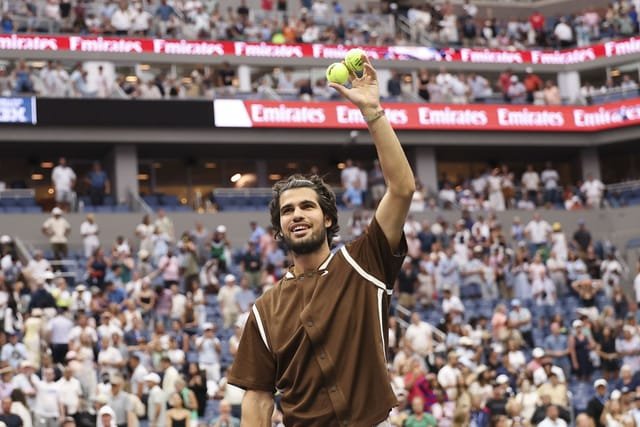
Carlos Alcaraz US Open 2026 campaign got off to a highly successful start on Monday, August 31, as the defending champion returned to competitive tennis following an extended injury layoff. Alcaraz defeated Roman Safiullin 6-4, 6-4, 6-4 in the opening round, but his performance was not the only moment that attracted attention.
During the match at Arthur Ashe Stadium, Alcaraz experienced a brief wardrobe mishap when his Nike shirt shifted awkwardly across his chest. The light-hearted moment quickly caught the attention of tennis fans online and former WTA star Eugenie Bouchard, who responded with a playful message on X.
The incident provided a humorous break from what was otherwise an important competitive comeback for the 23-year-old Spaniard. Alcaraz had been away from the tour for more than four months after suffering a wrist injury in April, forcing him to miss the clay-court and grass-court portions of the season, including the French Open and Wimbledon.
Eugenie Bouchard reacts to Alcaraz’s outfit mishap
Alcaraz’s return match produced plenty of serious tennis discussion, but one unexpected moment generated its own share of attention.
During the contest, his shirt moved in an awkward position across his chest. The moment was harmless, but its timing made it noticeable to viewers watching the defending champion’s return.
Bouchard, who knows the pressures of professional tennis from her own career, reacted to the moment with humor on social media.
Her playful comment quickly became part of the online conversation surrounding Alcaraz’s opening-round appearance.
The reaction also highlighted one of the unusual realities of modern sports. A major player’s match can produce multiple storylines simultaneously: the result, the performance, the injury comeback and, occasionally, an unexpected moment that has nothing to do with the score.
Alcaraz’s return was the real story in New York
Behind the humorous moment was a much more significant development for Alcaraz.
The US Open represented his first competitive tournament appearance in more than four months. His wrist injury in April interrupted what had been expected to be another major season for one of the leading players of his generation.
The injury forced him to miss major tournaments during both the clay and grass portions of the calendar.
For a player accustomed to competing deep into Grand Slam events, such a long absence creates uncertainty. Match rhythm can disappear, movement can feel unfamiliar and even routine competitive situations can become mentally demanding after months away.
That made his first-round performance particularly important.
Roman Safiullin tested Alcaraz without taking control
Safiullin was not an opponent Alcaraz could simply overlook.
The Russian possesses powerful baseline tennis and has previously demonstrated that he can trouble high-level opponents. Against Alcaraz, however, he struggled to turn promising stretches into sustained control.
The Spaniard won each set 6-4, maintaining the same winning margin throughout the match.
That scoreline tells an important part of the story. Alcaraz was not involved in a one-sided contest from the opening point, but he consistently found ways to win the critical moments.
His forehand was particularly important when rallies became longer. Alcaraz used its combination of pace and angle to create openings, while his variety prevented Safiullin from settling into a predictable rhythm.
How Alcaraz controlled the match
Alcaraz’s performance showed why he remains one of the most difficult players to prepare for.
His baseline power was complemented by changes of pace, drop shots and occasional trips toward the net. Instead of relying exclusively on heavy groundstrokes, he repeatedly changed the shape of rallies.
That variety was especially useful against Safiullin, who attempted to stay close on the scoreboard.
Alcaraz found a breakthrough at 3-3 in the opening set and used a powerful forehand to take control. He then managed the remainder of the set without allowing his opponent to recover.
The second set followed a similar pattern. Safiullin managed an early break, but Alcaraz immediately responded and continued applying pressure.
Once Alcaraz moved ahead again, he was able to create another break and put himself firmly in control.
The third set was more straightforward. An early break gave the Spaniard the advantage, and he protected that lead until the finish.
The biggest positive: Alcaraz felt pain-free
For Alcaraz, the most encouraging part of the evening was not simply the straight-sets victory.
It was how his wrist felt during competitive play.
After months away from major competition, there would naturally be questions about whether the injury might affect his ability to hit normally or execute his usual style.
Alcaraz indicated that he felt comfortable during the match and did not experience the lingering problems that would have been a major concern during his return.
That is significant because his game depends heavily on aggressive movement and explosive shot-making. A wrist issue can affect confidence even when a player is medically cleared, particularly when powerful forehands and serves are required under match pressure.
His opening-round performance therefore provided an encouraging early indication that he can compete without allowing the previous injury to dominate his game.
Why the US Open was the right comeback stage
Alcaraz’s decision to return at the US Open carried considerable risk.
He had withdrawn from the Cincinnati warm-up event, meaning he entered New York without a recent competitive match to help rebuild his rhythm.
Normally, players returning from injury may prefer a smaller tournament before entering a Grand Slam. That provides opportunities to test movement, timing and physical condition without the pressure of best-of-five-set competition.
Alcaraz instead chose one of the biggest stages in tennis.
The decision appears to have paid off in his first match.
Arthur Ashe Stadium is also a particularly meaningful venue for him. It was the setting where he established himself as a US Open champion, making his return there more than just another tournament appearance.
Alcaraz remembers what he missed
After the victory, Alcaraz spoke openly about how much he had missed competitive tennis.
The Spaniard highlighted the atmosphere, crowd and energy surrounding the US Open, describing the return as both difficult and special.
That emotional element matters because injury layoffs can be challenging beyond the physical rehabilitation process.
Players also have to adjust to the routines of tournament life, match preparation and the pressure of performing in front of thousands of spectators.
Alcaraz admitted that even the warm-up felt unfamiliar after such a long period away from competition.
Yet once the match began, his tennis quickly looked recognizable.
A comeback without unnecessary drama
There was another positive feature of Alcaraz’s return: he avoided turning the match into a physical marathon.
Winning in straight sets reduced the amount of time he had to spend on court and allowed him to progress without being pushed into a long five-set battle.
For a player returning from injury, that can be valuable.
It does not eliminate all concerns about workload, but a relatively controlled first-round victory gives Alcaraz additional time to recover before his next challenge.
What Bouchard’s reaction adds to the story
Bouchard’s humorous response may have been unrelated to the competitive implications of the match, but it illustrates how quickly social-media moments can become part of a major sporting event.
The US Open attracts enormous global attention, and Alcaraz is one of the sport’s most recognizable young stars. As a result, even a brief clothing mishap can generate discussion alongside much more important developments.
The key point is that the moment remained light-hearted rather than changing the substance of Alcaraz’s successful comeback.
His performance, fitness and progress through the draw remain the real priorities.
What comes next for Carlos Alcaraz?
Alcaraz’s next opponent will be Jaime Faria in the second round.
The match is scheduled for Wednesday, September 2, giving Alcaraz another opportunity to assess how his body responds to consecutive competitive matches.
The second round will also provide a better indication of whether his opening performance can become a consistent tournament run.
The challenge after a long injury layoff is not simply winning one match. It is repeatedly recovering, training and competing at Grand Slam intensity without physical problems returning.
That makes every round an important checkpoint for Alcaraz.
Why Alcaraz’s title defence remains fascinating
Even after winning his opening match, the broader US Open picture remains difficult to predict.
Alcaraz entered the tournament with questions that would not normally surround a defending champion. His lengthy absence meant that his preparation was different from that of players who had competed consistently throughout the summer.
His first-round victory answered some of those questions but not all of them.
The coming rounds will reveal more about his endurance, movement and ability to maintain his aggressive style against increasingly difficult opponents.
For Alcaraz, the objective is therefore bigger than simply defending a trophy. He is also rebuilding competitive confidence after an interrupted season.
Alcaraz’s return compared with a normal Grand Slam preparation
| Factor | Typical Grand Slam preparation | Alcaraz’s 2026 situation |
|---|---|---|
| Recent competition | Players generally arrive with recent match experience | Alcaraz returned after more than four months away |
| Warm-up events | Often used to build rhythm before a Grand Slam | He withdrew from Cincinnati before the US Open |
| Physical questions | Normal workload concerns | Extra attention because of his wrist injury |
| First-round result | Important for tournament progress | Especially significant because it marked his comeback |
| Next challenge | Build momentum through the draw | Continue competing while monitoring his recovery |
The bigger lesson from Alcaraz’s first match
The most encouraging aspect of Alcaraz’s comeback is that he did not appear to abandon the style that has made him successful.
Players returning from injury sometimes become overly cautious. They may avoid certain movements or reduce the aggression that previously defined their game.
Alcaraz instead used his forehand, drop shots, movement and net play throughout the match.
That suggests his return was not simply about getting through the opening round. He was also attempting to compete as the same player he was before the injury.
The challenge now is maintaining that confidence while managing the physical demands of a Grand Slam.
Conclusion
Carlos Alcaraz US Open 2026 campaign began with exactly the result the defending champion wanted: a straight-sets victory over Roman Safiullin.
His 6-4, 6-4, 6-4 win was especially encouraging because it came after more than four months away from competitive tennis following a wrist injury. Alcaraz moved well, used his trademark attacking game and reported that his wrist felt good during the match.
The evening also produced a lighter moment when his Nike shirt shifted awkwardly, prompting a playful social-media reaction from Eugenie Bouchard. While the incident quickly became part of the online conversation, the far more important development was Alcaraz’s successful return to Grand Slam competition.
Next, he faces Jaime Faria in the second round. That match will provide another valuable test of his fitness and competitive rhythm.
One victory does not guarantee a successful title defence, but Alcaraz could hardly have asked for a better first step. After months away, he is back on the court, back under the Arthur Ashe Stadium lights and, most importantly, back winning matches.
For breaking news and live news updates, like us on Facebook or follow us on Twitter and Instagram. Read more on Latest Sports on thefoxdaily.com.





COMMENTS 0