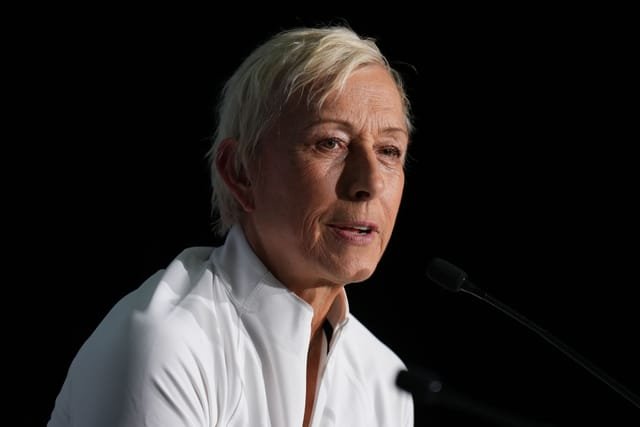
Martina Navratilova has intensified her criticism of the Democratic Party’s approach to transgender issues, warning that she could withdraw her political support if the party continues moving in a direction she believes overlooks sex-based rights in women’s sports.
The former World No. 1 Tennis player made the comments while reacting to a social media post discussing the Democratic Party’s approach to transgender policies ahead of the 2026 elections. Navratilova said she would reconsider not only her vocal support but also her financial backing and vote if the party continued along that path.
Her comments are significant because Navratilova has historically supported Democratic candidates and causes. The tennis legend has also been one of the most prominent former athletes to publicly argue that women’s competitive sport should retain eligibility rules based on biological sex.
The controversy comes amid a wider political and sporting debate over transgender participation in women’s competition, eligibility regulations and the role of sex-based categories in elite sport.
What did Martina Navratilova say about the Democratic Party?
Navratilova responded to a post claiming that Democrats could spend years attempting to change their position on transgender issues. Her response was direct and unusually strong.
“If they keep doing this, I will stop giving any support- be it vocal, financial or actually voting.”
The statement effectively put her political support on the line.
Rather than limiting her criticism to a disagreement over a particular policy, Navratilova indicated that the issue could influence three separate forms of political participation: public advocacy, financial donations and voting.
That makes her position especially noteworthy because political support from high-profile public figures can have value beyond the amount of money involved. Celebrities and former athletes can influence public discussion, attract attention to campaigns and mobilize supporters.
Why transgender sports policies are central to Navratilova’s criticism
Navratilova has repeatedly argued that women’s sport should maintain meaningful sex-based eligibility protections. Her position has focused particularly on competitive fairness and the physical differences associated with male and female athletic development.
She has previously criticized the participation of transgender athletes in women’s competitions, making the issue one of the most consistent themes of her public commentary in recent years.
Her latest political statement follows that same line of argument. Navratilova believes that policies intended to expand transgender inclusion should not come at the expense of protections designed specifically for female athletes.
The debate is complicated because sporting organizations must balance several competing considerations, including competitive fairness, inclusion, athlete welfare, privacy and the practical enforcement of eligibility rules.
Different sports organizations have adopted different approaches, which has contributed to an evolving and often contentious policy environment.
Navratilova’s position is not new
The latest comments are part of a broader pattern rather than an isolated political disagreement.
Navratilova has been outspoken about transgender participation in women’s sport for several years. Her argument has generally centered on the principle that women’s sport exists as a protected competitive category and that eligibility policies should account for biological differences relevant to athletic performance.
That position has also made her a controversial figure in LGBTQ+ policy discussions despite her long history as an LGBTQ+ rights advocate.
This apparent contradiction is important for understanding her political stance. Navratilova has supported LGBTQ+ equality while simultaneously arguing that transgender inclusion in women’s competitive sport requires different considerations.
Her critics view her position as exclusionary, while supporters argue that defending sex-based sporting categories is compatible with broader support for individual rights.
Navratilova has financial ties to Democratic campaigns
The political dimension of the dispute is also significant because Navratilova has previously provided financial support to Democratic campaigns.
The supplied report states that she has donated more than $25,000 to Democratic campaigns.
Her threat to stop providing financial support therefore represents more than a theoretical disagreement. If she follows through, it would mark a meaningful change in her relationship with the party.
Her warning also demonstrates how transgender sports policy has moved beyond sporting organizations and into broader political debates.
The 2026 election context
The dispute comes during an election cycle in which transgender rights and related policies remain politically significant.
According to the supplied report, the Human Rights Campaign and Democratic candidates are seeking to place transgender rights more prominently within their political messaging.
That creates a potential conflict with voters and supporters who agree with Democrats on many issues but disagree with the party’s approach to transgender policy.
Navratilova’s comments illustrate that tension particularly clearly. Her position suggests that political loyalty can have limits when a specific issue becomes important enough to override broader partisan alignment.
Why this could matter beyond one donor
High-profile disagreements within political coalitions can reveal larger debates taking place among their supporters.
Navratilova’s stance could resonate with people who traditionally support Democratic candidates but also believe women’s sporting categories should remain sex-based.
At the same time, Democratic leaders face pressure from supporters who view transgender protections as an important civil-rights issue.
The challenge is therefore not simply about one athlete’s political position. It reflects a broader disagreement over how parties should balance competing priorities within their own coalitions.
Navratilova also backed Aryna Sabalenka over WTA testing policy
Navratilova’s recent comments also connect with her support for Aryna Sabalenka following the World No. 1’s remarks about the WTA’s genetic testing policy.
Sabalenka publicly supported the policy and argued that maintaining fairness in women’s tennis was important. She also said she was willing to undergo the testing herself if required.
Her comments attracted criticism from some observers, but Navratilova defended the tennis star.
Navratilova argued that Sabalenka’s position was not controversial and emphasized her view that the policy concerned biological sex rather than being a general transgender policy.
“There is nothing controversial about Aryna’s take on the WTA policy at all.”
Navratilova’s defense of Sabalenka demonstrates how strongly she views sex-based eligibility as an issue of competitive fairness.
Why Aryna Sabalenka’s comments became part of the debate
Sabalenka’s position is important because she is not simply an outside commentator. She is one of the leading players in women’s tennis and therefore has direct experience with the competitive environment governed by WTA rules.
Her willingness to publicly support testing indicates that the debate is not limited to administrators, politicians and activists. Current athletes can also have strong opinions about how women’s competitions should be regulated.
For Navratilova, Sabalenka’s comments provided an opportunity to reinforce her own argument that competitive fairness should remain central to discussions about eligibility.
It also illustrates why the issue is particularly sensitive in tennis. The sport has clearly defined men’s and women’s competitive categories, meaning changes to eligibility criteria can have direct consequences for professional competition.
The science and policy debate behind sex testing
One of the most complicated aspects of the debate is the distinction between biological sex, gender identity and the sporting criteria used to determine eligibility.
Sports organizations have historically created separate men’s and women’s categories because physical differences can influence athletic performance.
Modern eligibility policies attempt to determine how those categories should operate while addressing the participation of transgender athletes.
Genetic testing, hormone-related criteria and other eligibility measures have all been discussed or implemented in different sporting contexts. Each approach carries practical and ethical questions, including privacy, medical information, consistency and enforcement.
That complexity explains why the debate has remained unresolved across international sport.
Navratilova’s unique position as a tennis legend
Navratilova’s voice carries particular weight because of her extraordinary career in women’s tennis.
As a former World No. 1 and one of the most accomplished players in tennis history, she spent decades competing in the women’s category at the highest level.
Her perspective is therefore frequently framed around protecting the competitive opportunities that women’s sport provides.
However, her celebrity also makes her statements more politically consequential than those of an ordinary former athlete.
When Navratilova publicly threatens to withdraw her vote or financial support from a major political party, the statement can become part of a much larger national conversation.
The political dilemma: inclusion versus sex-based competition
The disagreement surrounding Navratilova’s position ultimately reflects a difficult policy question: how should institutions protect transgender people from discrimination while also maintaining sex-based categories in competitive sport?
Supporters of greater transgender inclusion argue that transgender athletes should have meaningful opportunities to participate in sport without discriminatory barriers.
Supporters of sex-based restrictions argue that women’s categories require eligibility rules that preserve competitive fairness and protect opportunities for female athletes.
These positions can come into direct conflict, particularly in elite sport where small physical advantages can have significant competitive consequences.
There is no simple policy formula that satisfies every stakeholder. Sporting bodies must establish rules that are clear enough to administer while also addressing fairness, inclusion and athlete rights.
What Navratilova’s threat could mean politically
Navratilova’s warning creates an unusual situation because she is not threatening to support the opposing political party outright. Instead, she is threatening to withdraw support from her traditional political side.
That distinction matters.
A political party can potentially lose support not only when voters switch to an opponent but also when longtime supporters become disengaged, stop donating or decide not to vote.
For a high-profile supporter, such a break can attract media attention and encourage others to examine their own positions.
Whether Navratilova ultimately follows through will depend on how Democratic candidates and organizations approach transgender sports policy during the election cycle.
Could this become a larger divide within Democratic support?
The most important long-term question is whether transgender sports policy becomes a dividing line within Democratic voters rather than simply a conflict between Democrats and Republicans.
Navratilova’s position demonstrates that some people can support Democratic causes while disagreeing strongly with the party’s approach to a specific cultural issue.
If more prominent supporters express similar concerns, Democratic strategists may face pressure to clarify how they balance transgender rights with sex-based protections in women’s sport.
However, predicting the political impact of one public statement would be premature. Election outcomes depend on many issues, and the importance of transgender policy can vary considerably among voters.
Conclusion: Navratilova draws a political line over women’s sports
Martina Navratilova’s warning to the Democratic Party represents a significant escalation in her public criticism of transgender policies. By threatening to withdraw her vocal, financial and electoral support, she has made clear that women’s sports eligibility is an issue on which she is willing to challenge her traditional political alignment.
Her position is rooted in a long-running argument that women’s competitive sport should retain meaningful sex-based protections. Her support for Aryna Sabalenka’s comments about the WTA’s testing policy reflects the same underlying concern about competitive fairness.
The broader debate is unlikely to disappear soon. Political parties, sporting organizations and athletes will continue to face difficult questions about inclusion, fairness, eligibility and the future of women’s competition.
For Navratilova, however, the message is already clear: if she believes her political allies are moving too far away from her position on sex-based rights in women’s sport, she is prepared to reconsider the support she has given them for years.
For breaking news and live news updates, like us on Facebook or follow us on Twitter and Instagram. Read more on Latest Sports on thefoxdaily.com.






COMMENTS 0