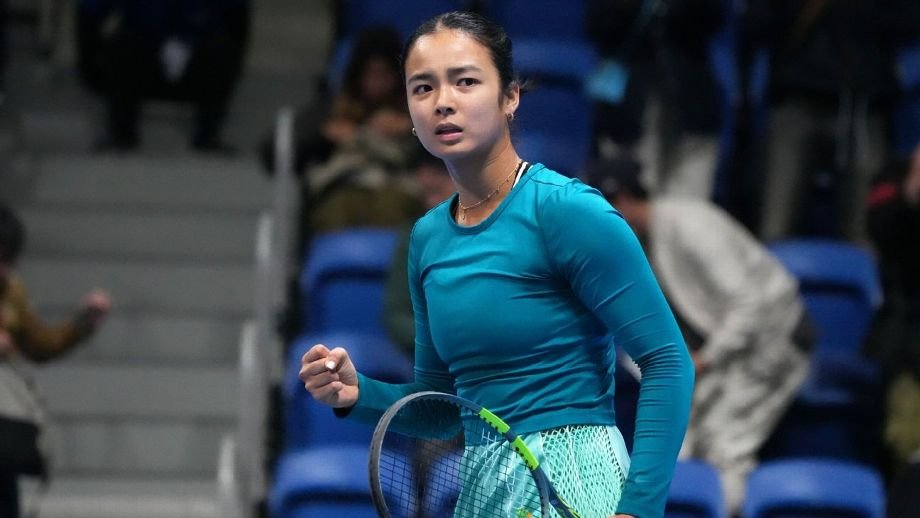
Alex Eala delivered an impressive comeback at the Toray Pan Pacific Open, overcoming Australia’s Talia Gibson in three sets to secure a place in the quarterfinals. The Filipina Tennis star recovered after losing the opening set 4-6, winning the next two sets 6-2, 6-0 to complete a convincing turnaround in Tokyo on Wednesday evening.
The victory marked an important step forward for Eala during the Asian swing, a stretch of tournaments in which she has been seeking greater consistency. After opening her Tokyo campaign with a win over Mika Stojsavljevic, the Filipino left-hander recorded consecutive victories for the first time during this part of the season, improving her record on the Asian swing to 3-3.
Beyond the result, the match demonstrated Eala’s ability to respond to adversity. Gibson initially capitalized on her opportunities and took the first set despite facing pressure on serve. Eala subsequently improved her control of the rallies, found greater success on return and prevented the Australian from winning another game after the second set.
The comeback also sets up an intriguing quarterfinal against Diana Shnaider. The Russian defeated Eala 7-5, 6-4 in their round-of-16 encounter at the Ningbo Open the previous week, giving the Filipina another opportunity to challenge an opponent who recently found a way past her.
With a quarterfinal place secured, Eala now has an opportunity to build on her latest performance and demonstrate whether the adjustments that helped her defeat Gibson can translate into another competitive showing against Shnaider.
Alex Eala vs Talia Gibson: How the Tokyo match unfolded
The opening set was closely contested during its early stages, with both players establishing their service games and attempting to prevent the other from gaining an immediate advantage.
Gibson began with a comfortable service hold, and Eala responded by conceding just one point in her opening game. The first significant opportunity arrived in the third game, when Eala earned a break point against the Australian.
Gibson managed to escape the early pressure through effective serving, preserving her advantage and moving ahead 2-1. Both players subsequently held serve through the next several games, leaving Gibson in front at 4-3.
The Australian then found the breakthrough she needed. In the eighth game, Gibson used aggressive returning to secure the match’s first break and move into a 5-3 lead. The development put Eala under immediate pressure, as Gibson needed only one more game to claim the opening set.
Eala responded with determination, breaking Gibson to love in the ninth game to reduce the deficit. The response appeared to offer the Filipina an opportunity to shift the momentum, but she could not consolidate the breakthrough.
Errors in the following game allowed Gibson to break back, securing the first set 6-4. The Australian had taken advantage of the key opportunities available to her, even though Eala finished the set with a 4-2 advantage in aces.
The difference was more evident in the return statistics. Gibson won 13 return points compared with Eala’s nine in the opening set, according to the supplied match report. That advantage helped explain how the Australian managed to create pressure on Eala’s serve and take control of the set despite the Filipina’s stronger ace count.
For Eala, the task was to improve her response to Gibson’s returns while reducing the errors that had interrupted her progress. Losing the first set did not end her chances, but it left little room for another extended lapse.
Eala changes the momentum in the second set
The second set began with another break, as Eala immediately put Gibson under pressure and took control of the opening game. However, the key difference from the first set was that the Filipina followed the breakthrough by holding her own serve.
That hold gave Eala a 2-0 lead and helped her establish a more stable position in the set. Instead of allowing an early advantage to disappear, she maintained the pressure while limiting Gibson’s opportunities to regain control.
The players exchanged service holds over the next two games, leaving Eala ahead 3-1. Gibson then faced a difficult situation in the fifth game, when Eala earned another break point that could have extended the gap.
The Australian held her nerve, saved the opportunity and reduced the deficit to 3-2. The hold kept Gibson within reach, but Eala responded by winning the next game on serve before producing another important return game.
In the seventh game, Eala secured a decisive break to move ahead 5-2. Her return pressure made it increasingly difficult for Gibson to control the rallies, and the Filipina had created the advantage needed to force a deciding set.
Gibson challenged Eala during the eighth game, but the left-hander completed the set 6-2. After dropping the opener, Eala had won the second set by a comfortable margin, transforming the contest from a potential straight-sets defeat into an opportunity to complete a comeback.
The change was not simply a matter of the scoreline. Eala had begun to turn more of the important points in her favor, while Gibson was finding fewer opportunities to sustain the momentum that had carried her through the opening set.
For players competing at this level, such changes can be crucial. A break of serve can alter the tactical balance of a match, particularly when the player who gains the advantage follows it with a successful service game. Eala’s ability to consolidate her early break gave her the platform to take control of the set.
A dominant third set sends Eala into the quarterfinals
Eala carried her momentum into the deciding set and quickly took command. She secured breaks in the first and third games, building an early advantage while continuing to put pressure on Gibson’s service games.
With Eala holding serve in between those breaks, the Filipina moved ahead 3-0. Gibson was now facing a player who had found her rhythm and was winning the critical exchanges that had been more evenly contested in the opening set.
Eala continued to attack with confidence, using her forehand to help maintain control of the rallies. Gibson struggled to halt the run, and the Australian was unable to win a game in the final set.
The 6-0 scoreline completed a remarkable turnaround. After losing the first set 4-6, Eala won the second 6-2 and then dominated the third 6-0, taking the final nine games of the match to advance to the last eight.
A deciding-set bagel is a particularly emphatic way to finish a match because it leaves the opponent without a game in the final set. However, the score alone does not tell the full story of how the comeback developed.
Eala’s most important achievement was her ability to recover from the setbacks in the opening set and sustain the improvement across the remainder of the match. She did not merely edge through the second set before winning a close decider. Instead, she steadily increased her control until Gibson could no longer interrupt her run.
For Eala, the performance offers a useful foundation for the next round. The challenge now is to reproduce that level of execution against a different opponent, particularly one who has already demonstrated the ability to beat her.
What Eala’s comeback means for her Asian swing
The victory over Gibson gave Eala consecutive wins in the Asian swing, improving her record during this stretch to three victories and three defeats.
That record places the latest result in context. Eala has experienced both wins and losses during the swing, and the Tokyo tournament provides another opportunity to build consistency against international competition.
Winning consecutive matches can be important during a tournament because it allows a player to build confidence and continue testing tactical adjustments against different opponents. However, the quality of the next challenge increases as a player advances through the draw.
Against Gibson, Eala demonstrated that she could respond after losing a set and maintain her level under pressure. That ability will be relevant in the quarterfinals, where the opponent will have her own strengths and may attempt to exploit any weaknesses that emerge during the match.
The comeback also illustrates why a difficult opening set does not necessarily determine the final result. Tennis matches can change quickly when a player improves her return game, reduces errors or begins to control the longer exchanges.
In Eala’s case, the shift from a 4-6 opening-set loss to a 6-0 deciding set indicates how dramatically the balance changed. Although the available match information does not establish the precise tactical adjustments behind every point, the final score shows that Gibson was unable to maintain her early advantage.
Eala will need to carry that resilience into the next round without assuming that the same pattern will repeat. Each opponent presents a different challenge, and a successful quarterfinal performance will depend on her ability to make effective decisions throughout the match.
Diana Shnaider rematch gives Eala another major test
Eala’s quarterfinal opponent will be Diana Shnaider, the Russian player who defeated her in the round of 16 at the Ningbo Open the previous week.
Shnaider won that encounter 7-5, 6-4, denying Eala a place in the later rounds of the Chinese tournament. The result gives the upcoming Tokyo meeting a clear competitive storyline: Eala will have the opportunity to respond to a recent defeat while attempting to continue her run at the Toray Pan Pacific Open.
The earlier match also provides a reference point for the rematch, although it does not determine what will happen next. A previous result can reveal which player succeeded in the conditions of that particular encounter, but the next match begins with a new set of opportunities.
Eala’s latest victory may give her a different sense of momentum heading into the quarterfinals. She has just completed a three-set comeback, won the final nine games against Gibson and demonstrated an ability to recover after losing an opening set.
Shnaider, meanwhile, will enter the meeting knowing she has already beaten Eala recently. That familiarity may influence preparation, but both players will still need to execute their plans on court.
The key for Eala will be to focus on the quality of her own game rather than treating the encounter purely as an opportunity for revenge. Her performance against Gibson showed the value of staying composed when a match moves against her. Against Shnaider, maintaining that composure from the opening games could be important.
What Eala needs to carry into the rematch
Several aspects of Eala’s performance against Gibson could prove useful in the quarterfinals.
- Return pressure: Eala improved her ability to challenge Gibson’s serve as the match progressed, helping her secure important breaks in the second and third sets.
- Service-game stability: Holding serve after taking an early break allowed her to protect her advantage rather than immediately giving Gibson an opportunity to recover.
- Composure under pressure: Eala responded to the opening-set defeat by winning the next two sets, demonstrating that she could reset her approach instead of allowing the early setback to dictate the match.
- Forehand effectiveness: Her forehand helped her maintain control during the deciding set, when she extended her winning run and completed the comeback.
These elements are not guarantees of success against Shnaider, whose game presents a different challenge. They do, however, identify areas of Eala’s latest performance that she can seek to reproduce in the next round.
Why the Toray Pan Pacific Open quarterfinal matters
Advancing to the quarterfinals gives Eala another opportunity to build momentum during the Asian swing. The result also extends her stay in Tokyo, allowing her to compete for a place in the semifinals rather than ending her campaign in the round of 16.
For a player looking to establish greater consistency across tournaments, consecutive victories can provide valuable competitive experience. They require a player to recover physically, prepare for a different opponent and make tactical adjustments without much time to dwell on the previous match.
The Toray Pan Pacific Open therefore represents more than a single win for Eala. It is another test of her ability to manage the demands of a tournament and maintain her level across successive rounds.
Her victory over Gibson is especially notable because of the way it developed. Eala did not control the match from the start. She had to respond after losing the opening set, regain her service-game stability and build pressure until Gibson could no longer keep pace.
That sequence offers a more complete picture of her performance than a straightforward win might have provided. It shows how she handled a difficult position and converted a match that initially appeared to be slipping away into a decisive victory.
The next match against Shnaider will provide a more demanding assessment of whether Eala can maintain that improvement. A quarterfinal victory would take her into the semifinals and give her another opportunity to extend her campaign in Tokyo.
Alex Eala’s Tokyo campaign: What happens next?
Eala has secured her place in the quarterfinals after defeating Gibson 4-6, 6-2, 6-0. The victory followed her opening-round win over Mika Stojsavljevic and gave her the consecutive victories she had been seeking during the Asian swing.
Her next opponent, Shnaider, represents a familiar challenge after the Russian won their previous meeting at the Ningbo Open by a 7-5, 6-4 scoreline. The rematch offers Eala a chance to test her progress against a player who recently prevented her from advancing.
The outcome will depend on how effectively Eala translates her latest performance into the next contest. Her return game, ability to protect service advantages and composure under pressure will all be relevant, but the match will ultimately be decided by the players’ execution on the day.
For now, Eala can take confidence from the way she recovered against Gibson. Winning the final nine games after losing the first set was an emphatic finish, and it demonstrated her ability to sustain pressure once she gained control.
The quarterfinal against Shnaider will offer a new test and a chance to move one step closer to the title. If Eala can carry the same resilience and level of play into the rematch, she will give herself an opportunity to continue her promising run at the Toray Pan Pacific Open.
For breaking news and live news updates, like us on Facebook or follow us on Twitter and Instagram. Read more on Latest Sports on thefoxdaily.com.






COMMENTS 0