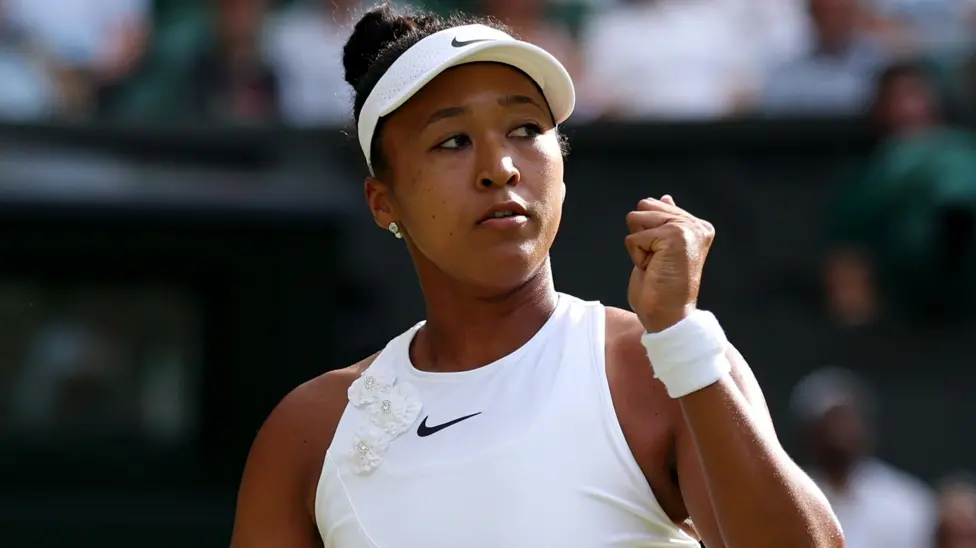
Naomi Osaka‘s remarkable resurgence reached another milestone at Wimbledon 2026 as the Japanese star delivered one of the biggest upsets of the tournament, defeating world number one Aryna Sabalenka in straight sets to reach the quarter-finals of the prestigious grass-court Grand Slam for the first time in her career.
On Centre Court, under the intense spotlight that accompanies every major Wimbledon showdown, Osaka produced a performance that blended power, precision, and composure. She defeated Sabalenka 6-2, 7-6 in a match that showcased not only her elite shot-making ability but also her growing confidence on a surface that had historically been her most challenging.
The victory represents far more than a quarter-final qualification. It signals the return of one of tennis’ most recognizable champions to the sport’s elite tier and serves as evidence that Osaka is once again capable of challenging for the biggest titles in the game.
For Sabalenka, the defeat marked a surprising end to her Wimbledon campaign and extended her wait for a first Grand Slam title of the season. For Osaka, however, it may become the defining moment of a comeback story that has steadily gathered momentum throughout 2026.
Naomi Osaka’s Wimbledon Breakthrough Finally Arrives
Despite being a four-time Grand Slam champion before arriving at Wimbledon this year, Osaka had never progressed beyond the third round at the All England Club.
That statistic often stood out when discussing her career achievements. While she had conquered hard courts around the world and lifted some of tennis’ most prestigious trophies, consistent success on grass remained elusive.
The 2026 tournament has completely changed that narrative.
By reaching her first Wimbledon quarter-final, Osaka has now demonstrated that her game can thrive on every major surface. More importantly, she has achieved the breakthrough by defeating the world’s top-ranked player, making the accomplishment even more significant.
For years, analysts debated whether Osaka’s powerful baseline style could fully adapt to the unique demands of grass-court tennis. Her performances this fortnight have provided a convincing answer.
How Osaka Outplayed the World Number One
Defeating Aryna Sabalenka requires more than simply hitting powerful shots. The Belarusian has built her reputation on overwhelming opponents with aggressive tennis, relentless pressure, and elite serving.
Yet on Centre Court, Osaka managed to neutralize many of Sabalenka’s greatest strengths.
Several aspects of her performance stood out:
- Superior serving consistency
- Efficient return games
- Aggressive baseline control
- Smart point construction
- Excellent movement on grass
- Strong mental resilience in key moments
Rather than allowing Sabalenka to dictate rallies, Osaka frequently took the initiative. She matched the world number one shot for shot while also demonstrating greater tactical variety than many observers expected.
The result was a performance that combined power with intelligence, forcing Sabalenka into uncomfortable positions throughout the match.
A Statement First Set That Changed Everything
The opening set immediately signaled that Osaka had arrived with a clear game plan.
From the first few games, she looked sharper, more confident, and more composed than her opponent. Her serve repeatedly earned free points, while her aggressive groundstrokes prevented Sabalenka from establishing rhythm.
Winning the first set 6-2 against the world number one was not merely a statistical advantage—it was a psychological statement.
Grand Slam matches often hinge on confidence, and Osaka’s dominant start sent a message that this would not be another routine victory for Sabalenka.
The set also exposed a broader trend. Osaka was no longer simply competing with elite opponents; she was controlling matches against them.
The Crucial Second-Set Tiebreak
As expected, Sabalenka raised her level in the second set.
Champions rarely surrender without a fight, and the Belarusian responded by increasing her aggression and improving her consistency. The set became significantly more competitive, eventually reaching a tiebreak.
Many matches involving top-ranked players are decided in these pressure-filled moments.
Instead of tightening under the pressure, Osaka elevated her game once again. Her execution in the tiebreak reflected the confidence of a multiple Grand Slam champion.
By winning the breaker convincingly, she removed any possibility of a third-set comeback and secured one of the most important victories of her recent career.
Why This Result Is So Significant
The significance of the victory extends well beyond a single match.
Osaka’s triumph represents several important milestones:
- First Wimbledon quarter-final appearance
- Victory over the world number one
- Strongest grass-court result of her career
- Back-to-back deep runs at major tournaments
- Further evidence of her return to elite tennis
In recent years, questions surrounded whether Osaka could consistently challenge at the highest level again. Injuries, breaks from competition, and fluctuating form created uncertainty about her future trajectory.
The 2026 season has steadily provided answers.
Her performances now suggest that she is once again becoming one of the most dangerous players on the WTA Tour.
Comparing Osaka’s Wimbledon Record Before and After 2026
| Category | Before Wimbledon 2026 | Wimbledon 2026 |
|---|---|---|
| Best Result | Third Round | Quarter-Final |
| Wins Over World No. 1 | None at Wimbledon | Defeated Sabalenka |
| Grass-Court Confidence | Questioned | Strongly Established |
| Tournament Expectations | Dark Horse | Title Contender |
The transformation illustrates how quickly momentum can shift in professional tennis when a player rediscovers confidence and rhythm.
The Evolution of Osaka’s Grass-Court Game
Historically, grass was considered Osaka’s least effective surface.
While her powerful serve naturally suited faster courts, other aspects of her game sometimes struggled to adapt to grass-court conditions.
This year, however, several improvements have become evident:
- Better movement on low-bouncing surfaces
- More effective transition play
- Improved defensive positioning
- Enhanced tactical flexibility
- Greater confidence during longer rallies
These developments have transformed her from an outsider into a genuine Wimbledon contender.
Perhaps most importantly, she now appears comfortable embracing the unique challenges of grass rather than fighting against them.
A Tough Day for Aryna Sabalenka
While Osaka deserves enormous credit, the result also represented a disappointing outcome for Sabalenka.
The world number one entered Wimbledon among the favorites to lift the trophy. Her powerful game and recent consistency had made her one of the most feared players in the draw.
The defeat ended several impressive streaks and marked her earliest Grand Slam exit in years.
More notably, it was the first time in a long period that she had been eliminated from a major tournament in straight sets.
Such statistics highlight the quality of Osaka’s performance and the unexpected nature of the result.
What Makes Osaka Dangerous Again?
One of the most encouraging signs for Osaka’s supporters is that her game now appears complete rather than reliant on a single strength.
During her rise to Grand Slam success, she was primarily known for her devastating power.
Today, her tennis includes additional dimensions:
- Greater tactical awareness
- Improved point construction
- Enhanced defensive capabilities
- Better emotional control
- More strategic shot selection
These qualities make her a more versatile and potentially more dangerous player than she was during earlier phases of her career.
Karolina Muchova Awaits in the Quarter-Finals
Osaka’s reward for defeating the world number one is a quarter-final showdown with Karolina Muchova.
The Czech star presents a very different challenge from Sabalenka.
Where Sabalenka relies heavily on raw power and aggression, Muchova is known for creativity, variety, and tactical intelligence. Her ability to mix spins, angles, and net approaches often disrupts opponents who prefer rhythm from the baseline.
This matchup promises a fascinating contrast of styles.
For Osaka, maintaining the level she displayed against Sabalenka will be crucial if she hopes to continue her Wimbledon journey.
What This Means for the Women’s Draw
Every Grand Slam experiences defining moments that reshape the tournament landscape.
Sabalenka’s elimination has dramatically altered the championship picture.
With the top seed out of contention, the draw becomes significantly more open. Several players who may have viewed Sabalenka as the primary favorite now see a clearer path toward the title.
At the same time, Osaka’s form suggests she may have inherited the mantle of one of the tournament’s most dangerous competitors.
Momentum can be a powerful force in Grand Slam tennis, and few players currently possess more momentum than Osaka.
Why This Could Be the Start of Another Grand Slam Run
Championship campaigns are often built on signature victories.
For Osaka, defeating the world number one at Wimbledon could serve as exactly that kind of catalyst.
The confidence gained from such a win can transform an entire tournament. Players who defeat top seeds often experience a psychological boost that carries into subsequent rounds.
Given her proven ability to perform on major stages, few would be surprised if Osaka uses this victory as a springboard toward another Grand Slam final.
Conclusion: Naomi Osaka Announces Her Return to Tennis’ Elite Stage
Naomi Osaka’s straight-sets victory over Aryna Sabalenka was more than just an upset—it was a powerful statement about her resurgence as one of the leading forces in women’s tennis.
By reaching her first Wimbledon quarter-final and defeating the world number one in such convincing fashion, Osaka has demonstrated that her comeback is no longer a developing story. It is now a reality.
Her performance combined power, intelligence, composure, and championship mentality, qualities that have defined the greatest moments of her career. The victory also confirms that she is becoming a serious contender on grass, a surface that once represented her biggest challenge.
With Karolina Muchova awaiting in the quarter-finals and confidence growing with every match, Osaka’s Wimbledon journey is far from over. If her performance against Sabalenka is any indication, the rest of the field has every reason to pay attention.
The former champion has rediscovered her best tennis, and Wimbledon 2026 may ultimately be remembered as the tournament where Naomi Osaka fully returned to the sport’s biggest stage.
For breaking news and live news updates, like us on Facebook or follow us on Twitter and Instagram. Read more on Latest Sports on thefoxdaily.com.






COMMENTS 0