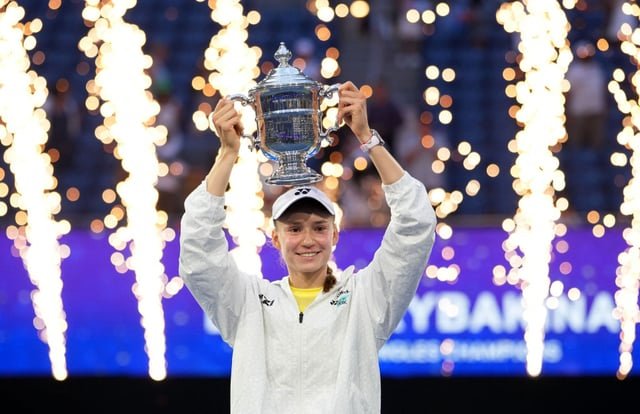
Elena Rybakina World No. 1 is the latest major milestone in the Kazakh tennis star’s career. Rybakina reached the summit of the WTA rankings after her outstanding run at the 2026 US Open, where she defeated Aryna Sabalenka in the final in New York.
The achievement carries additional significance because Rybakina has become the first player from Kazakhstan to reach the top position. She is also the 30th woman to become World No. 1 since the computerized women’s rankings were introduced in November 1975.
Rybakina’s arrival at the top brings together several generations of women’s tennis history. The list includes 18-time Grand Slam champion Chris Evert, record-setting Steffi Graf, Martina Navratilova, Serena Williams, Ashleigh Barty, Iga Swiatek and the recently displaced Sabalenka.
Each No. 1 player reached the summit through a different combination of titles, consistency, playing style and longevity. Some dominated for years, while others held the position for only a handful of weeks.
1. Chris Evert
Chris Evert was one of the defining players of women’s tennis during the 1970s and 1980s. The American won 18 Grand Slam singles titles and spent a combined 260 weeks at the top of the rankings.
Her consistency from the baseline made her one of the most difficult opponents of her generation. Evert also developed one of tennis’ most famous rivalries with Martina Navratilova.
Her extraordinary clay-court record, including a 125-match winning streak on the surface, remains one of the standout achievements of her career.
2. Evonne Goolagong Cawley
Australian great Evonne Goolagong Cawley spent two weeks as World No. 1 in 1976. She won seven Grand Slam singles titles, including two Wimbledon championships.
Known for her smooth movement and elegant style, Goolagong became one of the most celebrated players of the 1970s. Her return to top-level tennis after becoming a mother added another memorable chapter to her career.
3. Martina Navratilova
Martina Navratilova combined exceptional athleticism with one of the most effective serve-and-volley games in tennis history. The Czech-American star won 18 Grand Slam singles titles and spent an extraordinary 332 weeks at World No. 1.
Her success extended beyond singles, with Navratilova also becoming one of the greatest doubles players ever. She finished her career with 167 singles titles and established a standard of fitness and competitive longevity that influenced future generations.
4. Tracy Austin
Tracy Austin reached World No. 1 for 21 weeks. She became a teenage sensation and made history by winning the US Open at just 16 years old.
Austin won two major singles titles, but injuries severely limited the length of her career. Despite her relatively short time at the top, her early success established her as one of the sport’s remarkable young champions.
5. Steffi Graf
Steffi Graf is one of the most accomplished players in tennis history. The German won 22 Grand Slam singles titles and spent 377 weeks at World No. 1.
Her 1988 Golden Slam remains one of the defining achievements of the sport. Graf also finished a record eight seasons as the year-end No. 1, demonstrating her remarkable consistency across an extended period.
6. Monica Seles
Monica Seles reached World No. 1 and spent 178 weeks at the top. Her powerful two-handed forehand and backhand made her a formidable force, and she won eight Grand Slam singles titles.
Seles had already won eight majors by the age of 19. Her career was later interrupted by a serious attack away from the court, but she eventually returned to competition and won another Grand Slam title.
7. Arantxa Sánchez Vicario
Spain’s Arantxa Sánchez Vicario was known for her determination and relentless baseline game. She won four Grand Slam singles titles, including three French Open championships and one US Open crown.
She spent 12 weeks at World No. 1 and briefly displaced Graf from the summit during a highly competitive period of women’s tennis.
8. Martina Hingis
Martina Hingis became the youngest woman to reach World No. 1, doing so at just 16 years old. The Swiss star spent 209 weeks at the top and won five Grand Slam singles titles.
Hingis was renowned for her court intelligence, precision and ability to construct points. Her achievements also extended to doubles, where she became a No. 1-ranked player as well.
9. Lindsay Davenport
Lindsay Davenport combined a powerful serve with aggressive baseline tennis. She won three Grand Slam singles titles and spent 98 weeks at World No. 1.
Davenport first reached the summit in October 1998 and finished four seasons as the year-end No. 1. Her consistency made her one of the most important American players of her generation.
10. Jennifer Capriati
Jennifer Capriati was another teenage prodigy who eventually reached the top of the rankings. The American spent 17 weeks as World No. 1.
Her career included three Grand Slam singles titles, with two Australian Open championships and one French Open victory. Her aggressive groundstrokes and movement made her a major force during her peak years.
11. Venus Williams
Venus Williams spent 11 weeks at World No. 1 and won seven Grand Slam singles titles. Her powerful serve and aggressive style helped change the way women’s tennis was played.
Five of her seven major singles titles came at Wimbledon. Venus also played an important role in the rise of her younger sister Serena, with the two becoming central figures in women’s tennis for more than two decades.
12. Serena Williams
Serena Williams spent 319 weeks as World No. 1 and won 23 Grand Slam singles titles, the most in the Open Era.
Her career included major victories on every surface, and she finished five seasons as the year-end No. 1. Serena also achieved the Career Golden Slam in singles and doubles, becoming the only player to accomplish that feat in both categories.
Her combination of power, athleticism and mental strength made her one of the defining athletes of modern tennis.
13. Kim Clijsters
Kim Clijsters held the No. 1 ranking for 20 weeks. The Belgian won four Grand Slam singles titles and became the first mother to reach the top of the women’s singles rankings.
Three of her four major victories came after motherhood, adding a distinctive element to an already successful career.
14. Justine Henin
Justine Henin spent 117 weeks at World No. 1 and won seven Grand Slam singles titles.
The Belgian was particularly admired for her one-handed backhand, movement and tactical intelligence. Alongside Clijsters, she helped put Belgian women’s tennis on the global stage.
15. Amélie Mauresmo
Amélie Mauresmo became the first French woman to reach World No. 1. She spent 39 weeks at the summit and won two Grand Slam singles titles.
Her one-handed backhand, net play and all-court approach made her a distinctive player during an era increasingly dominated by powerful baseline tennis.
16. Maria Sharapova
Maria Sharapova first reached World No. 1 after winning Wimbledon as a teenager. Her initial reign lasted only one week, but she returned to the summit and ultimately spent 21 weeks at No. 1.
Sharapova won five Grand Slam singles titles and became one of the most recognizable figures in women’s tennis thanks to her aggressive game and intense competitive approach.
17. Ana Ivanovic
Ana Ivanovic spent 12 weeks at World No. 1. Her greatest Grand Slam achievement came at the 2008 French Open, where she captured her only major singles title.
The Serbian’s powerful attacking game and strong serve helped her rise rapidly to the top of the rankings.
18. Jelena Janković
Jelena Janković spent 18 weeks at World No. 1 despite never winning a Grand Slam singles title.
She was particularly effective as a counterpuncher and became the year-end No. 1 in 2008. That season also included a runner-up finish at the US Open.
19. Dinara Safina
Dinara Safina reached World No. 1 and held the position for 26 weeks. The Russian won 12 WTA Tour-level singles titles during her career.
Although she never won a Grand Slam, Safina reached three major finals and established herself as one of the strongest players of her era.
20. Caroline Wozniacki
Caroline Wozniacki spent 71 weeks at World No. 1 and finished two seasons at the top of the rankings.
The Danish star was renowned for her defensive skills and exceptional movement. Her defining Grand Slam moment came at the 2018 Australian Open, where she defeated Simona Halep to win her first major title.
21. Victoria Azarenka
Victoria Azarenka spent 51 weeks at World No. 1. Her powerful baseline game and outstanding return made her one of the leading players of her generation.
She won consecutive Australian Open titles in 2012 and 2013 and became the first player from Belarus to win a Grand Slam singles championship.
22. Angelique Kerber
Angelique Kerber reached World No. 1 in 2016 and spent 34 weeks at the summit.
The German won three Grand Slam singles titles, including the Australian Open and US Open in 2016 and Wimbledon in 2018. Her ability to turn defense into offense was central to her success.
23. Karolína Plíšková
Karolína Plíšková became World No. 1 in 2017 and remained there for eight weeks.
The Czech player relied heavily on her powerful serve and aggressive baseline game. She reached the US Open final in 2016 and the Wimbledon final in 2021, while winning 17 WTA Tour singles titles.
24. Garbiñe Muguruza
Garbiñe Muguruza spent four weeks at World No. 1. The Spaniard won two Grand Slam singles titles, triumphing at the 2016 French Open and 2017 Wimbledon.
She also won the 2021 WTA Finals and reached additional major finals during her career before retiring from professional tennis.
25. Simona Halep
Simona Halep spent 64 weeks at World No. 1 and finished two seasons at the top.
The Romanian won the 2018 French Open and 2019 Wimbledon, establishing herself as one of the leading baseline players of her generation. Her athleticism and movement were central to her style.
26. Naomi Osaka
Naomi Osaka became World No. 1 in 2019. The Japanese star has won four Grand Slam singles titles, including two Australian Open championships and two US Open titles.
Her flat, powerful groundstrokes made her particularly dangerous on hard courts. Osaka’s rise also represented an important moment for Japanese tennis on the global stage.
27. Ashleigh Barty
Ashleigh Barty spent 121 weeks at World No. 1 and won three Grand Slam singles titles.
The Australian developed an unusual and highly effective all-court game, combining variety with precise serving and strong movement. After winning the 2022 Australian Open, Barty retired from professional tennis while still ranked No. 1.
Her retirement eventually opened the door for Iga Swiatek to take over the top position.
28. Iga Świątek
Iga Świątek became World No. 1 after Barty’s retirement and established herself as one of the strongest players of her generation.
She has spent 125 weeks at the top and won six Grand Slam singles titles, with four of those victories coming at the French Open. Her dominance on clay became one of the defining features of her rise.
29. Aryna Sabalenka
Aryna Sabalenka became one of the most consistent players on the WTA Tour after improving several areas of her game, particularly her serve and ability to handle pressure.
The Belarusian won four Grand Slam singles titles and spent 99 weeks at World No. 1. Her reign ended at the 2026 US Open after she lost the final to Rybakina.
That result created the latest change at the top of women’s tennis and opened the way for Kazakhstan to have its first women’s singles World No. 1.
30. Elena Rybakina
Elena Rybakina is the newest member of the WTA’s World No. 1 club. Her breakthrough came after winning the 2026 US Open final against Sabalenka in New York.
The Kazakh has built her career around one of the most powerful serves on the women’s tour, combined with aggressive baseline hitting and a composed approach under pressure.
Rybakina is now a three-time Grand Slam champion and has made history as the first player representing Kazakhstan to reach World No. 1.
Her rise also marks another generational change in women’s tennis. Sabalenka’s 99-week reign has ended, and Rybakina now has the opportunity to establish her own period at the top.
Women Who Have Reached World No. 1: Key Statistics
| Player | Weeks at No. 1 | Grand Slam Singles Titles |
|---|---|---|
| Chris Evert | 260 | 18 |
| Evonne Goolagong Cawley | 2 | 7 |
| Martina Navratilova | 332 | 18 |
| Tracy Austin | 21 | 2 |
| Steffi Graf | 377 | 22 |
| Monica Seles | 178 | 9 |
| Arantxa Sánchez Vicario | 12 | 4 |
| Martina Hingis | 209 | 5 |
| Lindsay Davenport | 98 | 3 |
| Jennifer Capriati | 17 | 3 |
| Venus Williams | 11 | 7 |
| Serena Williams | 319 | 23 |
| Kim Clijsters | 20 | 4 |
| Justine Henin | 117 | 7 |
| Amélie Mauresmo | 39 | 2 |
| Maria Sharapova | 21 | 5 |
| Ana Ivanovic | 12 | 1 |
| Jelena Janković | 18 | 0 |
| Dinara Safina | 26 | 0 |
| Caroline Wozniacki | 71 | 1 |
| Victoria Azarenka | 51 | 2 |
| Angelique Kerber | 34 | 3 |
| Karolína Plíšková | 8 | 0 |
| Garbiñe Muguruza | 4 | 2 |
| Simona Halep | 64 | 2 |
| Naomi Osaka | 1+ periods | 4 |
| Ashleigh Barty | 121 | 3 |
| Iga Świątek | 125 | 6 |
| Aryna Sabalenka | 99 | 4 |
| Elena Rybakina | New No. 1 | 3 |
What Elena Rybakina’s Rise Means for Women’s Tennis
Rybakina’s arrival at No. 1 adds another major name to an increasingly international era of women’s tennis. The list of former leaders already includes players from Europe, North America, Asia and Oceania, and Rybakina now adds Kazakhstan to that history.
Her achievement is particularly notable because the rankings reward sustained performance across tournaments rather than a single match. Winning the US Open provided the defining result that pushed her to the top, but the milestone reflects her overall body of work.
The change also highlights how quickly the hierarchy can shift in women’s tennis. Sabalenka had occupied No. 1 for 99 weeks, while Rybakina now takes over after defeating her in the final of the year’s final Grand Slam.
How the No. 1 Ranking Has Changed Across Generations
The history of the WTA No. 1 ranking shows several distinct eras. Evert and Navratilova dominated the early years, followed by Graf and Seles. The late 1990s and 2000s brought players such as Hingis, Davenport, Venus Williams, Serena Williams and Henin.
The following generations produced champions including Sharapova, Clijsters, Azarenka, Kerber, Wozniacki, Halep and Osaka. More recently, Barty, Swiatek and Sabalenka have led the rankings before Rybakina’s breakthrough.
Some players enjoyed extraordinarily long reigns, while others held the position briefly. That difference demonstrates that reaching No. 1 and remaining there are separate achievements.
Final Verdict
Elena Rybakina is the 30th woman to reach World No. 1 in the Open Era, completing the milestone after her 2026 US Open triumph over Aryna Sabalenka.
Her achievement places Kazakhstan into a unique chapter of WTA history, while adding another Grand Slam champion to an exclusive group of former No. 1 players.
From Chris Evert and Martina Navratilova to Steffi Graf, Serena Williams, Iga Świątek and Sabalenka, the history of women’s tennis has featured players with vastly different styles and careers. Rybakina now begins her own chapter at the summit.
The next part of her story will be determined by how long she can remain there and what additional achievements follow her breakthrough. For now, her name is firmly established among the women who have reached the highest position in the WTA rankings.
For breaking news and live news updates, like us on Facebook or follow us on Twitter and Instagram. Read more on Latest Sports on thefoxdaily.com.





COMMENTS 0