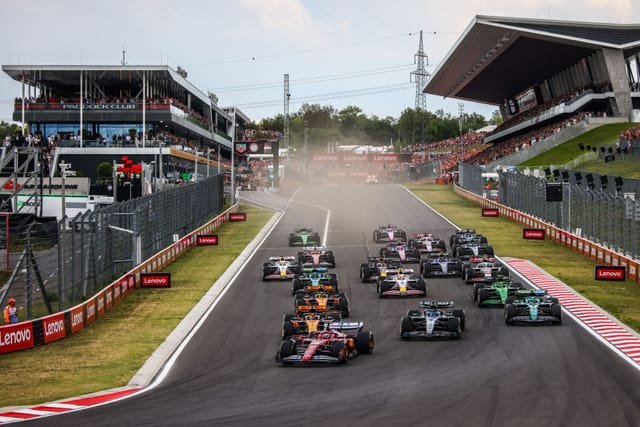
The Formula 1 paddock heads to Budapest for one of the most technically demanding events on the calendar as teams prepare for the 2026 Hungarian Grand Prix at the iconic Hungaroring. Positioned immediately before the summer shutdown, the race often serves as a critical momentum swing in championship battles, making every practice session, qualifying lap, and race strategy decision especially important.
While weather forecasts currently indicate a largely dry weekend, teams and drivers will be monitoring conditions closely. The Hungaroring is a circuit where track temperature, wind direction, and grip evolution can dramatically affect performance, sometimes even more than rain itself.
With Mercedes continuing its dominant campaign, rivals searching for answers, and the championship entering a decisive phase, weather conditions could become an unexpected factor in determining the outcome of the weekend.
2026 Hungarian Grand Prix Weather Forecast at a Glance
Current forecasts point toward favorable racing conditions throughout the weekend, though temperatures are expected to rise significantly by race day.
| Day | Session | Maximum Temperature | Rain Probability | Conditions |
|---|---|---|---|---|
| Friday | FP1 & FP2 | 26°C | 4% | Mostly Sunny |
| Saturday | FP3 & Qualifying | 28°C | 1% | Partly Sunny |
| Sunday | Race | 32°C | 10% | Very Warm, Partly Cloudy |
Based on current projections, teams are unlikely to face wet-track conditions during the race itself. However, the combination of rising temperatures and strong winds could still create significant challenges throughout the weekend.
Is Rain Expected During the 2026 F1 Hungarian Grand Prix?
The short answer is: probably not during the race.
Forecast models currently indicate only a minimal chance of rain during Formula 1’s on-track sessions. Friday and Saturday are expected to remain almost entirely dry, while Sunday’s race carries only a modest possibility of precipitation.
Although forecasts mention a greater likelihood of rain later on Sunday evening, current conditions suggest the Grand Prix should be run on a dry circuit.
That said, Formula 1 teams never completely ignore weather threats.
Modern forecasting has improved dramatically, but localized summer storms can still develop rapidly in Central Europe, particularly during hot weather conditions.
Even a brief shower could significantly alter race strategy.
Why Weather Matters So Much at the Hungaroring
Many fans immediately associate weather influence with rain. However, at the Hungaroring, temperature often plays an even larger role.
The circuit is known for being narrow, twisty, and physically demanding. Unlike high-speed tracks where airflow helps cool tires, Budapest places enormous stress on tire management.
Weather conditions directly affect:
- Tire degradation.
- Grip levels.
- Brake temperatures.
- Engine cooling.
- Driver endurance.
- Pit stop strategy.
As temperatures rise toward 32°C on race day, teams will need to carefully balance performance against tire preservation.
The Hungaroring: Formula 1’s Monaco Without the Walls
The Hungaroring has often been described as “Monaco without barriers” because of its tight sequence of corners and limited overtaking opportunities.
This characteristic makes qualifying particularly important.
When track position matters so much, even minor weather changes can have major consequences.
A sudden shift in cloud cover, track temperature, or wind conditions during qualifying can influence lap times by several tenths of a second—often enough to reshape the starting grid.
In modern Formula 1, those small margins can decide race outcomes.
How High Temperatures Could Affect Race Strategy
While rain may not be the headline threat, extreme heat could become the defining weather factor of the weekend.
Sunday’s forecasted temperature of 32°C is expected to create one of the warmest race environments seen this season.
Higher temperatures typically lead to:
- Increased tire wear.
- Reduced tire lifespan.
- Greater cooling demands.
- More challenging cockpit conditions.
- Higher likelihood of strategic variation.
Teams that manage tire temperatures effectively could gain a significant competitive advantage during long race stints.
Strong Winds Could Be an Underrated Challenge
One weather factor receiving less attention is wind.
Forecasts indicate gusts that could reach approximately 50 km/h during the weekend.
Wind can be surprisingly influential in Formula 1 because modern cars rely heavily on aerodynamic performance.
Strong gusts may affect:
- Cornering stability.
- Braking consistency.
- Aerodynamic balance.
- Driver confidence.
- Overtaking attempts.
Drivers often describe unpredictable wind as one of the most difficult conditions to adapt to because it can change from lap to lap.
Lessons From the Famous 2021 Hungarian Grand Prix
Whenever weather enters discussions about Hungary, memories quickly return to the dramatic 2021 Grand Prix.
That race produced one of the most chaotic opening laps in recent Formula 1 history.
Rain before the start created treacherous conditions, leading to a major first-corner incident that dramatically altered the race.
The event ultimately delivered:
- A red flag stoppage.
- Multiple retirements.
- An unforgettable restart.
- A surprise race winner.
Although current forecasts suggest a much calmer weekend in 2026, the 2021 example demonstrates how quickly weather can transform a race.
Mercedes Enter Budapest as the Team to Beat
Beyond weather discussions, one of the biggest stories entering the Hungarian Grand Prix is Mercedes’ extraordinary form.
The Silver Arrows have established themselves as the benchmark team of the 2026 season.
| Mercedes 2026 Record | Result |
|---|---|
| Races Won | 8 |
| Total Rounds | 10 |
| Pole Positions | 10 |
| Championship Leader | Kimi Antonelli |
Such dominance has placed significant pressure on rival teams heading into the second half of the season.
Budapest presents a different challenge compared to recent circuits, meaning rivals will hope the layout offers an opportunity to reduce Mercedes’ advantage.
Why the Hungarian GP Is a Unique Technical Test
The Hungaroring differs significantly from tracks such as Spa-Francorchamps and Silverstone.
Rather than emphasizing outright speed, the circuit rewards:
- Mechanical grip.
- Cornering precision.
- Aerodynamic efficiency.
- Tire management.
- Consistent balance.
Teams cannot rely solely on engine performance.
Instead, success often depends on producing a car capable of navigating numerous medium- and low-speed corners without excessive tire degradation.
This characteristic can sometimes compress the competitive order and create surprises.
Could Strategy Become More Important Than Pace?
Hungary has a long history of rewarding strategic excellence.
Because overtaking opportunities are limited, pit stop timing frequently determines finishing positions.
If temperatures rise as expected, teams may be forced to reconsider conventional strategies.
Key decisions could include:
- One-stop versus two-stop approaches.
- Tire compound selection.
- Undercut opportunities.
- Safety car planning.
- Track-position prioritization.
A small strategic advantage can often prove more valuable than raw speed at the Hungaroring.
Drivers Facing the Greatest Weather Challenge
Hot weather conditions create a substantial physical test for drivers.
Modern Formula 1 cockpits can become extremely uncomfortable during summer races, especially on circuits with limited airflow.
The Hungaroring’s demanding layout requires constant steering input, frequent braking, and intense concentration.
Over a full Grand Prix distance, physical endurance becomes almost as important as driving skill.
The drivers who maintain consistency during the closing stages may gain a crucial advantage.
What Fans Should Watch During the Weekend
Even if rain stays away, weather will remain a major storyline.
Fans should pay particular attention to:
- Track temperature fluctuations.
- Wind direction changes.
- Tire performance during long runs.
- Qualifying conditions.
- Race-day heat management.
These factors may ultimately influence the competitive picture more than any isolated weather forecast percentage.
Prediction: Expect a Dry but Demanding Hungarian Grand Prix
Based on current forecasts, the likelihood of a fully wet race appears low. However, that does not mean weather will be irrelevant.
Instead of rain creating drama, extreme temperatures and gusty winds could become the weekend’s defining variables.
Teams that optimize tire management and aerodynamic stability are likely to gain the greatest rewards.
If conditions remain stable, qualifying could become even more important than usual, making Saturday potentially the most decisive session of the entire weekend.
Conclusion: Weather May Not Cause Chaos, but It Could Still Decide the Race
The 2026 F1 Hungarian Grand Prix currently appears set for predominantly dry conditions, easing fears of a rain-disrupted weekend. Nevertheless, Formula 1 teams know that weather influences racing in far more ways than precipitation alone.
High temperatures, powerful wind gusts, and the unique characteristics of the Hungaroring are expected to create a challenging environment for drivers and engineers alike. Tire management, strategy execution, and qualifying performance could all be shaped by the conditions.
As Formula 1 heads into its final race before the summer break, the weather forecast suggests fans should expect a fast, tactical, and physically demanding contest rather than a rain-soaked spectacle. And with Mercedes seeking to extend its remarkable dominance, every variable—including the weather—could play a role in determining who heads into the break with momentum firmly on their side.
For breaking news and live news updates, like us on Facebook or follow us on Twitter and Instagram. Read more on Latest Sports on thefoxdaily.com.






COMMENTS 0