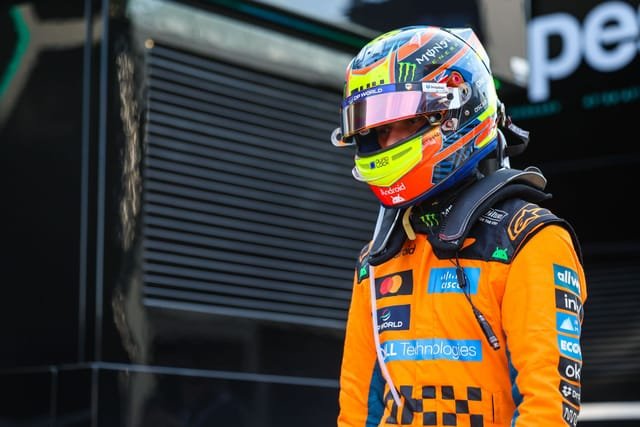
Oscar Piastri‘s criticism of Carlos Sainz became one of the biggest talking points following the 2026 Formula 1 Hungarian Grand Prix. What initially appeared to be another strategic battle between McLaren teammates quickly turned into controversy after Piastri was involved in a collision while attempting to lap Williams driver Carlos Sainz under blue-flag conditions.
The incident dramatically altered the complexion of the race. Piastri, who had been in the effective race lead before the contact, lost valuable time after being forced onto the grass. The delay allowed teammate Lando Norris to gain the advantage through pit strategy, while Piastri’s afternoon eventually ended in disappointment when a gearbox failure forced him to retire from the race.
For the Australian driver, it was a sequence of events that transformed a likely victory into a pointless finish.
How the Collision Happened
The decisive moment unfolded on Lap 39 of the 70-lap Hungarian Grand Prix.
Carlos Sainz was engaged in a close fight with Fernando Alonso when Oscar Piastri, leading the race before his scheduled pit stop, caught the pair while attempting to lap them.
As Piastri moved to overtake Sainz approaching Turn 2, contact occurred between the two cars. The McLaren driver was forced onto the grass, briefly lost control, and sacrificed crucial seconds while recovering.
Although the damage appeared manageable at first, the lost time proved extremely costly in a race where every second mattered.
Why Blue Flags Are So Important in Formula 1
Blue flags are among Formula 1’s most important sporting regulations. They are shown to slower cars being lapped, informing drivers that a faster car is approaching and should be allowed to pass safely.
The rule exists to prevent unnecessary incidents between race leaders and backmarkers while ensuring that battles at the front are not unfairly influenced by slower traffic.
Because Piastri was effectively leading the race at the time, the collision immediately became one of the event’s most controversial moments.
| Race Situation | Details |
|---|---|
| Lap | 39 of 70 |
| Oscar Piastri | Net race leader |
| Carlos Sainz | Battling Fernando Alonso |
| Incident | Collision while Piastri attempted to lap Sainz |
| Immediate Result | Piastri lost significant time |
Piastri Delivers a Blunt Reaction
Following the race, Piastri made his feelings unmistakably clear.
When informed that Sainz claimed he had not received blue-flag information on his dashboard, the McLaren driver rejected that explanation entirely.
“For me, that’s no excuse at all. That’s got to be one of the dumbest things I’ve ever seen on a race track.”
The unusually direct criticism reflected the enormous consequences of the collision. Rather than merely losing a position, Piastri saw a potential race victory begin slipping away through circumstances outside his control.
Carlos Sainz’s Explanation
After the incident, Carlos Sainz stated that no blue-flag warning appeared on his display, meaning he was unaware that the race leader was rapidly approaching.
According to the Williams driver, the lack of information limited his ability to react appropriately during an intense on-track battle with Alonso.
Whether that explanation fully accounts for the collision remains open to debate, but it has added another layer to one of the Hungarian Grand Prix’s defining incidents.
How One Incident Changed the Entire Race
Formula 1 races are often decided by fractions of a second, and Piastri’s afternoon perfectly illustrated how quickly fortunes can change.
The time lost after leaving the circuit disrupted McLaren’s strategic advantage and allowed teammate Lando Norris, who had not yet completed his pit stop, to emerge ahead through the overcut.
Instead of controlling the race from the front, Piastri suddenly found himself chasing under completely different circumstances.
The collision ultimately influenced both the race strategy and the final outcome.
Gearbox Failure Completed a Frustrating Afternoon
If the collision had not already made the Hungarian Grand Prix difficult enough, mechanical problems soon followed.
Late in the race, Piastri suffered a gearbox failure that forced him to retire entirely, eliminating any chance of recovering valuable championship points.
What had begun as one of his strongest performances of the season ended without a finish, making it one of the most disappointing races of his campaign.
Piastri Clarifies McLaren Strategy Complaints
During the race, Piastri’s team radio suggested frustration with McLaren’s decision-making after Norris gained track position through pit strategy.
However, once emotions had settled, the Australian acknowledged that the team’s strategic decisions were reasonable.
“In the moment I was hoping maybe they would not pit Lando. But I think that’s not very reasonable.”
He admitted his comments reflected frustration immediately after the collision rather than genuine disagreement with McLaren’s race strategy.
McLaren Could Not Have Predicted the Incident
Piastri also emphasized that the team should not be blamed for circumstances beyond its control.
From McLaren’s perspective, strategy calculations were based on normal race conditions. No team can realistically anticipate its leading driver losing valuable time after an unexpected collision with a backmarker.
Once the incident occurred, McLaren simply adapted to the new race situation using the information available.
This distinction allowed Piastri to separate his disappointment with the collision from his confidence in the team’s overall execution.
The Championship Picture Becomes Even Tighter
Formula 1 championships are often shaped by isolated moments rather than outright pace.
Missing out on a likely victory and leaving Hungary without points represents a significant setback for Piastri, particularly during a closely contested championship campaign.
Meanwhile, Norris benefited from both strategic circumstances and Piastri’s misfortune, underlining how unpredictable title battles can become across a long Formula 1 season.
| Before the Incident | After the Incident |
|---|---|
| Piastri leading effectively | Lost crucial time |
| Victory within reach | Norris gained advantage |
| Strong points finish expected | Retirement due to gearbox failure |
Why Traffic Management Remains Crucial in Formula 1
Managing traffic has become one of the most complex aspects of modern Formula 1.
Cars are faster than ever, while aerodynamic turbulence and strategic pit windows make every interaction between front-runners and backmarkers critically important.
Even a brief delay can determine race victories, podium finishes, and championship standings. That reality explains why drivers become especially frustrated when incidents occur during blue-flag situations.
As technology and race strategies continue evolving, communication between drivers, teams, and race control remains essential for avoiding costly misunderstandings.
Lessons from the Hungarian Grand Prix
The events in Hungary demonstrated how quickly a Formula 1 race can unravel. A combination of on-track contact, strategic consequences, and mechanical failure completely changed Piastri’s afternoon within a matter of laps.
At the same time, the race highlighted the importance of composure after disappointment. Rather than continuing to criticize McLaren, Piastri accepted that the team had acted appropriately while directing his frustration toward the incident that triggered the chain of events.
Conclusion
Oscar Piastri’s harsh assessment of Carlos Sainz reflected more than just post-race emotion—it captured the frustration of seeing a potential Hungarian Grand Prix victory disappear through circumstances largely outside his control. The collision under blue flags disrupted his race, allowed Lando Norris to gain the strategic advantage, and was ultimately followed by a race-ending gearbox failure.
Despite the disappointment, Piastri’s willingness to later acknowledge McLaren’s correct strategic decisions demonstrated a balanced perspective once emotions had settled. As the Formula 1 season continues, the Hungarian Grand Prix is likely to be remembered as a pivotal race where one controversial incident dramatically altered both the result and the championship narrative.
For breaking news and live news updates, like us on Facebook or follow us on Twitter and Instagram. Read more on Latest Sports on thefoxdaily.com.


COMMENTS 0