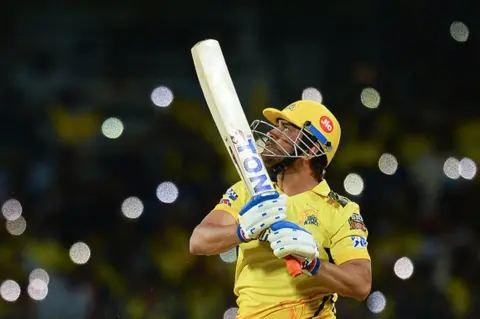
MS Dhoni’s legacy with Chennai Super Kings (CSK) was shaped by far more than his batting performances and five Indian Premier League (IPL) trophies. His ability to read situations, anticipate opponents’ moves and make decisive tactical adjustments repeatedly proved crucial in the franchise’s biggest matches.
After playing 278 IPL matches, including 235 as captain, scoring 5,439 runs and registering 24 half-centuries, Dhoni has called time on his career as an IPL player. On Tuesday, November 17, Chennai Super Kings announced that their five-time title-winning captain would take up a new role as the team’s mentor.
While Dhoni’s career produced countless memorable performances, some of his most influential contributions came through decisions that rarely appeared in scorecards. His field placements, bowling changes and understanding of individual match-ups often changed the direction of crucial contests.
Five such tactical masterstrokes stand out, with one coming from each of CSK’s five IPL title-winning finals.
1. 2010: Dhoni’s straight mid-off placement
Chennai Super Kings had come close to winning their maiden IPL title during the tournament’s first two editions but had failed to cross the final hurdle. Their opportunity finally arrived in 2010, when they faced Mumbai Indians in the final.
CSK appeared to be in control after restricting Mumbai to 114/6 in 17 overs while defending a target of 168. However, Kieron Pollard changed the momentum by smashing 22 runs off Doug Bollinger’s next over, bringing Mumbai back into contention.
With Mumbai needing 27 runs from the final seven deliveries and Albie Morkel preparing to bowl the penultimate over, Dhoni made a crucial adjustment to his field. He instructed Matthew Hayden to move straighter at mid-off and position himself just behind the bowler.
The placement immediately attracted attention from the commentary box. Sunil Gavaskar observed, “It’s one of the straightest mid-offs you will ever see.”
Dhoni’s decision proved decisive when Pollard attempted to hit straight and found Hayden positioned exactly where the captain had anticipated. The catch removed Mumbai’s dangerous batter and helped CSK secure their first IPL championship.
2. 2011: Giving Ravichandran Ashwin the new ball
CSK entered the 2011 final against Royal Challengers Bengaluru with a formidable total of 205 to defend. However, RCB had a dangerous opening batter in Chris Gayle, whose performances had dominated the season.
Gayle had scored 608 runs at a strike rate of 183.13, establishing himself as one of the most destructive batters in T20 cricket. Although he possessed few obvious weaknesses, his vulnerability against off-spin offered Dhoni a possible tactical opening.
Rather than beginning with a conventional pace option, Dhoni handed the new ball to Ravichandran Ashwin. The decision produced an immediate result.
On only the fourth delivery of the chase, Gayle attempted an aggressive cut against Ashwin. The ball took the edge and travelled into Dhoni’s gloves behind the stumps.
The early dismissal removed RCB’s biggest threat and gave CSK control of the contest. Dhoni’s understanding of Gayle’s weakness and willingness to trust Ashwin with the new ball became one of the defining decisions of the 2011 final.
3. 2018: Dhruv Shorey at backward square leg
After returning to the IPL in 2018, Chennai Super Kings ended their seven-year wait for another championship by defeating Sunrisers Hyderabad by eight wickets in the final.
Batting first, SRH were building towards a competitive total in the 17th over. Their captain, Kane Williamson, had provided the foundation with a 36-ball 47, while Deepak Hooda was expected to accelerate the scoring during the closing stages.
With Lungi Ngidi bowling, Dhoni made a specific field adjustment by placing Dhruv Shorey at backward square leg. The move proved important just two deliveries later, when Hooda attempted to attack and was caught in that position.
The wicket interrupted Hyderabad’s attempt to finish strongly and demonstrated Dhoni’s attention to the scoring areas favoured by individual batters. Ngidi later acknowledged the contribution of Dhoni’s intelligent field placements to CSK’s victory.
4. 2021: Bringing Shardul Thakur back early
Chennai Super Kings faced a challenging situation in the 2021 final against Kolkata Knight Riders. Defending 193, CSK watched KKR’s opening pair of Shubman Gill and Venkatesh Iyer take control of the chase.
After 10 overs, Kolkata had reached 88/0 and appeared to be moving comfortably towards the target. Both openers were batting confidently, making it essential for CSK to break their partnership before the chase became difficult to contain.
Dhoni turned to Shardul Thakur in the 11th over, despite the bowler having conceded 11 runs in his first over. Thakur was generally expected to be used later in the innings, but Dhoni chose to bring him back while the opening partnership was still intact.
The decision delivered exactly the breakthrough CSK needed. Thakur dismissed both Gill and Iyer in the same over, transforming the momentum of the chase.
Those two wickets disrupted KKR’s progress and prevented the opening pair from carrying their strong start deeper into the innings. Dhoni’s decision to use Thakur earlier than expected became a major turning point in CSK’s fourth IPL title triumph.
5. 2023: Trusting Deepak Chahar with his final over
Chennai Super Kings secured their fifth IPL title in 2023 after defeating Gujarat Titans in a rain-affected final. Gujarat had made a strong start while batting first, reaching 124/1 after 13 overs.
Wriddhiman Saha was well established at the crease and had already completed his half-century. Despite the batting side being in a strong position, Dhoni decided to bring Deepak Chahar back to bowl his fourth and final over.
The call was not an obvious one, considering Chahar had conceded 31 runs without taking a wicket in his first three overs. Nevertheless, Dhoni trusted the seamer to deliver another over rather than turn to a different bowling option.
The decision paid off when Saha attempted to slog a leg-cutter but failed to make clean contact. The ball took the edge and was caught by Dhoni behind the stumps.
Saha’s dismissal was particularly valuable because he had been batting confidently and providing Gujarat with the platform for a strong finish. Removing him at that stage helped CSK disrupt the innings and proved the value of Dhoni’s faith in Chahar.
Dhoni’s CSK legacy: Tactical decisions beyond the scorecard
Across five IPL-winning finals, Dhoni demonstrated that captaincy is not limited to choosing a playing XI or deciding when to bat or bowl. His success often came from recognising a batter’s preferred scoring areas, identifying bowling match-ups and making changes at moments when a game could still swing in either direction.
The straight mid-off for Pollard in 2010, Ashwin’s new-ball assignment against Gayle in 2011, Shorey’s position against Hooda in 2018, Thakur’s early return in 2021 and Chahar’s final over in 2023 all reflected different aspects of Dhoni’s tactical approach.
As he moves into a mentoring role with Chennai Super Kings, those decisions remain an important part of his legacy. His five IPL titles tell the story of the team’s success, but the small tactical details behind those victories explain why Dhoni’s captaincy became so influential in the franchise’s history.
For breaking news and live news updates, like us on Facebook or follow us on Twitter and Instagram. Read more on Latest Cricket on thefoxdaily.com.






COMMENTS 0